Topology: Product Spaces (II)

The Box Topology

Following an earlier article on products of two topological spaces, we’ll now talk about a product of possibly infinitely many topological spaces. Suppose \{X_i : i\in I\} is a collection of topological spaces indexed by I, and we wish to define a topology on the set X := \prod_{i\in I} X_i. What would be a good choice?

If we follow our instincts, the most natural definition would be:

Definition. The box topology on X = \prod_i X_i is defined by the basis:

\Sigma = \{\prod_{i\in I} U_i : \text{ each } U_i\subseteq X_i \text{ is open }\}.

Since (\prod_i U_i) \cap (\prod_i V_i) = \prod_i (U_i\cap V_i), our collection Σ is indeed a basis, so the definition makes sense. The only problem is that its behaviour has some anomalies.

Problem 1 : As Terence Tao pointed out in his blog post, if we consider the space X = \mathbf{R}^\mathbf{N} of all sequences of real numbers, then there are sequences which one would expect to converge but fail to under the box topology. For example:

x_1 = (e^{-n})_{n\ge 1}, \ x_2 = (e^{-2n})_{n\ge 1},\ x_3 = (e^{-3n})_{n\ge 1}, \ldots

Reasonably, one would expect the xi‘s to converge to (0, 0, … ), but if we pick the open subset

U=\prod_{m=1}^\infty U_m, where \ U_m = (-e^{-m^2}, +e^{-m^2}),

then no term of the sequence actually lies in U. The problem is that X has too many open subsets.

Problem 2 : Let I be any index set and X be a topological space. The diagonal map \Delta : X\to X^I takes x\in X to the constant tuple (x_i : x_i=x)_{i\in I}.  It turns out Δ is not continuous in general if we endow X^I with the box topology! Indeed, the open subset \prod_i U_i for open U_i\subseteq X_i gives

\Delta^{-1}(\prod_{i\in I} U_i) = \cap_{i \in I} U_i,

which is not open in X in general if I is infinite. The fact that such a natural map is non-continuous makes things rather awkward.

blue-linThe Product Topology

Let’s go back to the drawing board and decide what kind of subsets of X=\prod_i X_i can be open. Firstly, we most definitely want the projection maps

\pi_i : X \to X_i, \ (x_i)_{i\in I} \mapsto x_i,

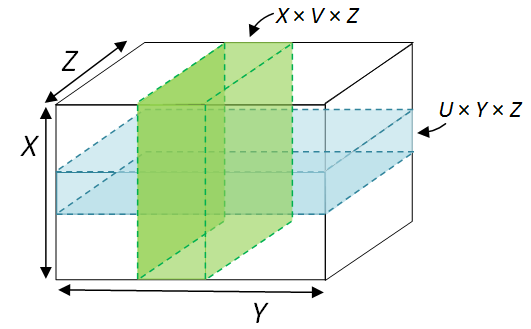
to be continuous. This means for any open subset U_i\subseteq X_i, the “open slice” given by \pi_i^{-1}(U_i) = (\prod_{j\ne i} X_j) \times U_i is an open subset of X. Let’s define the coarsest topology for which this is true.

Definition. The product topology on X is given by the subbasis of “open slices”:

\{ (\prod_{j\ne i} X_j)\times U_i : U_i\subseteq X_i \text{ open }, i\in I\}.

open_slices

[ Open slices of X × Y × Z ]

Taking intersections of finitely many elements of this subbasis, we get the basis:

\Sigma = \{ \prod_{i\in I} U_i : U_i\subseteq X_i \text{ open, } X_i\ne U_i \text{ for only finitely many } i\}.

Note that for a finite product X_1 \times X_2 \times\ldots\times X_n, the box topology and the product topology are identical.

Taking the complement of an “open slice” gives the “closed slice”

C = (\prod_{j\ne i} X_j) \times C_i,\ for a closed subset \ C_i\subseteq X_i.

Now if C_i\subseteq X_i is a collection of closed subsets, then the product \prod_i C_i is an intersection of the “closed slices”, so we get:

Proposition 1. The product \prod_i C_i of closed subsets is closed in the product topology.

Since the box topology is an even finer topology, \prod_i C_i is also closed in the box topology.

Next, we’ll proceed to give some nice properties of the product topology. Hopefully, these will convince you that we’ve made the “right” choice.

blue-lin

Properties of Product Topology

We’ll give the most important property first.

Universal Property of the Product. Let X=\prod_i X_i with projection maps \pi_i : X\to X_i. Now, for any topological space Z and function f:Z\to X,

  • f is continuous at z\in Z if and only if \pi_i\circ f:Z\to X_i is continuous at z, for each i.

Proof.

The forward direction is obvious since each \pi_i  is continuous.

For the converse, we need to show that for any open subset V of X containing f(x), f^{-1}(V) contains an open subset U which contains z. If we fix a subbasis of X, we may assume V belongs to this subbasis. Hence let V=\pi_i^{-1}(U_i) for some open subset U_i\subseteq X_i and index i. This gives:

f^{-1}(V) = f^{-1}\pi_i^{-1}(U_i) = (\pi_i\circ f)^{-1}(U_i),

which indeed contains an open subset containing z since \pi_i\circ f is continuous. ♦

In particular, we have:

Universal Property of the Product (II) : if Z is a topological space and f:Z → X is a map, then f is continuous if and only if πif is continuous for each index i.
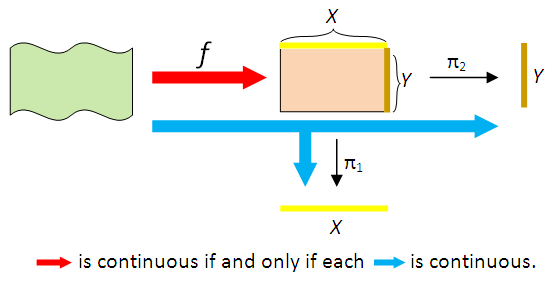
univ_prop

In examining the proof of the universal property, the reader may suspect that this property uniquely defines the product topology, and he’d be right!

In what follows, we’ll list some results which can be proven by invoking the universal property.

blue-lin

Applications of the Universal Property

We’ll use the above universal property of the product topology to prove a variety of results.

Proposition 2. The diagonal map \Delta : X\to X^I is a homeomorphism onto its image.

Proof.

Continuity: by the universal property, it suffices to show that composing with each projection map gives a continuous map \pi_i \circ \Delta : X\to X for each i. But this map is simply the identity, which is clearly continuous.

To show that the inverse map Δ(X) → X is continuous, note that it is simply the restriction of a projection map \pi_i : \prod_i X_i \to X_i to Δ(X). ♦

Proposition 3. Let f_i : X_i \to Y_i be a collection of continuous maps indexed by i. Then the map f:\prod_i X_i \to \prod_i Y_i which takes:

(x_i)_{i\in I} \mapsto (f(x_i))_{i\in I},

is continuous.

Proof

Let X = \prod_i X_i, Y = \prod_i Y_i and \pi_i : X\to X_i, p_i : Y\to Y_i be the projection maps.

To prove f is continuous, the universal property tells us it suffices to show p_i\circ f is continuous for each i. But then p_i\circ f = f_i\circ \pi_i so it is indeed continuous. ♦

Proposition 4. Let J be a directed set and (x_i)_j be a net in \prod_{i\in I} X_i indexed by j\in J. Then

  • the net converges converges to (a_i)\in \prod_i X_i if and only if for each fixed i, the net x_{ij} \to a_i converges in Xi.

[ Feel free to substitute “net” with “sequence” if you’re not too comfortable with it. ]

Proof.

As we noted earlier, (x_i)_j \to (a_i) if and only if the map

f:J^* \to \prod_i X_i,\ which takes j \mapsto (x_i)_j,\ \infty \mapsto (a_i),

 is continuous at ∞. By the universal property, this is true if and only if for each i, the composition \pi_i\circ f : J^* \to X_i is continuous. But this map takes j\mapsto x_{ij},\ \infty\mapsto a_i, which is continuous at ∞ if and only if (x_{ij})\to a_i\in X_i for each i. ♦

Application: consider the earlier sequence (x_i)_j = e^{-ij} for positive integers ij. If we fix i, then as j → ∞, (x_i)_j \to 0. Hence, (x_i)_j \to (0, 0, \ldots).

Proposition 5. Suppose we have a collection of collections of topological spaces \{X_{ij}\}, where the index set J(i) for j may depend on i. Then:

\prod_{i\in I} \left(\prod_{j\in J(i)} X_{ij}\right) = \prod_{i\in I, j\in J(i)} X_{ij},

as topological spaces.

Proof.

Note that set-theoretically, there’s a natural bijection between the two sides. Let f : LHS → RHS and g : RHS → LHS be this bijection and its inverse. We need to show that they’re both continuous.

There are three collections of projection maps, all of which are continuous.

\pi_{ij} : (\prod_{i,j} X_{ij}) \to X_{ij},\quad \pi_j : (\prod_j X_{ij})\to X_{ij},\quad \pi_i : \prod_i (\prod_j X_{ij})\to (\prod_j X_{ij}),

for various i\in I, j\in J(i).

  • To show that f is continuous, we need to show \pi_{ij}\circ f is continuous for any ij. But this map is simply \pi_j\circ \pi_i, so it is indeed continuous.
  • To show that g is continuous, we need to show \pi_i\circ g is continuous for each i. For that, we need to show that \pi_j\circ\pi_i \circ g is continuous for each i\in I, j\in J(i). But this is simply \pi_{ij} so it is indeed continuous. ♦

Exercise (on Universal Properties)

Prove the following universal property for subspace. Suppose Y\subseteq X gets the subspace topology from X. Let i:Y\hookrightarrow X be the inclusion map. Then:

    • for any topological space Z, a function fZ → Y is continuous if and only if i\circ f : Z\to X is continuous.

Suppose Y_i\subseteq X_i is a collection of subsets of topological spaces. There are two ways to form a topology on \prod_i Y_i:

  • take the subspace topology on each Y_i\subseteq X_i and take the product topology \prod_i Y_i or
  • take the product topology on \prod_i X_i then take the subspace topology \prod_i Y_i\subseteq \prod_i X_i.

Prove that both constructions give the same topology, using the universal properties of the product and the subspace topologies.

blue-lin

Interior and Closure

Next, we attempt to generalise the prior two articles on interior/closure of products.

Proposition 6. If Y_i\subseteq X_i is a collection of subsets of topological spaces, then

  • \text{int}(\prod_i Y_i) \ne \prod_i \text{int}(Y_i) in general;
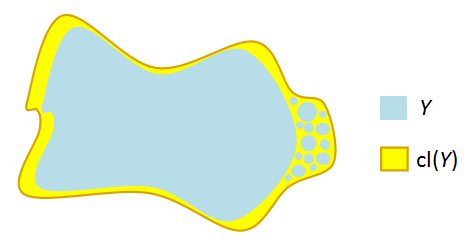
  • \text{cl}(\prod_i Y_i) = \prod_i \text{cl}(Y_i).

Proof.

For the first property, suppose each Yi is open in Xi. Then the RHS is \prod_i \text{int}(Y_i) = \prod_i Y_i which is not open in general unless Y= Xi for all but finitely many i. Hence it is not equal to the LHS.

For the second property, the RHS is a closed subset containing \prod_i Y_i so it must also contain \text{cl}(\prod_i Y_i). For the reverse inclusion, if (x_i)\not\in \text{LHS} then it does not lie in \prod_i Y_i and is not a point of accumulation for it. Thus, we can pick a basic open subset:

(x_i)\in \prod_i U_i\subseteq \prod_i X_i,\ where Ui=Xi except for finitely many i,

such that (\prod_i U_i) \cap (\prod_i Y_i) = \emptyset. Thus for some i, U_i\cap Y_i = \emptyset and xi is not a point of accumulation of Yi. Furthermore, since x_i\in U_i, we have x_i\not\in Y_i so

x_i \not \in Y_i \cup Y_i^{acc} = \text{cl}(Y_i). ♦

Exercise

Prove that in the box topology, we do have:

\text{int}(\prod_i Y_i) = \prod_i \text{int}(Y_i)\ and \ \text{cl}(\prod_i Y_i) =\prod_i \text{cl}(Y_i).

Thus there’s at least one aspect of the box topology which triumphs the product topology.

Product of Metric Spaces

Finally, we ask: if each (X_i, d_i) is a metric space, is the topological product necessarily metrisable also? For finite products, we knew this to be true. It turns out for countably infinite products X = \prod_{i=1}^\infty X_i this is still true.

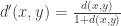
The first step is to replace each di with a bounded metric. Recall that for any metric space (Xd), replacing d with d'(x, y) = \frac{d(x,y)}{1 + d(x,y)} gives a metric d’ which is topologically equivalent and bounded by 1. Multiplying by a suitable constant, we ensure that each di is bounded by 2i for i = 1, 2, 3, … and define a metric on X = \prod_{i=1}^\infty X_i by:

d( (x_i), (y_i)) := \sum_{i=1}^\infty d_i(x_i, y_i).

It’s not hard to check that d is a metric bounded by 1.

The only question is whether the induced topology is identical to the product topology.

First, let’s consider each open slice: U=(\prod_{j\ne i} X_j) \times U_i where U_i\subseteq X_i is open. If a=(a_i) is in this slice, then a_i \in U_i so there’s an open ball N(a_i, \epsilon) \subseteq U_i. Now it’s clear that the open ball in X : N(a, \epsilon) \subseteq U. So U is indeed open in the metric topology.

Conversely, consider an open ball N(a, ε) in the metric topology, where a=(a_i) as before. Pick N such that 2N < ε/2. Then the set:

N(a_1, \frac\epsilon {2N}) \times N(a_2, \frac\epsilon {2N}) \times \ldots\times N(a_N, \frac\epsilon {2N}) \times X_{N+1} \times X_{N+2} \times\ldots

is open in the product topology, and the distance between a and any point in this set is bounded by N\cdot \frac\epsilon{2N} + 2^{-N-1} + 2^{-N-2} + \ldots = \frac\epsilon 2 + 2^{-N} < \epsilon. Thus this set is contained in the open ball N(a, ε).

Posted in Notes | Tagged , , , , , , , , , | Leave a comment

Topology: Interior

Let Y be a subset of a topological space X. In the previous article, we defined the closure of Y as the smallest closed subset of X containing Y. Dually, we shall now define the interior of Y to be the largest open subset contained in it. The construction is similar.

  • Let Σ be the collection of all open U\subseteq X contained in Y.
  • Since \emptyset \in\Sigma, we see that Σ is not empty.
  • Hence, it makes sense to define the interior of Y as the union of all U in Σ.

Thus, \text{int}(Y) = \cup_{U\in\Sigma} U. As before, the interior satisfies the following.

  • \text{int}(Y)\in\Sigma : since a union of open subsets is open, so int(Y) must be open;
  • if U\in\Sigma, then since int(Y) is a union of many sets including U, we must have U\subseteq \text{int}(Y).

This justifies describing int(Y) as the largest open subset contained in Y

interior

As an immediate property:

Basic Fact. If Y\subseteq Z are subsets of X, then \text{int}(Y)\subseteq \text{int}(Z).

Now int(Y) is an open subset contained in Y and hence Z. Thus, int(Y) must be contained in int(Z).

Examples

  1. If Y is open in X, then int(Y) = Y.
  2. Take the half-open interval Y=[0, 1)\subseteq \mathbf{R}. The interior is (0, 1).
  3. The the set of rationals YQ in XR. The interior is empty.
  4. Suppose Y is the set of even positive integers in N*, together with ∞. What is the interior of Y? [ Answer: empty set. ]

warningSuppose X is a metric space. Now the open ball N(a, ε) is always open, but the interior of the closed ball N(a, ε)* is not the open ball N(a, ε) in general. For example, suppose X is the subspace [-1, 1] of R. Then the closed ball Y := N(0, 1)* is already open, so int(Y) = Y, whereas the open ball N(0, 1) is a proper subset of Y.

blue-linProperties of Interior

One can relate the interior of Y with the closure of the complement of Y.

Proposition 1. For any subset Y\subseteq X, we have:

\text{int}(Y) = X - \text{cl}(X-Y).

Proof.

Now int(Y) is the union of all open U contained in Y. Thus its complement is the intersection of all closed C which contains Y. This gives X-\text{int}(Y) = \text{cl}(X-Y), which is exactly what we desired to prove. ♦

Proposition 2. If Y, Z\subseteq X are subsets, then

\text{int}(Y\cap Z) = \text{int}(Y)\cap\text{int}(Z).

Proof.

We’ll turn this into a relation of closure by invoking proposition 1. Taking the complement turns the LHS into:

\begin{aligned}X-\text{int}(Y\cap Z) &=\text{cl}(X - (Y\cap Z)) = \text{cl}((X-Y)\cup(X-Z))= \text{cl}(X-Y)\cup\text{cl}(X-Z)\\&= (X-\text{int}(Y))\cup (X-\text{int}(Z)) = X - (\text{int}(Y)\cap\text{int}(Z)),\end{aligned}

where the third equality followed from proposition 2 of the previous article. ♦

By induction, this can be generalised to finite intersections:

\text{int}(Y_1) \cap \text{int}(Y_2) \cap\ldots\cap \text{int}(Y_n) = \text{int}(Y_1\cap Y_2 \cap \ldots \cap Y_n)

for arbitrary subsets Y_1, Y_2, \ldots, Y_n\subseteq X.

warningThis does not hold for infinite intersections. For example, if Y_n = [-\frac 1 n, +\frac 1 n], then the intersection \cap_n \text{int}(Y_n) = \cap_n (-\frac 1 n, +\frac 1 n) = \{0\}. On the other hand, \text{int}(\cap_n Y_n) = \text{int}(\{0\}) = \emptyset.

It also doesn’t work for finite union. E.g. let YQ and ZRQ, in the real line XR. Then int(Y) and int(Z) are both empty so \text{int}(Y)\cup\text{int}(Z) = \emptyset. But \text{int}(Y\cup Z) = \text{int}(\mathbf{R}) = \mathbf{R}.

However, we do have:

\text{int}(\cup_i Y_i) \supseteq \cup_i \text{int}(Y_i)\ and \text{int}(\cap Y_i) \subseteq \cap_i \text{int}(Y_i)

for any collection of subsets Y_i\subseteq X.

  • For the first inclusion: since for each i, we have Y_i\subseteq \cup_i Y_i, we get \text{int}(Y_i)\subseteq \text{int}(\cup_i Y_i). Since this works for each i, we’re done.
  • For the second inclusion: for each i, we have \cap_i Y_i \subseteq Y_i so this gives \text{int}(\cap_i Y_i) \subseteq \text{int}(Y_i). Since this holds for each i, we’re done.

blue-linFurther Properties

Unfortunately, the interior of Y in a smaller subspace cannot be deduced from its interior in a bigger space.

Proposition 3. Let Y\subseteq Z\subseteq X be subsets of a topological space X. Then:

\text{int}_Z(Y) \supseteq Z\cap\text{int}_X(Y).

In general equality doesn’t hold.

Proof.

Since the RHS is an open subset of Z and is contained in Y, it must be contained in the LHS.

To see that equality doesn’t hold in general, let RQ and YQ ∩ (0, 1). Then since (0, 1) is open in RY is open in Z. Hence, \text{int}_Z(Y) = Y. On the other hand, \text{int}_X(Y) = \emptyset, so the RHS is empty. ♦

Thankfully, product still works:

Proposition 4. If Y_1\subseteq X_1 and Y_2\subseteq X_2 are subsets of topological spaces, then

\text{int}(Y_1 \times Y_2) = \text{int}(Y_1)\times \text{int}(Y_2),

where the LHS interior is taken in X_1\times X_2.

Proof.

Since \text{int}(Y_1)\times \text{int}(Y_2) is an open subset of X_1\times X_2 and is contained in Y_1\times Y_2, we see that the RHS is contained in the LHS.

Conversely, if (x,y)\in \text{int}(Y_1\times Y_2) then there’s a basic open subset U×V such that (x,y)\in U\times V\subseteq \text{int}(Y_1 \times Y_2). Then U\subseteq Y_1 and V\subseteq Y_2 so x\in \text{int}(Y_1) and y\in \text{int}(Y_2). So the LHS is contained in the RHS. ♦

Finally, since \text{int}(Y) \subseteq Y\subseteq \text{cl}(Y) we define the boundary of Y to be the difference

bd(Y) := cl(Y) – int(Y).

Note that since bd(Y) is the intersection of cl(Y) and the complement of int(Y), both closed, bd(Y) is closed too.

Note: some people also call cl(Y)-int(Y) the frontier of Y, since the term “boundary” has a different meaning in algebraic topology. We opt not to use that term, since in practice there’s little cause for confusion.

Comparing Interior and Closure

The following table summarises the contents of this and the previous article. Some of these  relations are equivalent by virtue of the fact that X-int(Y) = cl(XY).

Closure of Y Interior of Y
If Y\subseteq Z, then \text{cl}(Y)\subseteq \text{cl}(Z). If Y\subseteq Z, then \text{int}(Y) \subseteq \text{int}(Z).
Finite union: \text{cl}(Y\cup Z) = \text{cl}(Y) \cup \text{cl}(Z). Finite intersection: \text{int}(Y \cap Z) = \text{int}(Y) \cap \text{int}(Z).
Arbitrary union: \text{cl}(\cup_i Y_i) \supseteq \cup_i \text{cl}(Y_i). Arbitrary union: \text{int}(\cup_i Y_i) \supseteq \cup_i \text{int}(Y_i).
Arbitrary intersection: \text{cl}(\cap_i Y_i) \subseteq \cap_i \text{cl}(Y_i). Arbitrary intersection: \text{int}(\cap_i Y_i) \subseteq \cap_i\text{int}(Y_i).
If Y\subseteq Z\subseteq X, then \text{cl}_Z(Y) = Z\cap \text{cl}_X(Y). If Y\subseteq Z\subseteq X, then \text{int}_Z(Y) \supseteq Z\cap \text{int}_X(Y).
For subsets Y_1\subseteq X_1, Y_2\subseteq X_2, we have \text{cl}(Y_1\times Y_2) = \text{cl}(Y_1)\times \text{cl}(Y_2). For subsets Y_1\subseteq X_1, Y_2\subseteq X_2, we have \text{int}(Y_1\times Y_2) = \text{int}(Y_1)\times \text{int}(Y_2).

Exercises: deduce the corresponding entries for boundary bd(Y).

Answers:

  • If Y is contained in Z, it’s not always true that bd(Y) is contained in bd(Z). Indeed, take Y = (0, 1) ∩ Q and Z = (0, 1). Then the boundary of Y is cl(Y) – int(Y) = [0, 1] – (empty set) = [0, 1], but the boundary of Z is {0, 1}. Surprised? 
  • For finite union, bd(union of YZ) is contained in the union of bd(Y) and bd(Z).
  • For finite intersection, bd(∩ Z) is contained in bd(Y) ∩ bd(Z).
  • For arbitrary union, things get hairy. E.g. if Yn = [0, (n-1)/n] for n=2, 3, …, then union of bd(Yn) is {0, 1/2, 2/3, 3/4, … }, while bd(union of Yn) = {0, 1}. Neither is contained in the other.
  • Same for arbitrary intersection.
  • bdZ(Y) is contained in Z ∩ bdX(Y).
  • bd(Y1 × Y2) is the union of bd(Y1) × cl(Y2) and cl(Y1) × bd(Y2).
Posted in Notes | Tagged , , , , , , | 2 Comments

Topology: Closure

Suppose Y is a subset of a topological space X. We define cl(Y) to be the “smallest” closed subset containing Y. Its formal definition is as follows.

  • Let Σ be the collection of all closed subsets C\subseteq X containing Y.
  • Note that X\in \Sigma, so Σ is not empty.
  • Thus, we can take define \text{cl}(Y) := \cap_{C\in\Sigma} C.

This is called the closure of Y in X. Note that the notation cl(Y) does not indicate the ambient space X. If there’s any possibility of confusion, we denote it by clX(Y) instead. The closure satisfies the following properties:

  • \text{cl}(Y) \in \Sigma: since an intersection of closed subsets is still closed;
  • if C\in \Sigma, then since cl(Y) is the intersection of many sets, including C, we must have \text{cl}(Y)\subseteq C.

This justifies our calling cl(Y) the smallest closed subset containing Y.

closureAs an immediate property, we have:

Basic Fact. If Y\subseteq Z are subsets of X, then \text{cl}(Y)\subseteq \text{cl}(Z).

Indeed, cl(Z) is a closed subset of X containing Z, and hence Y. Thus, it must contain cl(Y).

Examples

  1. If Y is closed in X, then cl(Y) = Y.
  2. Take the half-open interval Y = [0, 1)\subseteq \mathbf{R}. The closure is [0, 1].
  3. Take the set of rationals YQ in XR. The closure is the whole real line.
  4. Suppose Y = {3, 5, 7} in N*. What is the closure of Y (see here for the definition of N*)? [ Answer: {1, 2, 3, 4, 5, 6, 7}. ]

warning

Warning: in a metric space X, the closed ball N(a, \epsilon)^* := \{x\in X: d(x, a) \le \epsilon\} is a closed subset since the complement (which contains all x such that d(xa) > ε) is open in X.

However, the closure of the open ball N(a, \epsilon) is not the closed ball N(a, \epsilon)^* in general. For a rather pathological example, consider X = [-1, +1] \cup \{2\} and take the open ball Y = N(0, 2). Then Y = [-1, +1] is already closed in X so cl(Y) = Y, while the closed ball N(0, 2)* = X ≠ cl(Y).

blue-lin

Properties of Closure

The closure of can be characterised as follows.

Proposition 1. We have \text{cl}(Y) = Y\cup Y^{acc} where Yacc is the collection of all points of accumulation of Y.

Proof.

Let’s first prove that C:=Y\cup Y^{acc} is closed in X.

  • If x\in X-C, then in particular x is not a point of accumulation of Y, so there exists an open subset U\subseteq X containing x such that U ∩ Y contains at most x. But x is not in Y, so U\cap Y=\emptyset, i.e. U\subseteq X-Y.
  • Next we wish to show U\subseteq X-Y^{acc}. Suppose on the contrary y\in U\cap Y^{acc}, so in particular y is a point of accumulation of Y. Since U is an open subset of X containing y, we have U ∩ Y containing a point z ≠ y, which contradicts what we just proved. Thus U\subseteq X - (Y\cup Y^{acc}) = X-C, so XC is a union of open subsets and is thus open.

To complete the proof, since C is a closed subset containing Y, it also contains cl(Y). On the other hand, since cl(Y) is closed, \text{cl}(Y) \supseteq \text{cl}(Y)^{acc} \supseteq Y^{acc}. This gives \text{cl}(Y) \supseteq Y\cup Y^{acc} = C, which completes the proof. ♦

Proposition 2. If Y, Z\subseteq X are subsets, then

\text{cl}(Y\cup Z) = \text{cl}(Y) \cup \text{cl}(Z).

Proof.

Since the RHS is closed and contains Y\cup Z, it must contain the LHS also.

Conversely, since Y\subseteq Y\cup Z, we have \text{cl}(Y) \subseteq \text{cl}(Y\cup Z). Similarly, \text{cl}(Z) \subseteq\text{cl}(Y\cup Z) so the LHS contains the RHS. ♦

Unions and Intersections of Closures

By induction, one can prove that:

\text{cl}(Y_1 \cup Y_2 \cup \ldots \cup Y_n) = \text{cl}(Y_1) \cup \text{cl}(Y_2) \cup \ldots \cup \text{cl}(Y_n)

for any subsets Y_1, Y_2, \ldots, Y_n \subseteq X. However, this is as far as we go, as we cannot extend this to the union of infinitely many sets. E.g. if Y_n = [\frac 1 n, 1] in X=R, then since each Y_n\subseteq X is closed, we have \cup_n\text{cl}(Y_n) = \cup_n Y_n=(0, 1] which isn’t closed, so it cannot possibly be \text{cl}(\cup_n Y_n).

warningAlso, the result is not true for intersection. E.g. let YQ and ZRQ be subsets of the real line R. Then Y ∩ Z is empty, and so is cl(Y ∩ Z). On the other hand, cl(Y) ∩ cl(Z) = R ∩ RR. So we have cl(Y) ∩ cl(Z) ≠ cl(Y ∩ Z).

That being said, we do at least have a one-sided inclusions:

\text{cl}(\cap_i Y_i) \subseteq \cap_i \text{cl}(Y_i), \quad \text{cl}(\cup_i Y_i) \supseteq \cup_i \text{cl}(Y_i)

for any collection of subsets Y_i\subseteq X.

  • For the first inclusion: since \cap_i Y_i \subseteq Y_i for each i, we have \text{cl}(\cap_i Y_i)\subseteq \text{cl}(Y_i). Since this holds for every i, we get the desired inclusion.
  • For the second inclusion: since Y_i\subseteq \cup_i Y_i for each i, we have \text{cl}(Y_i) \subseteq \text{cl}(\cup_i Y_i). Since this holds for each i, we’re done. ♦

blue-lin

Further Properties

Next, the closure of Y in a smaller subspace can be deduced from the closure in a bigger space.

Proposition 3. If Y\subseteq Z \subseteq X are subsets of a topological space X, then the closure of Y in Z is the intersection of Z with the closure of Y in X.

\text{cl}_Z(Y) = Z\cap \text{cl}_X(Y).

Proof

Since the RHS is a closed subset of Z containing Y, it must contain the LHS.

Conversely, since LHS is closed in Z it must be of the form C ∩ Z for some closed subset C of X. Then C is a closed subset of X containing Y and thus must contain clX(Y). So C ∩ Z must contain the RHS. ♦

Finally, closure also respects the product.

Proposition 4. If Y_1 \subseteq X_1 and Y_2\subseteq X_2 are subsets of topological spaces, then:

\text{cl}(Y_1\times Y_2) = \text{cl}(Y_1) \times \text{cl}(Y_2)

where the LHS closure is taken in X_1\times X_2.

Proof.

Since the RHS is closed in X_1 \times X_2, it must contain the LHS. For the reverse inclusion, we prove by contradiction by picking an element (xy) outside the LHS, cl(Y1 × Y2).

  • In particular, (x, y)\not\in (Y_1\times Y_2)^{acc}, so there is an open subset containing (xy) which doesn’t intersect Y1 × Y2.
  • This open subset must contain a basic open set of the form U × V which contains (xy).
  • Note that we still have (U\times V)\cap (Y_1\times Y_2) = \emptyset and so U\cap Y_1 = \emptyset or V\cap Y_2 = \emptyset.
  • Assume the former; then x\not\in Y_1^{acc}. Since x\in U, we also have x\not\in Y_1, thus giving x\not\in Y_1\cup Y_1^{acc} = \text{cl}(Y_1).

So (xy) is outside the RHS also, and we’re done. ♦

Posted in Notes | Tagged , , , , , , , | Leave a comment

Thoughts on a Problem III

I saw an interesting problem recently and can’t resist writing it up. The thought process for this problem was exceedingly unusual as you’ll see later.

First, here’s the source:

But here’s the full problem (rephrased a little) if you’d rather not watch a video.

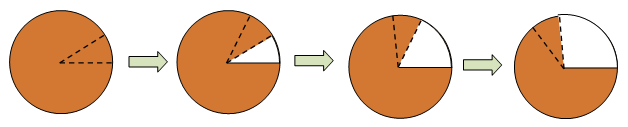
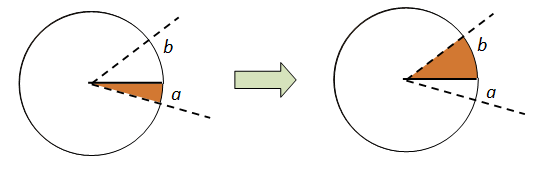
Problem. From a cylindrical cake with chocolate icing on top, cut successive slices of a fixed angle x. Each slice is then inverted and inserted back into the cake. Find all angles x, such that after finitely many iterations, all the icing is back on top of the cake.

cakeflip

The whole point of the video is to present us with problems whose solutions violate our intuition. This problem is a prime example. At first glance, one might conjecture that the answer is any rational multiple of the full rotation. The correct answer is a little surprising, to say the least.

[ Warning: spoiler ahead with detailed solution. Actually, since this article is about my thoughts on a problem, what else did you expect? 😛 ]

warningThe following solution is to be performed by trained professionals only. Readers please do not attempt to try this on an actual cake.

blue-linSolution

The correct answer is: any angle. Yes, even irrational multiples of the full rotation! This completely bowled me over since for these “irrational angles”, you’ll never cut the same position twice. Fortunately, the professor in the video stopped short of explaining why all angles work, which gives us viewers an opportunity to think this through.

It took me a full 10 minutes to convince myself that “irrational angles” are possible. I realised that after one full round, in passing through the original baseline, the process of flipping the slice also introduces a rather unexpected turn of events.

What I had thought:

cakeflip_1round

What actually transpires:

cakeflip_1round_b

Note that even the initial cutting line had been flipped within the sector.

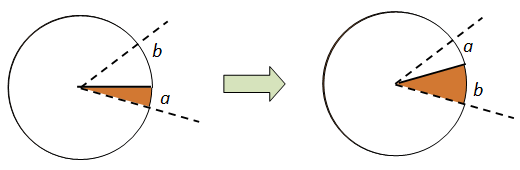
Upon this realisation, one sees that cutting lines may repeat even though the positions at which you cut don’t, since the cutting lines themselves aren’t stationary. Needless to say, the next step is to see what happens with the second round of cuts. As we continue round, we get: x (brown), x (brown) …

cakeflip_2roundon

Now it should be noted that a = 2π-kx for some integer k such that kx ≤ 2π < (k+1)x. And bxa = (k+1)x – 2π. Hence, upon the second round, a sector of the cake is inverted which includes “b” above:

cakeflip_2roundend

The pattern actually got more complex! As the cutting goes through more and more rounds, we’ll certainly expect more interspersing of the colours. How do we prove that it eventually returns to the original pattern?

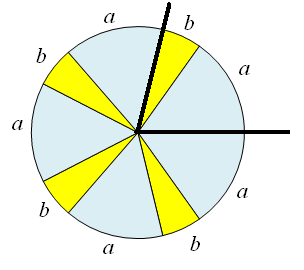
Turns out there’s a nice way. First we let a and b be as above: a = 2π – kx, where k is the largest positive integer such that kx ≤ 2π < (k+1)x. Then let bx – a = (k+1)x – 2π. This gives kb + (k+1)a = k(a+b) + akx+a = 2π. Draw a pie chart with k+1 slices of angle a and k slices of angle b. Also highlight the sector where one of edges is the common edge between two slices of angle a (see diagram below); this is the slice we’ll invert.

cakeflip_div

Observe that after inverting this slice, the two angles a and b are swapped and the next sector is highlighted. This new sector also has one of its edges lying on the common edge between two slices of angle a. Thus, if we consider the total set S of all possible ways to colour each slice with either brown and white (|S| = 2^{2k+1}), then inverting a slice corresponds to a bijective function on S. By elementary theory of permutations, we must eventually get back the original configuration, i.e. all chocolate icing up.

This pretty much solves our problem, although there’s a nagging feeling that the proof may not work if angle x > π. For this case, we imagine the corresponding problem with angle x’ = 2π – x < π. Instead of inverting a slice of angle x, one imagines inverting a slice of angle x’ then flipping the whole cake over. Hence if, for angle x’, we get back the cake with chocolate icing up in N moves, then for the case of angle x, performing N moves will give us the cake with chocolate icing either all up or all down. In the former case, that’s good; in the latter case, another N moves will flip the cake back up.

Conclusion (with apologies to Valve):

cake_not_lie

Posted in Thought | Tagged , , , , | Leave a comment

Topology: Cauchy Sequences and Uniform Continuity

updated [ Updated on 8 Mar 13 to include Cauchy-continuity and added answers to exercises. ]

We wish to generalise the concept of Cauchy sequences to metric spaces. Recall that on an intuitive level, a Cauchy sequence is one where the elements get “closer and closer”.

Definition. Let (X, d) be a metric space. A sequence (x_n) in X is said to be Cauchy if

  • for any ε>0, there exists N such that whenever m, n > N, we have d(x_m, x_n) < \epsilon.

Let’s list some basic results.

Proposition 1. A convergent sequence is Cauchy.

Proof.

Suppose (x_n) \to a in the metric space (Xd). For any ε>0, there exists N such that whenever nN, we have d(x_n, a)<\epsilon/2. Thus, whenever mnN, we have:

d(x_m, x_n) \le d(x_m, a) + d(a, x_n) < \frac\epsilon 2 + \frac\epsilon 2 = \epsilon. ♦

Proposition 2. Let Y be a metric subspace of (X, d). Then a sequence (x_n) in Y is Cauchy if and only if it’s Cauchy in X.

There’s nothing to prove here since Y inherits the distance function from X. However, this serves to highlight the fact that while a sequence from Y which converges in X may not be convergent in Y, the same problem doesn’t hold for Cauchy sequences, i.e. being Cauchy is a property of the sequence itself, regardless of the ambient space.

Proposition 3. If (x_n), (y_n) are sequences of metric spaces (X, d_X), (Y, d_Y) respectively, then (x_n, y_n) is a Cauchy sequence of X × Y if and only if each of (x_n), (y_n) is Cauchy in the respective metric space.

For the metric of X × Y, we can pick any one of the following:

  • ((x, y), (x', y')) \mapsto \sqrt{d_X(x, x')^2 + d_Y(y, y')^2};
  • ((x, y), (x', y')) \mapsto d_X(x, x') + d_Y(y, y');
  • ((x, y), (x', y')) \mapsto\max(d_X(x, x'), d_Y(y, y')).

Proof

First suppose (x_n) and (y_n) are Cauchy. For any ε>0,

  • there exists M such that when mnM, we have d_X(x_m, x_n) < \frac\epsilon 2;
  • there exists N such that when mnN, we have d_Y(y_m, y_n) < \frac\epsilon 2.

Thus, when mn > max(MN), we have – for any metric d on X × Y in the above list – d((x_m, y_m), (x_n, y_n)) < \epsilon.

For the converse, we use the fact that

d((x,y), (x',y')) \ge d_X(x, x')  and  d((x,y), (x', y')) \ge d_Y(y, y')

for any one of three choices of d. ♦

One might ask if it’s necessary to consider all three metrics on X × Y since they all give rise to the same topology anyway. And this is where we drop the bombshell.

warning

The concept of Cauchy sequences actually relies heavily on the metric and not just the underlying topology. In other words, it’s possible for two metrics on the same space to be topologically equivalent, but a sequence is Cauchy in one and not the other.

For example, consider the homeomorphism fR+ → R+ of the space of positive reals given by f(x) = 1/x. The sequence x_n = 1/n is Cauchy, but the resulting sequence f(x_n) = n is not. Put in another way, we can define two metrics on R+ via (r, r') \mapsto |r-r'| and (r, r')\mapsto |r^{-1} - r'^{-1}|. Then the sequence x_n = 1/n is Cauchy under the first metric but not the second.

The same example also tells us:

Definition. A function f:(X, d_X) \to (Y, d_Y) of metric spaces is said to be Cauchy-continuous if whenever (x_n) is a Cauchy sequence in X, (f(x_n)) is a Cauchy sequence in Y.

Warning. Not all continuous functions are Cauchy-continuous.

To rectify that, we need a stronger form of continuity.

blue-linUniform Continuity

The answer to our problem is the following definition. We had already seen it earlier in the case of R.

Definition. A map f:(X, d_X)\to (Y, d_Y) of metric spaces is said to be uniformly continuous if

  • for any ε>0, there exists δ>0 such that whenever x, x'\in X satisfies d_X(x, x')<\delta, we have d_Y(f(x), f(x')) < \epsilon.

Clearly, a uniformly continuous function is also continuous (at every point of X). But here’s an example where the converse is not true.

Take the function f :  R+ → R+ given by f(x) = 1/x as before. This is clearly continuous. To show that it’s not uniformly continuous, negating the definition means we need to find an ε>0 such that for any δ>0, there exist x and x’ such that |x – x’| < δ but |f(x) – f(x’)| ≥ ε.

This is not too hard: set ε=1. Now for any δ>0, pick a positive integer n > 1/δ and let x = \frac 1 n, x' = \frac 1 {n+1}. We now have:

d(x, x') = |x - x'| = \frac 1 {n(n+1)} < \frac 1 n <\delta  but  d(f(x), f(x')) = 1.

Next, the main result we’d like to prove is:

Theorem 4. If f:(X, d_X) \to (Y, d_Y) is a uniformly continuous map of metric spaces, then it is Cauchy-continuous.

Proof.

Let ε>0. Then:

  • by uniform continuity of f, there exists δ>0 such that whenever x, x'\in X satisfies d_X(x, x')<\delta, we have d_Y(f(x), f(x')) < \epsilon;
  • there exist N such that when mn > N, we get d_X(x_m, x_n) < \delta.

Thus, when mnN, we get d_Y(f(x_m), f(x_n)) < \epsilon. So (f(x_n)) is indeed a Cauchy sequence in Y. ♦

The following are some easy properties of uniformly continuous functions.

Proposition 5.

  • If Y is a metric subspace of (X, d), then the inclusion map Y\hookrightarrow X is uniformly continuous.
  • If f:X\to Y and g:Y\to Z are uniformly continuous functions of metric spaces, then so is g\circ f:X\to Z.
  • The projection maps p_1: X\times Y\to X and p_2 : X\times Y\to Y are uniformly continuous, where the metric on X × Y is one of the three in proposition 3.

Proof.

The first two statements are obvious. The last follows from the inequality we saw earlier:

d((x, y), (x', y')) \ge d_X(x, x') and d((x,y), (x', y'))\ge d_Y(y, y'),

for any one of the three d. ♦

Finally, we end this article with some exercises on Cauchy and convergent sequences.

Exercises

  1. Prove that if (x_n) is a Cauchy sequence in a metric space X, then every subsequence is also Cauchy.
  2. Prove that if (x_n) is a convergent sequence in a topological space X, then every subsequence is also convergent.
  3. Suppose (x_n) is a Cauchy sequence in a metric space X. Prove that if a subsequence of (x_n) is convergent, so is the entire sequence.
  4. Prove that a Cauchy-continuous map f:(X, d_X)\to (Y, d_Y) of metric spaces is continuous.
  5. Find a Cauchy-continuous f which is not uniformly continuous.

Answers (Highlight to Read)

  1. Suppose (xn) is Cauchy, and the subsequence indexed by n[1] < n[2] < n[3] … converges to x. For each ε>0, pick N such that (i) when mnN, d(xmxn) < ε/2 and (ii) when k>Nd(xn[k], x) < ε/2. Thus, when n>N, we have d(xnx) ≤ d(xnxn[k]) + d(xn[k], x) < ε for some k>N. This proves that (xn) → x.
  2. By theorem 6 in the previous article, it suffices to show that for any convergent (xn) → x in X, we have (f(xn)) → f(x). Now construct a new sequence (yn) by interspersing (xn) and x : y2nxn and y2n-1x, for n = 1, 2, … . Then (yn) still converges to x, so it’s Cauchy; since f is Cauchy-continuous, (f(yn)) is Cauchy too. But (f(yn)) has a subsequence (f(x), f(x), … ), so by Q3, (f(yn)) → f(x).
  3. Take fR → R, given by f(x) = x2.
    • Not uniformly continuous since we can set ε=2; if x=ny=n + (1/n), then |xy| = 1/n, but |f(x)-f(y)| > 2.
    • Cauchy-continuous since any Cauchy sequence (xn) in R must be convergent so (f(xn)) is also convergent, and hence Cauchy.

Summary

We have three related notions of continuity (for maps f:(X, d_X)\to (Y, d_Y) of metric spaces).

\left\{\begin{matrix}\text{Uniform}\\ \text{continuity}\end{matrix}\right\}\implies \left\{\begin{matrix} \text{Cauchy-}\\ \text{continuity}\end{matrix}\right\}\implies \left\{\text{Continuity}\right\}.

All implications are non-reversible since there’re counter-examples. The first two are only defined for maps between metric spaces while the last is a topological property.

Posted in Notes | Tagged , , , , , , | Leave a comment

Topology: Nets and Points of Accumulation

Recall that a sequence (x_n) in a topological space X converges to a in X if the function fN* → X which takes n\mapsto x_n, \infty\mapsto a is continuous at \infty\in\mathbf{N}^*. Unrolling the definition, it means that for any open subset U of X containing a, the set f^{-1}(U)\subseteq \mathbf{N}^* contains (N, ∞] for some N. In other words,

  • for any open subset U\subseteq X containing a, there exists N such that when nN, x_n\in U.

We also saw that if X is Hausdorff, then the limit a is unique, but we won’t make that assumption now.

The key question here is:

Suppose Y\subseteq X is a subspace and (x_n) is a sequence in Y converging to a\in X. Does it mean a \in Y?

Even in the case where XR, this is not true for some subspaces, e.g. Y = (0, 1), where the sequence x_n = 1/n converges to 0 which lies outside Y. In an earlier article, we saw that this is related to the requirement that Y is closed in X. Let’s attempt to reproduce that result for topological spaces.

Definition. Let a be a point in topological space X. We say it is a point of accumulation for Y if for every open subset U\subseteq X containing a, there exists x\in U\cap Y, x≠a.

topological_space_accum

The Case of Metric Spaces

Let’s examine this definition for a metric space X. In this case, a is a point of accumulation for Y iff for each ε>0, the intersection N(a, ε) ∩ Y contains some point other than a. Indeed, (LHS) → (RHS) follows from the fact that N(a, ε) is an open subset containing a, while (RHS) → (LHS) follows from the fact that every open subset containing a must contain an open ball N(a, ε).

Example

Suppose XR and Y is the set of rational numbers 0 < r < 1. Then any real number in [0, 1] is a point of accumulation for Y since for any ε>0, the open ball N(r, ε) must contain a rational number. [ The full rigourous argument needs a bit more care, but we won’t harp on this any more. ]

This result is reminiscent of an earlier one.

Theorem 1. In a metric space X and subspace Y, the following are equivalent.

  1. If (x_n) is a sequence in Y converging to a\in X, then a\in Y.
  2. Y contains all its points of accumulation.
  3. Y is closed in X.

Proof.

(1) → (2) : let a be a point of accumulation of Y. For each n = 1, 2, …, N(a, 1/n) ∩ Y contains a point xn ≠ a. Then (xn) is a sequence in Y converging to a; thus a is in Y.

(2) → (3) : let a\in X-Y, so it is not a point of accumulation of Y. By definition, there exists an open subset U containing a such that U ∩ Y has no point other than possibly a. But a is not in Y anyway, so U ∩ Y is empty, i.e. U\subseteq X-Y and XY is open in X.

(3) → (1) : suppose (xn) is a sequence in Y converging to a. If a\in X-Y, which is open in X, then there exists N such that when n>Nxn lies in XY, which is absurd. ♦

blue-linThe Case of Topological Spaces

We will see later that in the case of topological spaces, (2) and (3) are still equivalent, but (1) fails. The problem lies in the definition of sequences, which is essentially a function fN* – {∞} → X, and the space N* is given unnecessary prominence. To overcome this one needs a more general form of sequences for topological spaces.

Definition. A directed set is a partially ordered set I such that for any i, j\in I, there exists k\in I such that i\le k, j\le k. In words, this means that every finite subset has an upper bound.

net in a topological space X (indexed by I) is a function f : I → X, written as (x_i)_{i\in I}.

We say that a net (x_i) has limit a\in X if for any open subset U\subseteq X containing a, there exists an index i such that for all j ≥ i, x_j \in U.

topological_net

Now the following is true.

Theorem 2.  Let Y be a subspace of a topological space X. The following are equivalent.

  1. If (x_i) is a net in Y which converges to a\in X, then a\in Y.
  2. Y contains all its points of accumulation.
  3. Y is closed in X.

Proof

(1) → (2) : suppose a is a point of accumulation of Y. Let the index set I correspond to the collection of open subsets U containing a, ordered by reverse inclusion: i \le j iff U_i \supseteq U_j. Since a is a point of accumulation of Y, for each i\in I we can pick x_i \in U_i\cap Y, x_i \ne a. Then (x_i)_{i\in I} \to a so a\in Y.

(2) → (3) : identical to earlier.

(3) → (1) : let (x_i) be a net in Y converging to a\in X-Y. Since XY is open in X, there exists index i such whenever ji, x_j \in X-Y, which is a contradiction. ♦

Interlude: Alternate Look at Nets

At this point, the reader may wonder why we need I to be a directed set, i.e. wouldn’t an ordinary partially ordered set (poset) suffice? Indeed, the above theorem seems to work even when I is just a poset.

To answer this question, we provide an alternate definition for nets and limits. Given a directed set I, let I^* := I \cup \{\infty\}, where ∞ is just a dummy symbol. A basis for open subsets of I* is given by:

  • P_i := \{j\in I: j\ge i\} \cup \{\infty\}, for various i\in I.

To check that this is a basis, we claim that P_i \cap P_j = \cup_{k\ge i, k\ge j} P_k.

  • Indeed, clearly RHS is contained in LHS since k\ge i \implies P_k \subseteq P_i.
  • Conversely, if k\in P_i\cap P_j is an index, then k ≥ i and k ≥ j so k\in P_k is found in the RHS. The only case left is \infty \in P_i \cap P_j. Since I is a directed set, there exists k≥i and k≥j. Thus, the RHS is a non-empty union and ∞ is in the RHS. This proves that LHS is contained in RHS.

Thus, the fact that I is a directed set is necessary for Pi‘s to form a basis. Otherwise, they’d only form a subbasis in which case it’s possible for {∞} to be open in I*.

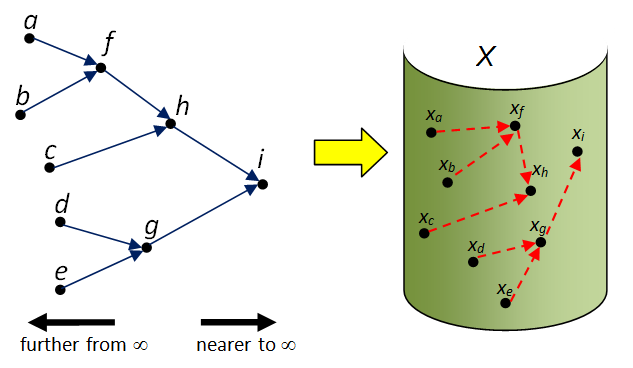
Next, the condition that a net (x_i) \to a is exactly the same as that \lim_{i\to\infty} x_i = a where the limit was defined in the previous article. Since {∞} is not open in I*, we conclude:

Proposition 3. If X is Hausdorff, a converging net in X has a unique limit.

Finally, we have the following.

Proposition 4. If g : X → Y is a continuous map of topological spaces, then every convergent net (x_i) \to a gives (g(x_i)) \to g(a).

The proof follows from the proposition here.

Proposition 5. If (x_i, y_i) is a net in X × Y, then (x_i, y_i) \to (a, b) \in X\times Y if and only if (x_i)\to a and (y_i)\to b.

Proof.

We have (x_i, y_i) \to (a, b) if and only if the function I* → X × Y which takes i\mapsto (x_i, y_i) and \infty \mapsto (a, b) is continuous. Now we use the following property, whose proof is left as an exercise.

  • If XYZ are topological spaces, then fZ → X × Y is continuous if and only if composing it with the projection maps X × Y → X and X × Y → Y, we get continuous maps Z → X and Z → Y.

So the above function I* → X × Y is continuous if and only if composing with the projection maps give continuous functions I* → X and I* → Y. And this is true if and only if (x_i) \to a and (y_i)\to b. ♦

One Final Result

Another sign that nets are a good way to generalise sequences:

Theorem 6.

If f : X → Y is a map of metric spaces, then f is continuous if and only if for any convergent sequence (x_n) \to a, we also have (f(x_n)) \to f(a).

If f : X → Y is a map of topological spaces, then f is continuous if and only if for any convergent net (x_i) \to a, we also have (f(x_i)) \to f(a).

Proof.

The forward direction in both cases has been proven in proposition 4 above and here. For the converse:

First statement: if f is not continuous at a, then there exists ε>0 such that for any δ>0, we can find x in X such that dX(xa) < δ but dY(f(x), f(a)) ≥ ε. Letting δ = 1/n for n=1, 2, 3, … we get a sequence x_n\in X such that d_X(x_n, a) < \frac 1 n but d_Y(f(x_n), f(a)) \ge \epsilon. Then (x_n) \to a but (f(x_n)) \not\to a.

Second statement: if f is not continuous at a, there exists an open subset V\subseteq Y, f(a)\in V, such that f^{-1}(V) doesn’t contain an open subset of U containing a. As before, let the index set I correspond to the collection of open subsets of X containing a, ordered by reverse inclusion: i\le j iff U_i\supseteq U_j. Since no Ui is contained in f-1(V), we can pick x_i \in U_i - f^{-1}(V) for each i. Then (x_i) is a net approaching a but (f(x_i)) doesn’t approach f(a) since they lie outside V. ♦

Posted in Notes | Tagged , , , , , , , , , | Leave a comment

Topology: Limits and Convergence

Following what we did for real analysis, we have the following definition of limits.

Definition of Limits. Let X, Y be topological spaces and a\in X. If  f : X-{a} → Y is a function, then we write \lim_{x\to a} f(x) = b \in Y if the function:

g:X\to Y,\ g(x) = \begin{cases} f(x), &\text{if } x\ne a, \\ b, &\text{if }x=a.\end{cases}

is continuous at x=a. In words, we say that f(x) approaches b as x approaches a.

Definition of Convergence. If X is a topological space, a sequence of elements x_n \in X is said to converge to a if the function f : N* – {∞} → X, f(n) = xn, approaches a as n approaches ∞. A sequence which has a limit is called a convergent sequence.

[ Refer here for the definition of N*. ]

sequence_in_topo

We shall show that this convergence is consistent with our earlier definition of convergence.

Proposition. Let (X, d) be a metric space. Then a sequence x_n\in X converges to a (in the above definition) if and only if:

  • for any ε>0, there exists N such that whenever n>N, d(x_n, a) < \epsilon.

Proof.

  • Suppose x_n\in\mathbf{R} converges to a.  Given any ε>0, N(a, ε) is an open ball containing a. By definition, if N* → X is defined by g(n)=xn, for n=1, 2, 3, … and g(∞)=a, then g is continuous at ∞. Thus U:=g^{-1}(N(a,\epsilon)) contains an open subset of N* containing ∞. So U contains some UN = {NN+1, N+2, … } and n>N\implies n\in U\implies x_n=g(n)\in N(a,\epsilon).

  • Conversely, assume the condition in the proposition holds; let’s prove that g is continuous at ∞. Now any open subset V\subseteq X containing a must contain an open ball N(a,\epsilon) \subseteq V for some ε>0. Then there exists N such that whenever n>N, d(x_n, a)<\epsilon \implies x_n \in N(a,\epsilon). Thus g^{-1}(V) contains the set UN+1 = {N+1, N+2, N+3, …, ∞} which is an open subset containing ∞. ♦

In addition to N*, let’s consider the extended real line \overline{\mathbf{R}} = \mathbf{R}\cup \{-\infty, \infty\}. Again we should think of the infinities as dummy symbols. Its topology is defined via the basis:

  • (a,b) for real ab;
  • (a,\infty] = (a, \infty) \cup \{\infty\} for real a;
  • [-\infty, b) = (-\infty, b)\cup \{-\infty\} for real b.

Then all prior limits can be expressed via the extended real line. For example:

Proposition.

  • If x_n is a sequence of real numbers, then \lim_{n\to\infty} x_n = \infty in the classical sense iff the function f:\mathbf{N}^*-\{\infty\}\to \overline{\mathbf{R}} which takes n\mapsto x_n tends to ∞ as n tends to ∞.
  • If f: \mathbf{R}\to\mathbf{R} is a function, then \lim_{x\to\infty} g(x) = L \in \mathbf{R} in the classical sense iff the function f:\overline{\mathbf{R}} - \{\infty\} \to \mathbf{R} tends to L as x→∞.

Proof.

We’ll prove (LHS) → (RHS) and leave the converse to the reader.

Let’s prove the first statement. Suppose LHS holds; we need to show g:\mathbf{N}^* \to \overline{\mathbf{R}} which takes n\mapsto x_n, \infty\mapsto \infty is continuous at ∞. Indeed, any open subset of \overline{\mathbf{R}} containing ∞ must contain some (L, ∞]. By classical definition, there exists N such that whenever n>N, we have xn>L. Then g^{-1}((L,\infty]) contains U_{N+1}\cup\{\infty\}, an open set containing ∞.

For the second statement, again assume LHS holds. Let g:\overline{\mathbf{R}} \to \mathbf{R} be the function which takes real x to f(x) and ∞ to L; our job is to prove continuity of g at ∞. Let V be an open subset of R containing L, which contains (L-ε, L+ε) for some ε>0. By classical definition, there exists M such that whenever x>Mf(x) lies in (L-ε, L+ε) and hence V. Thus, (M,\infty] \subseteq f^{-1}(V) is an open subset of \overline{\mathbf{R}} containing ∞, and g is continuous at ∞. ♦

The point we’re trying to say is this.

Summary. The various multi-case definitions of limits and convergence can all be subsumed under a single definition by considering various topological spaces.

blue-linBasic Properties of Limits

The following is basic.

Proposition. Let f : X-{a} → Y be a function where \lim_{x\to a} f(x) = b. If g : Y → Z is continuous at b, then gf : X-{a} → Z satisfies \lim_{x\to a} gf(x) = g(b).

Proof.

Define h:X\to Y and i:X\to Z via:

h(x)=\begin{cases} f(x), &\text{if } x\ne a,\\ b, &\text{if }x=a,\end{cases}  and  i(x) = \begin{cases} gf(x), &\text{if } x\ne a,\\ g(b), &\text{if }x=a.\end{cases}

From the condition, we know that h is continuous at a. Since g is continuous at b=h(a), igh is also continuous at a. ♦

Corollary. If x_n \to a in the topological space X, and f : X → Y is continuous, then f(x_n)\to f(a) in Y.

Proof

Since x_n\to a, the function g:\mathbf{N}^* \to X which takes n\mapsto x_n has a limit \lim_{n\to\infty} g(n) = a. By the previous proposition, we get \lim_{n\to\infty} f(g(n)) = f(a) and so f(x_n)\to f(a). ♦

Next we shall approach the basic question: is the limit \lim_{x\to a} f(x) unique? Phrased in such generality, the answer is no, as we saw counter-examples even for the case where X is a subset of R.

So let’s first consider sequences.

Theorem. Let X be a topological space. Assume:

  • for any two distinct points x, y\in X, there exist open subsets U and V, x\in U, y\in V, U\cap V=\emptyset.

Then every sequence x_n \in X has at most one limit in X.  A topological space satisfying the above property is said to be Hausdorff.

hausdorff

Thus, the Hausdorff property is a sufficient condition for unique convergence, but it’s known that the condition is not necessary.

Proof.

Suppose ab are distinct limits of (x_n). Pick open subsets UV such that a\in U, b\in V, U\cap V=\emptyset. Then there exists MN such that (i) whenever n>M, we have x_n \in U, (ii) whenever n>N, we have x_n\in V. The two statements clearly contradict. ♦

One obvious source of Hausdorff topological spaces is via metric spaces, i.e. metric spaces are Hausdorff. Indeed, if xy are distinct points in a metric space X, then letting ε=d(xy)/2 > 0, we have N(x,\epsilon) \cap N(y,\epsilon) = \emptyset, for if z satisfies d(xz) < ε and d(yz) < ε, then d(xy) ≤ d(xz) + d(zy) < 2ε = d(xy), which is absurd. In particular, any convergent sequence in a metric space has a unique limit.

For uniqueness of general limits, obviously we have to care about the domain space X.

Theorem. Let f : X-{a} → Y be a map of topological spaces. Assume the following.

  • Y is Hausdorff.
  • The singleton set {a} is not open in X.

Then there’s at most one limit for \lim_{x\to a} f(x).

Proof.

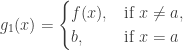
Suppose b,c\in Y are distinct limits. Hence the functions g_1, g_2:X\to Y,

g_1(x) = \begin{cases} f(x), &\text{if } x\ne a,\\ b, &\text{if }x=a\end{cases} and g_2(x)=\begin{cases} f(x), &\text{if }x\ne a,\\ c &\text{if }x=a\end{cases}

are continuous. Pick open subsets U and V of Y, such that b\in U, c\in V and U\cap V=\emptyset. Now g_1^{-1}(U) = f^{-1}(U)\cup\{a\} must contain an open subset which contains a. Same for g_2^{-1}(V) = f^{-1}(V) \cup\{a\}. But since f^{-1}(U)\cap f^{-1}(V) = f^{-1}(U\cap V)=\emptyset, the intersection of these two open subsets is {a}, which contradicts the second condition. ♦

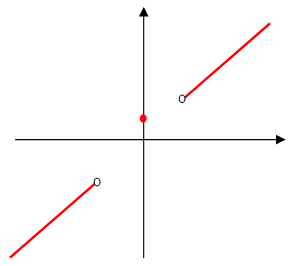
Note: it’s easy to find a counter-example when {a} is open in X. In an earlier article, we saw the following:

kindacontinuous

Here X=(-\infty, -1)\cup \{0\}\cup (1, \infty) and fX-{0} → R is defined by f(x)=x. But because {0} is an open subset of Xf(0) can take any value without violating its continuity.

Posted in Notes | Tagged , , , , , , , | Leave a comment

Topology: Continuous Maps

Continuity in Metric Spaces

Following the case of real analysis, let’s define continuous functions via the usual ε-δ definition.

Definition. Let (X, d) and (Y, d’) be two metric spaces. A function f : X → Y is said to be continuous at a\in X if:

  • for each ε>0, there exists δ>0 such that whenever x\in X satisfies d(x, a) < δ, we have d’(f(x), f(a)) < ε.

Equivalently, we can replace the condition “whenever … ” by the set-theoretic statement f(N_d(a, \delta))\subseteq N_{d'}(f(a), \epsilon) which is often more convenient.

If f is continuous at every a, we just say that f is continuous.

continuity_metric

Theorem. The function f : X → Y is continuous at a iff for any open subset V\subseteq Y containing f(a), there’s an open subset U\subseteq f^{-1}(V) containing a.

In particular, f is continuous if and only if for any open subset V\subseteq Y, the pull-back f^{-1}(V)\subseteq X is open.

Proof.

Suppose f is continuous at a. If V is an open subset of Y containing f(a), then N_{d'}(f(a),\epsilon)\subseteq V for some ε>0. By continuity at a, there exists δ>0 such that f(N_d(a,\delta))\subseteq N_{d'}(f(a),\epsilon). Hence N_d(a,\delta) \subseteq f^{-1}(V) is an open subset containing a.

For the converse, suppose the stated condition holds. Given ε>0, V := N_{d'}(f(a),\epsilon) is an open subset of Y containing f(a), so there is an open U\subseteq f^{-1}(V) containing a. Since U is open, there’s an open ball N(a,\delta)\subseteq U. It thus follows that f(N(a,\delta))\subseteq V.

For the second statement, suppose f is continuous and V\subseteq Y is open. By what we just proved, each element a of U:= f^{-1}(V) is contained in an open subset U_a \subseteq X which is contained in U. Thus U is a union of open subsets and is hence open.

Conversely, suppose whenever V\subseteq Y is open, so is U:=f^{-1}(V)\subseteq X. Let a be any point in X. From what we just proved, f is continuous at a. ♦

The theorem tells us that continuity is fundamentally a statement on the underlying topologies. In other words, if f : (Xd) → (Yd’) is a continuous map of metric spaces, then we can replace d or d’ by any topologically equivalent metric and it wouldn’t make any difference.

Next, we prove that the metric itself is continuous (considering this map is so fundamental, it’d be pretty weird if it weren’t).

Proposition. In a metric space (X, d), the map d:X\times X\to\mathbf{R} is continuous.

Proof

First, recall that there’s no fixed way of defining a metric on X × X, so we pick one of the many topologically equivalent ones, say d_1((x,y), (x',y')) = d(x,x') + d(y,y').

Let (x,y)\in X\times X. To show continuity at that point, suppose ε>0. Letting δ = ε/2, we see that whenever d_1((x, y), (x',y')) < \delta, we have: d(xx’) < δ and d(yy’) < δ and thus the triangular inequality gives:

  • d(xy) – d(x’y’) ≤ d(y’y) + d(xx’) < 2δ = ε;
  • d(x’y’) – d(xy) ≤ d(yy’) + d(x’x) < 2δ = ε.

Hence, |d(x’y’) – d(xy)| ≤ ε. This shows d is continuous at (xy). ♦

Note

In addition, we had already proved that the standard arithmetic operations on real numbers are continuous. Thus, addition and product \mathbf{R}\times \mathbf{R}\to \mathbf{R} are continuous, as is reciprocal \mathbf{R}^*\to\mathbf{R}^*.

blue-lin

Continuity in Topology

Since the notion of continuity can be described by open sets, let’s generalise it to topological spaces.

Definition. Let X and Y be topological spaces. A function f : X → Y on the underlying sets is said to be continuous at a\in X if:

  • for any open subset V\subseteq Y containing f(a), there’s an open subset U\subseteq f^{-1}(V) containing a.

In particular, f is continuous (at every point of X) if for any open V\subseteq Y, the pullback f^{-1}(V) is open in X.

The following properties of continuity are obvious for any topological spaces XY and Z.

  • The identity map id : X→ X is continuous.
  • If fX → Y is continuous at x and gY → Z is continuous at f(x), then gfX → Z is continuous at x.
  • If T and T’ are both topologies on X, then id : (XT) → (XT’) is continuous if and only if T is finer than T’.

 From the third property, one sees that if fX → Y is bijective and continuous, the inverse f^{-1} may not be continuous. Specifically, if T is strictly finer than T’, then the identity map (XT) → (XT’) is continuous but (XT’) → (XT) is not. Recall that if f : X → Y is bijective, continuous and has a continuous inverse, then we say f is a homeomorphism, in which case we get a bijection between the collection of open subsets of X and that of Y.

To check that a map is continuous, we don’t have to look at every open subset of Y.

Proposition. Let f : X→ Y be a map of topological spaces and S'\subseteq \mathbf{P}(Y) be a subbasis of Y. Then f is continuous iff for any V\in S', f^{-1}(V) \subseteq X is open.

Proof.

The forward direction is obvious. The converse follows from the fact that the pullback preserves arbitrary intersection and union:

f^{-1}(W_1 \cap W_2 \cap\ldots \cap W_k) = f^{-1}(W_1) \cap f^{-1}(W_2) \cap\ldots \cap f^{-1}(W_k),

f^{-1}(\cup V_i) = \cup_i f^{-1}(V_i). ♦

For example, to check that fX → R is continuous, it only suffices to prove that f^{-1}((a, \infty)) and f^{-1}((-\infty, b)) are open in X for any real ab.

Next, we wish to prove that the standard maps are continuous.

Proposition.

  • If Y\subseteq X is a subspace of a topological space, then the inclusion map i:Y\hookrightarrow X is continuous.
  • If X and Y are topological spaces, then the projection maps p_1: X\times Y\to X and p_2 : X\times Y\to Y are continuous.
  • If X_i is a collection of topological spaces and X=\coprod_i X_i is the disjoint union, then every inclusion map \iota_i : X_i \to X is continuous.

Proof

For the first statement, each open U\subseteq X pulls back to i^{-1}(U) = U\cap Y which is open in Y by definition of subspace. For the second statement, each open U\subseteq X pulls back to p_1^{-1}(U) = U\times Y which is open in X × Y by definition of product space. For the last statement, each open subset U =\coprod_i U_i of X pulls back to \iota_i^{-1}(U) = U_i which is open in Xi. ♦

In retrospect, one could even define topological spaces specifically to satisfy the above properties. And one defines the topology “just enough” such that the properties are satisfied. This will be expounded in a separate article.

Finally, we wish to show that continuity of a function depends “locally” on small neighbourhoods.

Theorem. If f:X \to Y is a function of topological spaces and X=\cup_i U_i is a union of open subsets U_i \subseteq X, then

  • f is continuous if and only if f|_{U_i} : U_i \to Y is continuous for every i.

Proof.

The forward direction is easy: since the inclusion map \iota_i:U_i \hookrightarrow X is continuous, so is the composition f\circ\iota_i = f|_{U_i}. Conversely, suppose each f|_{U_i} is continuous. Let V be an open subset of Y. Then

f^{-1}(V) = \cup_i (f^{-1}(V) \cap U_i) = \cup_i (f|_{U_i})^{-1}(V).

Now each (f|_{U_i})^{-1}(V) is open in U_i which is in turn open in X. Thus, (f|_{U_i})^{-1}(V) is open in X. So f^{-1}(V), being a union of open subsets of X, is open in X. ♦

Exercises

  1. Suppose f : X → Y is a continuous function of topological spaces and X_1\subseteq X and Y_1\subseteq Y are subspaces such that f(X_1)\subseteq Y_1. Prove that the restriction g := f|_{X_1} : X_1\to Y_1 is also continuous.
  2. Suppose fX1 → Y1 and gX2 → Y2 are continuous maps. Then the concatenation h:X_1\times X_2 \to Y_1\times Y_2, which takes (x_1, x_2)\mapsto (f(x_1), g(x_2)), is also continuous.
  3. Let Y be a topological space written as a union of subspaces Y = \cup_i X_i. Prove that we get a continuous map \coprod_i X_i \to Y which takes an element x_i \in X_i to the corresponding image in Y.

Answers (Highlight to read)

  1. Let V1 be an open subset of Y1. So we have V1 = V ∩ Y1 for some open subset V of Y. Then g-1(V1) = f-1(V) ∩ X1; by continuity of ff-1(V) is open in X, so f-1(V) ∩ X1 is open in X1.
  2. Let U1 and U2 be open subsets of Y1 and Y2 respectively; thus U1 × U2 is a basic open subset of Y1 × Y2. Then h-1(U1 × U2) = f-1(U1) × g-1(U2) which is open in X1 × X2 since f and g are continuous. Thus the result follows.
  3. Let V be an open subset of Y. The inverse image in disjoint union of Xi is the disjoint union of Ui, where each Ui = Xi ∩ V is open in Xi by definition of subspace.
Posted in Notes | Tagged , , , , , , , | Leave a comment

Topology: Disjoint Unions

Disjoint Unions

Let X and Y be topological spaces and Z := X \coprod Y be a set-theoretic disjoint union. We wish to define a topology on Z in a most natural way.

Definition. The topology on Z := X \coprod Y is defined to be:

T = \{U \coprod V : U \subseteq X, V \subseteq Y \text{ open }\}.

It’s almost trivial to check that this satisfies the axioms of a topology. E.g. to check T is closed under union of arbitrarily many elements, we have

\cup_i (U_i \coprod V_i) = (\cup_i U_i)\coprod (\cup_i V_i) \in T.

Pictorially, the definition for T is quite straight-forward. One imagines placing the two spaces side-by-side and separate them by an insurmountable gulf.

disjoint_union_spacesMore generally, one can take the disjoint union of an arbitrary collection of topological spaces X = \coprod_i X_i, where the open subsets of U are precisely those of the form U = \coprod_i U_i for open subsets U_i\subseteq X_i.

The bases and subbases of Xi give rise to that of X in a natural manner:

Proposition. Let X_i be a collection of topological spaces and X := \coprod_i X_i.

  • If B_{X_i} is a basis of X_i for each i, then B:=\coprod_i B_{X_i} is a basis for X.
  • If S_{X_i} is a basis of X_i for each i, then S:=\coprod_i S_{X_i} is a basis for X.

Proof (of first property)

Let T be the topology for X obtained via disjoint union. Clearly, each B_{X_i}\subseteq T since an open subset of Xi is also open in X. Thus B\subseteq T. Conversely, every open subset U of X is a (disjoint) union of open subsets of Xi, each of which is a union of elements of B_{X_i}. Hence U is a union of elements from B and B is a basis for T. ♦

The proof for the second property is similar and we won’t repeat ourselves. Since the disjoint union can be thought of as “addition” between topological spaces, it shouldn’t surprise us to find the distributive property for product.

Theorem (Distributive Property). Let X, Y_i be a collection of topological spaces. Then:

X \times (\coprod_i Y_i) \cong \coprod_i (X\times Y_i).

Proof.

We clearly have a set-theoretical bijection between both sides. It remains to see that the collection of open subsets on both sides correspond.

Now, a basis of the LHS is given by U\times (\coprod_i V_i) for some open subsets U\subseteq X, V_i\subseteq Y_i. But this is just \coprod_i (U\times V_i) and since each U\times V_i\subseteq X\times Y_i is open, so is their (disjoint) union. Thus, the LHS topology is contained in the RHS.

Conversely, a basis of the each term X\times Y_i of the RHS is given by \{U\times V_i\}, where U\subseteq X, V_i\subseteq Y_i are open. By the above proposition, the set \cup_i \{U\times V_i : U\subseteq X, V_i\subseteq Y_i\}  is a basis of RHS. Since each element of this basis is open in LHS, the RHS topology is contained in the LHS. ♦

Note.

The fact that multiplication is distributive over an infinite sum should not be taken for granted. Indeed, the corresponding case for algebra requires careful consideration of convergence on both sides.

Corollary. Let X be a topological space. If I is an index set, endowed with the discrete topology, then X × I is isomorphic to  a disjoint union of \{X_i\}_{i\in I}, where each X_i \cong X.

Proof.

Consider the singleton set {i} with the obvious topology. Now I is the disjoint union of {i}, over i\in I. Hence:

X \times I \cong X\times \left(\coprod_{i\in I} \{i\}\right)\cong \coprod_{i\in I} \left(X \times \{i\}\right),

where each component in the rightmost expression is isomorphic to X. ♦

blue-linMetrisability of Disjoint Unions

Next, we’re interested in the following question.

If X and Y are metrisable topological spaces, is Z = X\coprod Y metrisable too?

On an intuitive level, the space Z comprises of components X and Y such that points x\in X, y\in Y in different components are extremely far from each other. But one can’t set the distance between them to be infinite, since the metric can only take real values. [ One might understandably think of extending the metric function to include infinite distances, or even “nonstandard reals”, but that opens up a whole new can of worms. ]

However, it turns out that if X is a metrisable topological space, then we can pick a metric such that d(xy) < 1 for any xy in X.

Proposition. If (X, d) is a metric space, then the function d' : X\times X\to \mathbf{R}, d'(x, y) = \frac{d(x,y)}{1+d(x,y)} < 1, is also a metric.

Proof.

It suffices to show that if rst are non-negative real numbers satisfying r+s\ge t, then \frac{r}{1+r}+\frac{s}{1+s} \ge \frac{t}{1+t}. Since x\mapsto \frac{x}{1+x} is a strictly increasing function, we may assume tr+s. Then clearing denominators gives:

r(1+s)(1+r+s)+s(1+r)(1+r+s) - t(1+r)(1+s) = r^2 s + s^2 r + 2rs \ge 0.

Hence, if each Xi is a metrisable topological space, then we can pick a metric di which is bounded by 1. [ We say that a metric d on X is bounded by B if d(xy) ≤ B for any xy in X. ] Now we just define a metric on the disjoint union X := \coprod_i X_i via:

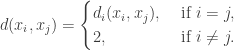
for x_i\in X_i, x_j \in X_j, we have d(x_i, x_j) = \begin{cases}d_i(x_i, x_j), &\text{ if } i=j,\\ 2,&\text{ if } i\ne j.\end{cases}

Let’s summarise what we’ve learnt in the last few paragraphs.

  1. If X is a metrisable metric space, then we may pick a metric which is bounded by 1. In other words, the condition that a metric is bounded is not a topological invariant.
  2. If each Xi is a metrisable topological space, then so is their disjoint union.

blue-linConnected Spaces

On the other hand, let’s start with some generic topological space X. We’d like to partition X as a disjoint union of topological subspaces. Note that if X:= \coprod_i X_i, then each X_i\subseteq X is an open subset. The following theorem shows that this suffices to characterise X as a disjoint union.

Theorem. Suppose X = \cup_i U_i, where each U_i\subseteq X is open and U_i\cap U_j=\emptyset for any i≠j. Then X \cong \coprod_i U_i.

disjoint_union_decomposition

Example

Consider the subset Y=(-\infty, -1]\cup\{0\}\cup [1,\infty) of R. Then Y = U \cup V \cup W where U=(-\infty, -1], V = \{0\} and W = [1,\infty). Each of these sets is open in Y since

U=(-\infty, -1/2)\cap Y, V=(-1/2,+1/2)\cap Y and W=(1/2,\infty)\cap Y.

Since they form a disjoint union of Y, we have Y \cong U\coprod V\coprod W.

Proof.

From the inclusion maps U_i\hookrightarrow X, we get a set-theoretic map f:\coprod_i U_i \to X. The map is surjective since X is the union of Ui‘s. It is injective since any two distinct Ui‘s don’t intersect.

To show that f is a homeomorphism, each open subset of \coprod_i U_i is of the form \coprod_i V_i for open V_i\subseteq U_i. Since U_i\subseteq X is also open, we see that V_i\subseteq X is open. Thus f(\coprod V_i)=\cup_i V_i is open in X.

Conversely, if V is an open subset of X, then f^{-1}(V) = \coprod_i V_i, where V_i = V\cap U_i is open in Ui. Thus f^{-1}(V) = \coprod_i V_i is open in \coprod_i U_i. ♦

Note that in the theorem, each Ui is also closed since it’s complement is \cup_{j\ne i} U_j which is open. Thus the Ui are clopen subsets of X: if X is a disjoint union of more than one components, than each component is a clopen subset.

Conversely, suppose U\subseteq X is clopen such that U\ne X,\emptyset. Then X = U \cup (X-U) satisfies the conditions of the above theorem, so X \cong U \coprod (X-U). Hence, we have the following.

Corollary. If X has no non-trivial clopen subsets, then we cannot write X \cong Y_1 \coprod Y_2 in a non-trivial manner. When that happens, we say that X is connected.

In a nutshell, connected spaces are those which cannot be broken up any further into disjoint unions. We’ll be looking at these in greater detail later.

Posted in Notes | Tagged , , , , , , , | Leave a comment

Topology: Product Spaces (I)

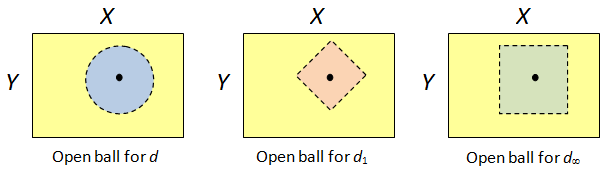
In this article, we consider the product of two topological spaces. To motivate our definition, we first begin with metric spaces (X, dX) and (Y, dY). Letting ZX × Y be the set-theoretic product, we wish to define a metric on Z from dX and dY. Here’re some possibilities, all of which seem rather reasonable. For any (x,y), (x',y')\in X\times Y, let:

  • d((x,y), (x',y')) = \sqrt{ d(x,x')^2 + d(y,y')^2};
  • d_1((x,y), (x', y')) = d_X(x,x') + d_Y(y,y');
  • d_\infty((x,y), (x',y')) = \max(d_X(x,x'), d_Y(y,y')).

three_metrics_for_product

It’s not hard to prove that all the above are metrics, but which one to choose? It turns out all these are topologically equivalent anyway. E.g. to show equivalence of d and d1, note that for any p, p'\in X\times Y,

d(p, p') \le d_1(p, p') and d_1(p, p') \le \sqrt 2 \cdot d(p, p').

Since this is not the main point, we’ll leave the details of the proof and the remaining cases to the reader. Instead, the point we wish to make is the following:

Theorem. The above metrics all define the topology T with basis given by

B= \{U\times V: U \text{ open in } X, V \text{ open in } Y\}.

Proof.

Since we can pick any metric and use the corresponding open balls as a basis, let’s pick:

\begin{aligned}N_{d_\infty}( (x,y),\epsilon) &= \{(x',y')\in X\times Y: d_X(x,x')<\epsilon \text{ and } d_Y(y,y')<\epsilon\}\\ &= N(x,\epsilon) \times N(y,\epsilon).\end{aligned}

Let B’ denote this collection of open balls. Clearly, B’ is contained in B. Conversely, each element of B is obviously a union of elements of B’. Thus, they generate the same topology. ♦

So let’s generalise the definition of product space to arbitrary topological spaces.

Definition. If X and Y are topological spaces, then the corresponding topology on X × Y is defined by the basis

B= \{U\times V: U \text{ open in } X, V \text{ open in } Y\}.

Note that in any topological space, our B is truly a basis since (i) the union of all elements of B is X × Y (in fact, X × Y lies in B), and (ii) the intersection of (U × V) and (U’ × V’) is (U ∩ U’) × (V ∩ V’) which is in B. So the definition is valid.

Note. If C\subseteq X, D\subseteq Y are closed subsets, then C × D is closed in X × Y, because its complement is ((X-C)\times Y) \cup (X\times (Y-D)), which is a union of two open subsets.

blue-lin

Relationship with Bases and Subbases

If we’re given bases or subbases of X and Y, then these can be used to define a corresponding basis or subbasis of X × Y.

Theorem. Let X and Y be topological spaces.

  • If BX and BY are given bases of X and Y respectively, then B=\{U\times V: U\in B_X, V\in B_Y\} is a basis of X × Y.
  • If SX and SY are given subbases of X and Y respectively, then S=\{U\times Y:U\in S_X\} \cup \{X\times V: V\in S_Y\} is a subbasis of X × Y.

basis_of_products

Proof.

For the first statement, we already saw that B' = \{U\times V: U \text{ open in } X, V\text{ open in } Y\} is a basis of X × Y. But since BX and BY are bases of X and Y,  we can write U = \cup_i U_i, V =\cup_j V_j for some U_i\in B_X, V_j\in B_Y. This gives U\times V = \cup_{i,j} (U_i\times V_j) so every element of B’ is expressible as a union of elements of B.

For the second, suppose finite intersections of SX (resp. SY) give the basis BX (resp. BY). Hence, if U\in B_X, V\in B_Y, we can write U = U_1\cap\ldots\cap U_m and V=V_1\cap \ldots\cap V_n for some U_i \in S_X, V_j\in S_Y. This gives U\times V = (U\times Y)\cap (X\times V) = \left(\cap_i (U_i\times Y)\right) \cap \left(\cap_j (X\times V_j)\right). Thus every element of the collection B =\{U\times V: U\in B_X, V\in B_Y\} is a finite intersection of elements of S; by the first statement, S is a subbasis for X × Y. ♦

Consistency of Successive Products

Next, let’s consider some basic properties on commutativity and associativity of products. Recall that we mentioned two topological spaces X and Y are homeomorphic if there’s a bijective map f : X → Y, such that a subset U of X is open if and only if f(U) is open in Y.

Proposition. Let X, Y, Z be topological spaces. Then the following spaces are homeomorphic.

  • X\times Y\cong Y\times X, via (x,y)\mapsto (y,x);
  • X\times (Y\times Z)\cong (X\times Y)\times Z, via (x, (y,z)) \mapsto ((x,y),z).

Proof.

The first property is obvious since the map takes U × V to V × U, for open subsets U\subseteq X, V\subseteq Y. For the second property, since B = {U × VU open in XV open in Y} is a basis for X × Y, the above theorem tells us that:

{(U × V) × WU open in XV open in Y, W open in Z}

is a basis for (X × Y) × Z. Likewise, the collection of U × (V × W) is a basis for X × (Y × Z). Since the above map takes (U × V) × W to U × (V × W), this gives a homeomorphism. ♦

From the proof, it follows that for the topology on X × Y × Z, one can take a basis comprising of U × V × W, for open subsets U\subseteq X, V\subseteq Y, W\subseteq Z. Also, given a finite number of topological spaces X_1, \ldots, X_k, one can unreservedly take their product X_1 \times \ldots \times X_k since product of topological spaces is commutative and associative.

Consistency with Subspace

Finally, we have the following.

Proposition. Let X, Y be topological spaces and X' \subseteq X, Y'\subseteq Y be subsets. One can define a topology on X’ × Y’ in two distinct ways.

  • Take subspace topologies on X’ and Y’, then form the product topology X’ × Y’.
  • Take the product topology on X × Y, then the subspace topology on X’ × Y’.

These two are identical.

Proof.

For the first case, the subspace topology on X’ is given by {U ∩ X’U open in X} and that on Y’ is given by {V ∩ Y’V open in Y}. Hence, the product topology on X’ × Y’ is given by the basis {(U ∩ X’) × (V ∩ Y’)}, for open subsets U of X and V of Y.

For the second case, the product topology on X × Y has basis U × V for open subsets U of X and V of Y. From our previous article, a basis on X’ × Y’ can thus be given by the collection of:

(U × V) ∩ (X’ × Y’) = (U ∩ X’) × (V ∩ Y’)

for open subsets U of X and V of Y. ♦

Examples

  1. The product of two (or finitely many) discrete topological spaces is still discrete. We’ll see later that this is not true for an infinite product of discrete spaces.
  2. The product of Rn and Rm, with topology given by the usual Euclidean metric, is Rn+m with the same topology. In particular, each Rn has the product topology of n copies of R.
  3. If X and Y are metrisable, then the initial paragraphs of this article show that X × Y is metrisable.
  4. Suppose X is any topological space and Y = {1, 2} with the discrete topology. Then the picture of X × Y is that of two identical copies of X. We’ll expound on disjoint unions in the next article.
  5. Let XS1, the set of points (x, y) in R2 satisfying x2 + y2 = 1. Then the space X × X is called a torus.
Posted in Notes | Tagged , , , , , | Leave a comment