
Modules
Having dipped our toes into algebraic geometry, we are back in commutative algebra.
Next we would like to introduce “linear algebra” over a ring A. Most of the proofs should pose no difficulty to the reader so we will skip them. We recommend that the reader prove these properties at least once.
Definition.
An A-module is an abelian group
together with a map
, written as
, such that the following hold for all
and
.
.
.
.
.
Alternative Look
If we fix 





In words, we say “addition is defined on the image and product is given by composition”.
Now that 
Easy Properties
Immediately, we can show the following:

E.g. a(-m) = -(am) because
Examples
1. Since the homomorphism 

2. A module over a field k is the same as a vector space over k.
3. Any ring A is a module over itself. More generally if 
4. If M and M’ are A-modules, then 

5. From examples 3 and 4, we get 

6. Let 


7. More generally for 


Basic Constructions
Just as we have subspaces of vector spaces, we have:
Definition.
If M is an A-module, a A-submodule is a subgroup N of
we have
.
And this gives:
Proposition 1.
Let N be an A-submodule of M. The quotient of
.
Thus we obtain the quotient module
.
Proof. Easy exercise. ♦
Next, we have the linear maps.
Definition.
Let M, N be A-modules. A module homomorphism is a function
such that
We will also say f is an A-linear map (or just linear map if the base ring is implicit).
A monomorphism (resp. epimorphism, isomorphism) of modules is an injective (resp. surjective, bijective) homorphism of modules.

Immediately we have the following.
First Isomorphism Theorem.
Let
- The kernel of f,
, is a submodule of M.
- The image of f,
, is a submodule of N.
- The map f induces an isomorphism of modules

Proof. Easy exercise. ♦
Exercise A
Let 


Ideals as Modules
Recall that every non-trivial ring A comes with two modules.
- The zero module is the trivial group (0, +), and
for all
- The ring A is a module over itself, where
is given by ring product
.
Lemma 1.
For any ring A, a subset of A is a submodule if and only if it is an ideal of A.
Proof. Easy exercise. ♦
Some Notes
Although the lemma is a trivial observation, it highlights an important philosophy: modules can be considered as a generalization of ideals. For an ideal 

Note that an ambiguity may arise if we were sloppy with words: for 


For readers with some experience with differentiable manifolds, another geometrical application of modules is as follows. Recall that closed sets V correspond with their coordinate ring k[V]. Modules over k[V] then correspond to “vector bundles” over the set V. Of special interest are those bundles which are “locally free”, i.e. close to each point the vector bundle restricts to a trivial one.
Operations on Submodules
Finally, the operations on ideals can be generalized.
Proposition 2.
Let
be a collection of submodules of M, over a ring A.
is a submodule of M.
- Let
be the set of all finite sums
, where
. This is a submodule of M.
- If
be the set of all finite sums
for
and
. This is a submodule of M.
Proof. Easy exercise. ♦
Exercise B
An A-module is said to be simple if it is non-zero and its only submodules are 0 and itself. Prove that a simple A-module must be isomorphic to 

Note
When M = A and each 
Note that product of submodules is not defined since we cannot multiply elements in a module. But as we shall see later, one can forcibly define a “product space” P for modules M and N so that 

The next result is important, so we will state it separately.
Proposition 3.
If M is an A-module and
has a canonical structure of an
-module, via
.
Proof. Easy exercise. ♦
Proposition 3 shows a “canonical” way of constructing a module over
 be a morphism of closed sets, with corresponding
 ![f^* : k[W] \to k[V]](https://s0.wp.com/latex.php?latex=f%5E%2A+%3A+k%5BW%5D+%5Cto+k%5BV%5D&bg=ffffff&fg=333333&s=0&c=20201002) .
. is injective if and only if
  is dense.
 is an embedding of V as a closed subspace of W.
 of topological spaces is called an embedding if f is injective and the topology of subspace of X is induced via the subspace topology from Y. For a non-example, the map
![f : (-1, 0] \cup (1, 2) \to \mathbb R, \ f(x) = \begin{cases} x+1, \ &\text{if } x \le 0,\\ x, \ &\text{if } x > 0,\end{cases}](https://s0.wp.com/latex.php?latex=f+%3A+%28-1%2C+0%5D+%5Ccup+%281%2C+2%29+%5Cto+%5Cmathbb+R%2C+%5C+f%28x%29+%3D+%5Cbegin%7Bcases%7D+x%2B1%2C+%5C%C2%A0+%26%5Ctext%7Bif+%7D+x+%5Cle+0%2C%5C%5C+x%2C+%5C+%26%5Ctext%7Bif+%7D+x+%3E+0%2C%5Cend%7Bcases%7D&bg=ffffff&fg=333333&s=0&c=20201002)
 , if
, if  then
then  . This is equivalent to: if g vanishes on f(V), then it vanishes on the whole of W.
 this holds since g is continuous.
 , then
  so there exists
  , i.e. g vanishes on W’ (and hence f(V)) but not W.
![k[W] \stackrel \pi\longrightarrow k[W]/\mathfrak a \stackrel \phi\longrightarrow k[V]](https://s0.wp.com/latex.php?latex=k%5BW%5D+%5Cstackrel+%5Cpi%5Clongrightarrow+k%5BW%5D%2F%5Cmathfrak+a+%5Cstackrel+%5Cphi%5Clongrightarrow+k%5BV%5D&bg=ffffff&fg=333333&s=0&c=20201002)
![\mathfrak a\subseteq k[W]](https://s0.wp.com/latex.php?latex=%5Cmathfrak+a%5Csubseteq+k%5BW%5D&bg=ffffff&fg=333333&s=0&c=20201002) and isomorphism
and isomorphism  , where
  is the canonical map. Since k[V] is a reduced ring, such an
  for some closed subset
  . ♦
. ♦ , where
  . Algebraically
![f^* : k[T] \to k[X, Y]/(XY - 1) \cong k[X, \frac 1 X],\quad T \mapsto X.](https://s0.wp.com/latex.php?latex=f%5E%2A+%3A+k%5BT%5D+%5Cto+k%5BX%2C+Y%5D%2F%28XY+-+1%29+%5Ccong+k%5BX%2C+%5Cfrac+1+X%5D%2C%5Cquad+T+%5Cmapsto+X.&bg=ffffff&fg=333333&s=0&c=20201002)
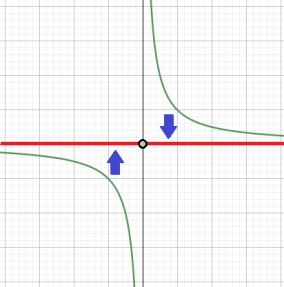
 which is dense in
  ; correspondingly
  . We take the following set
 .
. and
and  . Indeed if x, y, z are complex values and
  ,
,  and
and  , then either x = 0 (in which case y = z = 0), or we set t := y/x to obtain
 , then we just saw that
  ,
,  and
and 
 be the ideal generated by these 3 elements; we will show that
  . Now let
 ![B := k[X,Y,Z]/\mathfrak b](https://s0.wp.com/latex.php?latex=B+%3A%3D+k%5BX%2CY%2CZ%5D%2F%5Cmathfrak+b&bg=ffffff&fg=333333&s=0&c=20201002) ; we claim that B is spanned by
; we claim that B is spanned by ![k[X]](https://s0.wp.com/latex.php?latex=k%5BX%5D&bg=ffffff&fg=333333&s=0&c=20201002) ,
, ![k[X]Y](https://s0.wp.com/latex.php?latex=k%5BX%5DY&bg=ffffff&fg=333333&s=0&c=20201002) and
and ![k[X]Z](https://s0.wp.com/latex.php?latex=k%5BX%5DZ&bg=ffffff&fg=333333&s=0&c=20201002) as a k-vector space.
as a k-vector space. and
and  , we can replace any monomial modulo
  by
by  where j = 0, 1 and k = 0, 1.
 we are done.
 where
where  corresponds to the homomorphism
![f^* : k[X,Y,Z]/\mathfrak a \longrightarrow k[T], \quad X \mapsto T^3, Y \mapsto T^4, Z \mapsto T^5.](https://s0.wp.com/latex.php?latex=f%5E%2A+%3A+k%5BX%2CY%2CZ%5D%2F%5Cmathfrak+a+%5Clongrightarrow+k%5BT%5D%2C+%5Cquad+X+%5Cmapsto+T%5E3%2C+Y+%5Cmapsto+T%5E4%2C+Z+%5Cmapsto+T%5E5.&bg=ffffff&fg=333333&s=0&c=20201002)
 , we obtain the composition
![B = k[X,Y,Z]/\mathfrak b\longrightarrow k[X,Y,Z]/\mathfrak a \longrightarrow k[T]](https://s0.wp.com/latex.php?latex=B+%3D+k%5BX%2CY%2CZ%5D%2F%5Cmathfrak+b%5Clongrightarrow+k%5BX%2CY%2CZ%5D%2F%5Cmathfrak+a+%5Clongrightarrow+k%5BT%5D&bg=ffffff&fg=333333&s=0&c=20201002)
![k[T^3]](https://s0.wp.com/latex.php?latex=k%5BT%5E3%5D&bg=ffffff&fg=333333&s=0&c=20201002) ,
, ![k[T^3]T^4](https://s0.wp.com/latex.php?latex=k%5BT%5E3%5DT%5E4&bg=ffffff&fg=333333&s=0&c=20201002) and
and ![k[T^3]T^5](https://s0.wp.com/latex.php?latex=k%5BT%5E3%5DT%5E5&bg=ffffff&fg=333333&s=0&c=20201002) of
of ![k[T]](https://s0.wp.com/latex.php?latex=k%5BT%5D&bg=ffffff&fg=333333&s=0&c=20201002) . These spaces are linearly independent over k so the composed map is injective. Hence, the first map is injective and we see that
. These spaces are linearly independent over k so the composed map is injective. Hence, the first map is injective and we see that ![A := k[S^4, S^3 T, ST^3, T^4]](https://s0.wp.com/latex.php?latex=A+%3A%3D+k%5BS%5E4%2C+S%5E3+T%2C+ST%5E3%2C+T%5E4%5D&bg=ffffff&fg=333333&s=0&c=20201002) of k[S, T]. Consider the k-algebra homomorphism:
of k[S, T]. Consider the k-algebra homomorphism:![\phi : k[W, X, Y, Z] \longrightarrow A, \quad W \mapsto S^4, X \mapsto S^3 T, Y \mapsto ST^3, Z \mapsto T^4.](https://s0.wp.com/latex.php?latex=%5Cphi+%3A+k%5BW%2C+X%2C+Y%2C+Z%5D+%5Clongrightarrow+A%2C+%5Cquad+W+%5Cmapsto+S%5E4%2C+X+%5Cmapsto+S%5E3+T%2C+Y+%5Cmapsto+ST%5E3%2C+Z+%5Cmapsto+T%5E4.&bg=ffffff&fg=333333&s=0&c=20201002)
![k[W, Z] \to K[W,X,Y,Z]/\mathfrak a](https://s0.wp.com/latex.php?latex=k%5BW%2C+Z%5D+%5Cto+K%5BW%2CX%2CY%2CZ%5D%2F%5Cmathfrak+a&bg=ffffff&fg=333333&s=0&c=20201002) is an injection.
is an injection.![k[S^4, T^4] \hookrightarrow k[S^4, S^3 T, ST^3, T^4]](https://s0.wp.com/latex.php?latex=k%5BS%5E4%2C+T%5E4%5D+%5Chookrightarrow+k%5BS%5E4%2C+S%5E3+T%2C+ST%5E3%2C+T%5E4%5D&bg=ffffff&fg=333333&s=0&c=20201002) and the homomorphism
and the homomorphism ![k[W, Z] \to k[S^4, T^4]](https://s0.wp.com/latex.php?latex=k%5BW%2C+Z%5D+%5Cto+k%5BS%5E4%2C+T%5E4%5D&bg=ffffff&fg=333333&s=0&c=20201002) is an isomorphism. Now
is an isomorphism. Now ![k[S^4, T^4]](https://s0.wp.com/latex.php?latex=k%5BS%5E4%2C+T%5E4%5D&bg=ffffff&fg=333333&s=0&c=20201002) has basis given by
has basis given by  for all
  . Let us compute a small set of monomial representatives
  such that
![k[S^4, S^3 T, ST^3, T^4] = \sum_i k[S^4, T^4] m_i](https://s0.wp.com/latex.php?latex=k%5BS%5E4%2C+S%5E3+T%2C+ST%5E3%2C+T%5E4%5D+%3D+%5Csum_i+k%5BS%5E4%2C+T%5E4%5D+m_i&bg=ffffff&fg=333333&s=0&c=20201002)
 . For these we take
 .
. . But then
 ![S^4 T^4 \in k[S^4, T^4]](https://s0.wp.com/latex.php?latex=S%5E4+T%5E4+%5Cin+k%5BS%5E4%2C+T%5E4%5D&bg=ffffff&fg=333333&s=0&c=20201002) so we leave out this term and take
so we leave out this term and take .
. . But
. But ![S^7 T^5, S^3 T^9 \in k[S^4, T^4] m_2](https://s0.wp.com/latex.php?latex=S%5E7+T%5E5%2C+S%5E3+T%5E9+%5Cin+k%5BS%5E4%2C+T%5E4%5D+m_2&bg=ffffff&fg=333333&s=0&c=20201002) and
and ![S^5 T^7, S^9 T^3 \in k[S^4, T^4] m_3](https://s0.wp.com/latex.php?latex=S%5E5+T%5E7%2C+S%5E9+T%5E3+%5Cin+k%5BS%5E4%2C+T%5E4%5D+m_3&bg=ffffff&fg=333333&s=0&c=20201002) so there are no new terms added.
so there are no new terms added.![B = k[S^4, T^4]](https://s0.wp.com/latex.php?latex=B+%3D+k%5BS%5E4%2C+T%5E4%5D&bg=ffffff&fg=333333&s=0&c=20201002) we have shown
we have shown

![k[W, X, Y, Z]/\mathfrak b \to A](https://s0.wp.com/latex.php?latex=k%5BW%2C+X%2C+Y%2C+Z%5D%2F%5Cmathfrak+b+%5Cto+A&bg=ffffff&fg=333333&s=0&c=20201002) is injective.
is injective.![f(W,X,Y,Z) \in k[W,X,Y,Z]](https://s0.wp.com/latex.php?latex=f%28W%2CX%2CY%2CZ%29+%5Cin+k%5BW%2CX%2CY%2CZ%5D&bg=ffffff&fg=333333&s=0&c=20201002) .
. with
with  and
and  with
with  modulo
 ![\sum k[W, Z]X^i Y^j](https://s0.wp.com/latex.php?latex=%5Csum+k%5BW%2C+Z%5DX%5Ei+Y%5Ej&bg=ffffff&fg=333333&s=0&c=20201002) where the sum is over
where the sum is over  ,
,  .
. with
with  modulo
  .
. with
with  , we have
  where
where![g \in k[W, Z] + k[W, Z] X + k[W, Z] X^2 + k[W, Z] Y + k[Z] Y^2.](https://s0.wp.com/latex.php?latex=g+%5Cin+k%5BW%2C+Z%5D+%2B+k%5BW%2C+Z%5D+X+%2B+k%5BW%2C+Z%5D+X%5E2+%2B+k%5BW%2C+Z%5D+Y+%2B+k%5BZ%5D+Y%5E2.&bg=ffffff&fg=333333&s=0&c=20201002)
 , then
  so
so  . By looking at the monomials occuring, this can only happen for g = 0. This proves:
![k[W,X,Y,Z]](https://s0.wp.com/latex.php?latex=k%5BW%2CX%2CY%2CZ%5D&bg=ffffff&fg=333333&s=0&c=20201002) ?
? .
. and
and  are closed subsets. A morphism
  is a function which can be expressed as:
![f_1, f_2, \ldots, f_m \in k[X_1, \ldots, X_n]](https://s0.wp.com/latex.php?latex=f_1%2C+f_2%2C+%5Cldots%2C+f_m+%5Cin+k%5BX_1%2C+%5Cldots%2C+X_n%5D&bg=ffffff&fg=333333&s=0&c=20201002) . We also say f is a regular map.
. We also say f is a regular map. be any closed subset. Regular maps of the form
  are given by polynomials
 ![f \in k[X_1, \ldots, X_n]](https://s0.wp.com/latex.php?latex=f+%5Cin+k%5BX_1%2C+%5Cldots%2C+X_n%5D&bg=ffffff&fg=333333&s=0&c=20201002) .
. and
and  . Define
  . We write this as
  .
. . Define
  . We write this as
  .
.
 .
.![k[V]](https://s0.wp.com/latex.php?latex=k%5BV%5D&bg=ffffff&fg=333333&s=0&c=20201002) .
.![f\in k[X_1, \ldots, X_n]](https://s0.wp.com/latex.php?latex=f%5Cin+k%5BX_1%2C+%5Cldots%2C+X_n%5D&bg=ffffff&fg=333333&s=0&c=20201002) and two polynomials
and two polynomials 
![k[V] \cong k[X_1, \ldots, X_n]/I(V)](https://s0.wp.com/latex.php?latex=k%5BV%5D+%5Ccong+k%5BX_1%2C+%5Cldots%2C+X_n%5D%2FI%28V%29&bg=ffffff&fg=333333&s=0&c=20201002) , which gives k[V] its ring structure. To describe this ring structure in terms of regular functions, we have:
, which gives k[V] its ring structure. To describe this ring structure in terms of regular functions, we have:
 be closed. There is a bijection between:
![k[W] \to k[V]](https://s0.wp.com/latex.php?latex=k%5BW%5D+%5Cto+k%5BV%5D&bg=ffffff&fg=333333&s=0&c=20201002) is a homomorphism of k-algebras. In a later article, we will cover algebras over a ring in greater detail.
is a homomorphism of k-algebras. In a later article, we will cover algebras over a ring in greater detail. , we obtain a regular function
  of V. This gives a ring homomorphism
 ![\phi : k[W] \to k[V]](https://s0.wp.com/latex.php?latex=%5Cphi+%3A+k%5BW%5D+%5Cto+k%5BV%5D&bg=ffffff&fg=333333&s=0&c=20201002) is a ring homomorphism which is linear over k. Let
is a ring homomorphism which is linear over k. Let  be the images of
  in
in ![k[W] = k[X_1, \ldots, X_m]/I(W)](https://s0.wp.com/latex.php?latex=k%5BW%5D+%3D+k%5BX_1%2C+%5Cldots%2C+X_m%5D%2FI%28W%29&bg=ffffff&fg=333333&s=0&c=20201002) . Let
. Let ![f_i = \phi(\overline X_i) \in k[V]](https://s0.wp.com/latex.php?latex=f_i+%3D+%5Cphi%28%5Coverline+X_i%29+%5Cin+k%5BV%5D&bg=ffffff&fg=333333&s=0&c=20201002) which is a regular function
which is a regular function 
![g\in I(W)\subseteq k[X_1, \ldots, X_m]](https://s0.wp.com/latex.php?latex=g%5Cin+I%28W%29%5Csubseteq+k%5BX_1%2C+%5Cldots%2C+X_m%5D&bg=ffffff&fg=333333&s=0&c=20201002) we have
we have
 in k[W]. This creates a bijection. ♦
 we require
  with
with  then
then
![(1_V)^* = 1_{k[V]}](https://s0.wp.com/latex.php?latex=%281_V%29%5E%2A+%3D+1_%7Bk%5BV%5D%7D&bg=ffffff&fg=333333&s=0&c=20201002) .
. of closed sets we have
![(g\circ f)^* =f^* \circ g^* : k[V''] \longrightarrow k[V].](https://s0.wp.com/latex.php?latex=%28g%5Ccirc+f%29%5E%2A+%3Df%5E%2A+%5Ccirc+g%5E%2A+%3A+k%5BV%27%27%5D+%5Clongrightarrow+k%5BV%5D.&bg=ffffff&fg=333333&s=0&c=20201002)
![h\in k[V'']](https://s0.wp.com/latex.php?latex=h%5Cin+k%5BV%27%27%5D&bg=ffffff&fg=333333&s=0&c=20201002) , a regular map
, a regular map  . Then
 . ♦
. ♦ .
.![f^* : k[X, Y, Z]/(X^2 + Y^2 - Z^2) \longrightarrow k[T], \quad X \mapsto T^2 - 1, Y \mapsto 2T, Z \mapsto T^2 + 1.](https://s0.wp.com/latex.php?latex=f%5E%2A+%3A+k%5BX%2C+Y%2C+Z%5D%2F%28X%5E2+%2B+Y%5E2+-+Z%5E2%29+%5Clongrightarrow+k%5BT%5D%2C+%5Cquad+X+%5Cmapsto+T%5E2+-+1%2C+Y+%5Cmapsto+2T%2C+Z+%5Cmapsto+T%5E2+%2B+1.&bg=ffffff&fg=333333&s=0&c=20201002)

![f^* : k[X,Y]/(Y^2 - X^3) \longrightarrow k[T], \quad X \mapsto T^2, Y \mapsto T^3.](https://s0.wp.com/latex.php?latex=f%5E%2A+%3A+k%5BX%2CY%5D%2F%28Y%5E2+-+X%5E3%29+%5Clongrightarrow+k%5BT%5D%2C+%5Cquad+X+%5Cmapsto+T%5E2%2C+Y+%5Cmapsto+T%5E3.&bg=ffffff&fg=333333&s=0&c=20201002)
 is a continuous map, with respect to the subspace topology on both sets.
 . We need to show
  is closed in V (equivalently, in
  . Now W’ can be written as
![S' \subseteq k[X_1, \ldots, X_m]](https://s0.wp.com/latex.php?latex=S%27+%5Csubseteq+k%5BX_1%2C+%5Cldots%2C+X_m%5D&bg=ffffff&fg=333333&s=0&c=20201002) . It follows that
. It follows that
 . Hence
  and
and  such that
  and
and  .
.![f^* : k[W] \to k[V],\ g^* : k[V] \to k[W], \quad f^*\circ g^* = 1_{k[V]}, \ g^* \circ f^* = 1_{k[W]}.](https://s0.wp.com/latex.php?latex=f%5E%2A+%3A+k%5BW%5D+%5Cto+k%5BV%5D%2C%5C+g%5E%2A+%3A+k%5BV%5D+%5Cto+k%5BW%5D%2C+%5Cquad+f%5E%2A%5Ccirc+g%5E%2A+%3D+1_%7Bk%5BV%5D%7D%2C+%5C+g%5E%2A+%5Ccirc+f%5E%2A+%3D+1_%7Bk%5BW%5D%7D.&bg=ffffff&fg=333333&s=0&c=20201002)
 is defined by
  . Note that f is bijective on the points, and it corresponds to:
 There exist bijective regular maps
  which are not isomorphisms.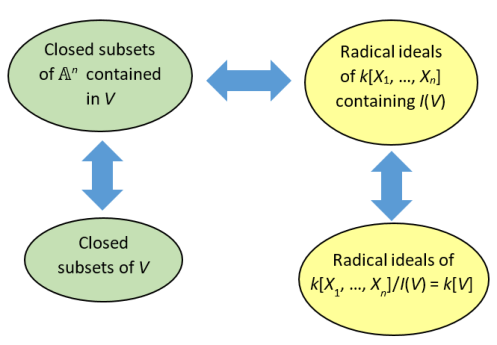
 is a reduced ring; now apply
  .
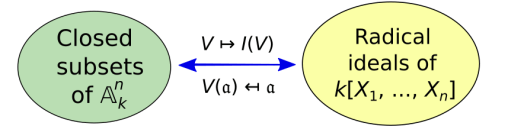
.![A = k[X_1, \ldots, X_n]](https://s0.wp.com/latex.php?latex=A+%3D+k%5BX_1%2C+%5Cldots%2C+X_n%5D&bg=ffffff&fg=333333&s=0&c=20201002) and closed subsets of
and closed subsets of  .
.
 if and only if
  . Not too surprisingly, operations on ideals translate to operations on the corresponding closed subsets.
 correspond to radical ideals
  .
. corresponds to
  .
. corresponds to
  .
. for any j, we have
  and thus
  .
. , then any
  gives
gives  for some n > 0 so
  is a finite sum of terms
  . Each such
  so
so  and thus
  . We have shown:
  .
. .
. we have
  . Likewise
  and we have shown ⊆.
 lies outside S and T then there exist
  such that
  and thus
  . Since
  this gives
  .
. . And since
  from
from ![e_P : A = k[X_1, \ldots, X_n] \longrightarrow k, \quad f \mapsto f(P)](https://s0.wp.com/latex.php?latex=e_P+%3A+A+%3D+k%5BX_1%2C+%5Cldots%2C+X_n%5D+%5Clongrightarrow+k%2C+%5Cquad+f+%5Cmapsto+f%28P%29&bg=ffffff&fg=333333&s=0&c=20201002)
 is a maximal ideal. By definition
  .
. , since
  its corresponding subset
  by the
  we get
  . By maximality of
  equality holds so S = {P}. ♦
 then
then  .
. have union X, then C = X or C’ = X.
 . Then
  and
and  are closed subsets of V and
  . Thus
  so we have
  .
. for a prime ideal
  . Let
. Let  be closed subsets (of V, and hence of
  for radical ideals
 corresponds to the ideal
  and we have
  . It remains to prove the following, which we will leave as an easy exercise. ♦
 are ideals of any ring A with
  prime. If
  and
and  or
or  .
. and
and  . Geometrically this gives the points of intersection between
  (a circle) and
  (a line). Clearly, we get two points (1, 1) and (-1, -1).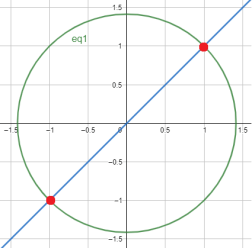
![\mathfrak a = (X^2 + Y^2 - 2, X - Y) \subset \mathbb C[X, Y]](https://s0.wp.com/latex.php?latex=%5Cmathfrak+a+%3D+%28X%5E2+%2B+Y%5E2+-+2%2C+X+-+Y%29+%5Csubset+%5Cmathbb+C%5BX%2C+Y%5D&bg=ffffff&fg=333333&s=0&c=20201002) . We have
. We have  so it remains to show that
 ![\mathbb C[X, Y]/\mathfrak a](https://s0.wp.com/latex.php?latex=%5Cmathbb+C%5BX%2C+Y%5D%2F%5Cmathfrak+a&bg=ffffff&fg=333333&s=0&c=20201002) .
.![e : A[X] \to A](https://s0.wp.com/latex.php?latex=e+%3A+A%5BX%5D+%5Cto+A&bg=ffffff&fg=333333&s=0&c=20201002) taking
taking  . The kernel of this map is precisely (X – a); indeed it clearly contains (X – a), conversely any
 ![f(X)\in A[X]](https://s0.wp.com/latex.php?latex=f%28X%29%5Cin+A%5BX%5D&bg=ffffff&fg=333333&s=0&c=20201002) can be written as
can be written as  with
with  ; if
; if  we have r = 0. Hence we have
 ![A[X]/(X-a) \cong A](https://s0.wp.com/latex.php?latex=A%5BX%5D%2F%28X-a%29+%5Ccong+A&bg=ffffff&fg=333333&s=0&c=20201002) where the isomorphism takes X to a.
where the isomorphism takes X to a.![\mathbb C[X, Y]/(X - Y) \cong \mathbb C[Y] \Rightarrow \mathbb C[X, Y]/(X^2 + Y^2 - 2, X - Y) \cong \mathbb C[Y]/(2Y^2 - 2)](https://s0.wp.com/latex.php?latex=%5Cmathbb+C%5BX%2C+Y%5D%2F%28X+-+Y%29+%5Ccong+%5Cmathbb+C%5BY%5D+%5CRightarrow+%5Cmathbb+C%5BX%2C+Y%5D%2F%28X%5E2+%2B+Y%5E2+-+2%2C+X+-+Y%29+%5Ccong+%5Cmathbb+C%5BY%5D%2F%282Y%5E2+-+2%29&bg=ffffff&fg=333333&s=0&c=20201002)
![\mathbb C[Y]/(Y^2 - 1) \cong \mathbb C[Y]/(Y-1) \times \mathbb C[Y]/(Y+1) \cong \mathbb C\times \mathbb C](https://s0.wp.com/latex.php?latex=%5Cmathbb+C%5BY%5D%2F%28Y%5E2+-+1%29+%5Ccong+%5Cmathbb+C%5BY%5D%2F%28Y-1%29+%5Ctimes+%5Cmathbb+C%5BY%5D%2F%28Y%2B1%29+%5Ccong+%5Cmathbb+C%5Ctimes+%5Cmathbb+C&bg=ffffff&fg=333333&s=0&c=20201002)
![\mathbb C[X,Y]/\mathfrak a](https://s0.wp.com/latex.php?latex=%5Cmathbb+C%5BX%2CY%5D%2F%5Cmathfrak+a&bg=ffffff&fg=333333&s=0&c=20201002) is a reduced ring and
is a reduced ring and  is not prime. Indeed, we saw that
  , but
, but  .
. . Geometrically, we now have only one point of intersection.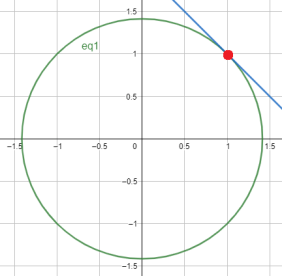
 now. We have
![\begin{aligned}\mathbb C[X, Y]/(X^2 + Y^2 - 2, X + Y - 2) &\cong \mathbb C[Y]/((2 - Y)^2 + Y^2 - 2)\\ &= \mathbb C[Y]/(2Y^2 -4Y + 2).\end{aligned}](https://s0.wp.com/latex.php?latex=%5Cbegin%7Baligned%7D%5Cmathbb+C%5BX%2C+Y%5D%2F%28X%5E2+%2B+Y%5E2+-+2%2C+X+%2B+Y+-+2%29+%26%5Ccong+%5Cmathbb+C%5BY%5D%2F%28%282+-+Y%29%5E2+%2B+Y%5E2+-+2%29%5C%5C+%26%3D+%5Cmathbb+C%5BY%5D%2F%282Y%5E2+-4Y+%2B+2%29.%5Cend%7Baligned%7D&bg=ffffff&fg=333333&s=0&c=20201002)
 which corresponds to the geometric picture.
 , this suggests that the intersection multiplicity is 2 here. Indeed we can construct a theory of intersection via considering general ideals instead of merely radical ideals.
  . For c = 0, we only have the trivial solution; for
  , we get
  so we need to solve
  in the field of rational numbers.
 with coordinates in ℚ, let us take the gradient of the line PQ, given by
  which is a rational number. Thus each Q gives us a rational number m.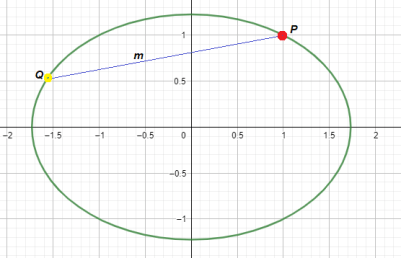
 . The line through P = (1, 1) with gradient m intersects the ellipse in another point Q = (x, y). Now x and y are rational, because x is the root of a quadratic equation with rational coefficients; thus the sum of the two roots is rational; since one of the root is 1, the other root is also rational.
 . The line through P of gradient m is then
  , or
, or  . Substituting this into the equation of the ellipse then gives
 . Since one of the roots is 1, the other is
  . And from
  . This gives the solution
  to the original equation
  . The case for cubic forms is much more complicated and involves elliptic curves, which is a huge topic.
 over the field k is the set of all n-tuples
  with each
  .
. . However, we have chosen a different notation because one often mentally associates
  can be interpreted as a function on
 ![\left.\begin{aligned} f = X^2 - Y^3 + 2Z \in \mathbb C[X, Y, Z]\\P = (2, 1, 0) \in \mathbb A_{\mathbb C}^3 \end{aligned}\right\} \implies f(P) = 2^2 - 1^3 + 2\cdot 0 = 3](https://s0.wp.com/latex.php?latex=%5Cleft.%5Cbegin%7Baligned%7D+f+%3D+X%5E2+-+Y%5E3+%2B+2Z+%5Cin+%5Cmathbb+C%5BX%2C+Y%2C+Z%5D%5C%5CP+%3D+%282%2C+1%2C+0%29+%5Cin+%5Cmathbb+A_%7B%5Cmathbb+C%7D%5E3+%5Cend%7Baligned%7D%5Cright%5C%7D+%5Cimplies+f%28P%29+%3D+2%5E2+-+1%5E3+%2B+2%5Ccdot+0+%3D+3&bg=ffffff&fg=333333&s=0&c=20201002) .
. of polynomials, let
![S \subset \mathbb R[X, Y, Z]](https://s0.wp.com/latex.php?latex=S+%5Csubset+%5Cmathbb+R%5BX%2C+Y%2C+Z%5D&bg=ffffff&fg=333333&s=0&c=20201002) comprises of
comprises of  and
and  , the resulting V(S) is a unit circle on the XY-plane.
 and
and  .
. , we have
  .
. we have
  , where
  .
. is equivalent to: for each i,
  , which is equivalent to: for each i and
  , we have
  we have
  : if P satisfies
  , then certainly
  for all
  . Similarly
  so we have proven ⊆ in the claim.
 such that
  ,
,  . But this means
  is the cofinite topology (i.e. a subset is closed if and only if it is finite, or the whole space).
 . Prove that
  is not a closed subset of
  .
. , let
, let  be the set of all
  .
. . Next if
  then for any
  . Similarly if
  and
and  , then for any
  .
. satisfies
  then for any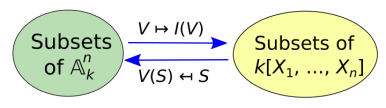
 and
and  .
. .
. .
. .
. .
. .
. . [Apologies for the awkward notation!]
 , then for any
  , any
, any  .
. ; by the definition of V(S) we have
  by the fourth claim. On the other hand since
  by the third claim we have
  by the second claim. ♦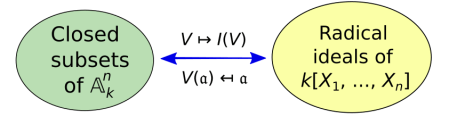

 again. For the ideal (m) where
  , each
  , its radical is simply (m’) where
  with the repeated exponents removed. Thus one thinks of the radical as “retaining only the prime factors”.
 . Suppose
  ; pick m, n > 0 such that
  .
. is a sum of terms
  with
with  and so each term is a multiple of
  or
or  . Thus
  so
so  .
. we have
  . Hence
  . Finally since
  , we see that
  be ideals of A, and
  be any collection of ideals of A.
 .
. .
. .
. we have proven ⊇ of the first claim. Conversely, if
  then
then  for some n > 0 and so
  for some m, n > 0. Thus
  .
. , ⊆ is obvious. Conversely, if x lies in the RHS then
  for some n > 0, and so
  with
with  . Without loss of generality, there is an m > 0 such that
  for each j = 1, …, k (take m large enough). Then
 = sum of terms of the form
  with
with 
 for some j, hence the term is a multiple of
  and x lies in the LHS.
 the second term is contained in the first.
 and similarly
  so the first term is contained in the third.
 there exist m, n > 0 such that
  . Then
  so the third term is contained in the second. ♦
 for any class of ideals
  . For example, take
  for
for  . Then
  so
so
 is called a radical ideal if
  .
. is a radical ideal.
 .
. .
. .
. .
. .
. be ideals. Write
 means
means  ; note that this is an ideal of A. As a convenient mnemonic for the definition (whether it is
  or
or  ), just recall that in the ring ℤ we have (mnℤ : nℤ) = mℤ.
 is an ideal of A.
 since
since  .
. , so
, so  . Then
  .
. , so
, so  , then any
  since
since  be ideals of A, and
  be any collection of ideals of A.
 .
. .
. .
. .
. ,
,  then by definition
  . Hence
  with
with  ,
,  .
. ,
,
 ,
,
 where the second equivalence follows from:
  and for any collection of ideals
  ,
,  . ♦
. ♦ , we have
 .
. .
. .
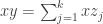
. and
and  , then
 for some
  .
. where each
  . Hence
  .
. we have
  and hence
  .
. , then
  since it is a multiple of
  , and similarly it lies in
  . Thus
  and so
  must contain all finite sums
  with
with  and
and  . ♦
. ♦ are coprime. The following properties of
  .
. and
and  .
. ,
,  are also coprime.
 are coprime if
  .
. are coprime if and only if there exist
  such that
  .
. is an ideal which strictly contains
  .
. .
. . Since either
  or
or  , this term is a multiple of
  or
or  . Hence the whole sum lies in
  and
and  . ♦
. ♦ are ideals such that
  is coprime and
  is coprime, then
  is coprime.
 such that
  . Then
 are ideals such that
  , then
  are coprime.
 and
and  are coprime pairs, so is
  . Together with the fact that
  is coprime, we see that
  is coprime, etc. ♦
 are coprime, there exist
  such that
  .
. so equality holds throughout. ♦
 are pairwise coprime ideals of A, then
  .
. , suppose it holds for n – 1 so that
  . By corollary 1,
  and
and  are coprime. By proposition 4 we have
 ♦
♦ ,
, by proposition 4. To prove that the map is surjective, pick
  in the RHS, let
  . Since
  and
and  we have
 maps to
  . ♦
. ♦ are pairwise coprime ideals, then the natural map

 be distinct maximal ideals of the ring A. Then their powers
  are pairwise coprime for any
  . Hence we have:
 , we write
  if their difference
  .
. in modular arithmetic. Thanks to the definition of an ideal, we immediately get:
 and
and  , then
 we have
  .
. satisfying:
 ;
; is a subgroup of
  ;
; , then
  .
. cannot be a subring of any other ring except itself, because of the first condition. However, it can be a ring quotient since for any ring
  gives a trivial ring for the quotient
  is a collection of ideals of
  is the set of all finite sums
  and
and  .
.
 . Aesthetically this is pleasing for we get
  .
. and generate the smallest ideal containing it.
 of all ideals
  . Note that
  . The intersection of all
  gives
gives
 , we also denote
  by
by  .
. means the notation
  on the RHS.
 where
where  and
and  . We can only restrict ourselves to finite sums since we are dealing with algebra here and infinite sums are not well-defined. [One can consider infinite sums in, say, functional analysis, but that is another story for another day.]
 is a collection of ideals of
  , the ideal generated by S is called the sum of the ideals
  , where
 of ring
  ,
,  such that
  .
. is a zero-divisor since
  and
and  . Be forewarned that the trivial ring can be a pitfall for the unwary.
 .
. ;
;![\mathbb Z[i] = \{a + bi : a, b\in\mathbb Z\}](https://s0.wp.com/latex.php?latex=%5Cmathbb+Z%5Bi%5D+%3D+%5C%7Ba+%2B+bi+%3A+a%2C+b%5Cin%5Cmathbb+Z%5C%7D&bg=ffffff&fg=333333&s=0&c=20201002) , where
, where  .
. .
. and call it the unit group of A. For example,
  and
and ![U(\mathbb Z[i]) = \{+1, +i, -1, -i\}](https://s0.wp.com/latex.php?latex=U%28%5Cmathbb+Z%5Bi%5D%29+%3D+%5C%7B%2B1%2C+%2Bi%2C+-1%2C+-i%5C%7D&bg=ffffff&fg=333333&s=0&c=20201002) . Finally, we define:
. Finally, we define: are all fields and
  and
and
 containing
  .
. is neither prime nor maximal. This should not come as a surprise, since in our definition of prime numbers, we explicitly exclude 1.
 is a prime (resp. maximal) ideal of the ring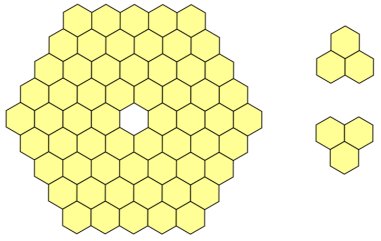


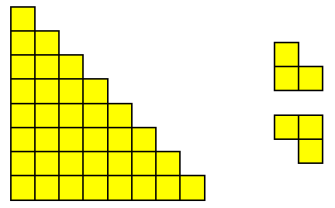
 Reduction in a word occurs when we remove two neighbouring occurrences of
  and
and  E.g.
E.g.

 (resp.
  ) and vice versa. E.g.
 for m neighbouring copies of
  and similarly for
  Thus
Thus  is shorthand for
 for the directions of right, left, up, down respectively, and record the loop as a word upon returning to the base point.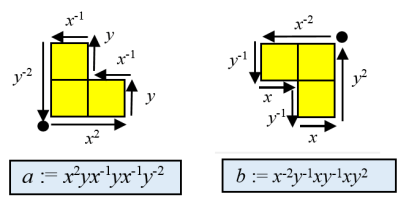

 depends on our choice of base points. Let’s see what happens to
  when we switch to a different point on the perimeter. Let
  correspond to the path from the old base point to the new along the perimeter, and let
  be the new loop. Then from the diagram:
 in the group F.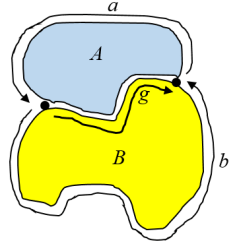
 (or a conjugate) while that for B is represented by
  Hence the resulting diagram has perimeter
  which is the product of the words for A and B in the group F.
 are represented by words
  . Upon tiling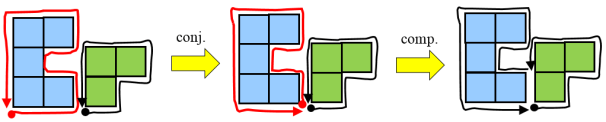
 lies in the normal subgroup N generated by a and b. This will be exploited in our proof.
 .
. , then
  is the program which does g, then h (which has no nett effect on the robot), then the reverse of g.

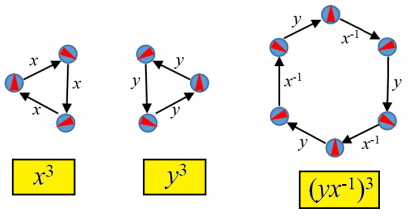
 be the canonical homomorphism. Since
  we have:
 .
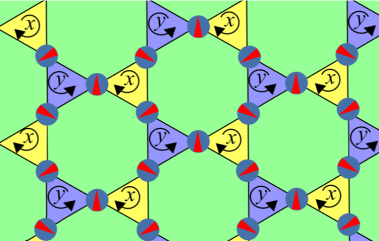
.

 is a closed path, we may define
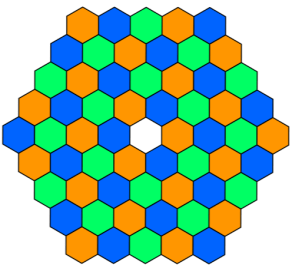
  to be the number of hexagons enclosed by the path. Here, the counting is oriented counter-clockwise – a loop which encloses a hexagon is counted +1 if the loop is counter-clockwise and -1 otherwise. This gives the desired homomorphism


 pieces. Hence c is obtained from the product of 12 conjugates of a and b (in F). Since K is normal in F, each conjugate a’ of a lies in K and furthermore
  Likewise
  for any conjugate b’ of b in F. From this, it follows that
  is even, which contradicts
  .
. which generates the permutation group G, the algorithm constructs a sequence
 ![k_1, k_2, \ldots, k_m \in [n] = \{1, 2, \ldots, n\}](https://s0.wp.com/latex.php?latex=k_1%2C+k_2%2C+%5Cldots%2C+k_m+%5Cin+%5Bn%5D+%3D+%5C%7B1%2C+2%2C+%5Cldots%2C+n%5C%7D&bg=ffffff&fg=333333&s=0&c=20201002) such that for:
such that for:
 for each
  Specifically, via the Sims filter, we can restrict
  for each i.
 as a product of elements of
  . At each step it picks a base element
 ![k_i \in [n]](https://s0.wp.com/latex.php?latex=k_i+%5Cin+%5Bn%5D&bg=ffffff&fg=333333&s=0&c=20201002) , computes a generating set for
, computes a generating set for  from
from  then pares down this set with the Sims filter so that
  Thus one can, in theory, keep track of the elements of
  , their lengths would be exponential in m. 😦
 , let
, let  be the orbit
  We wish to obtain a set
  , indexed by
  , such that
 takes the base element
 is any element of G satisfying:
 with
with  ; furthermore, the elements of the latter sets are stored as words in
  instead of mere permutations.
 to be the empty word for i = 0, …, m-1.
 , starting from those of length 1, then those of length 2, etc. For each word w, compute the corresponding element
  . Do we have an entry for
  ?
?
 Replace w with
  and increment i then repeat step 2.
 generated by:


 On the other hand, it takes
  Thus, we write the word ‘a’ into the last entry of the second row: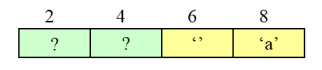
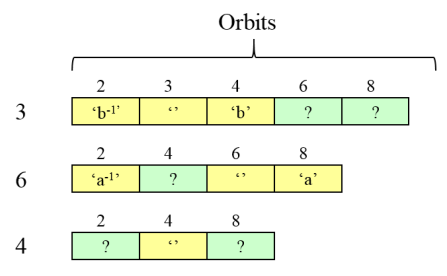
 . This takes
  However, the corresponding entry is already filled with ‘b’. Since this new word does not improve upon the old one, we replace the word with b-1ab. Now we have
 This element takes
  so we fill in the corresponding entry on the second row:

 Intuitively, the table fills up slowly because the elements {1, …, n} diffuse slowly via the generators.
 has quite a few empty entries. We look at the filled entries on that row, say
  and consider all words w found
  If the entry for
  is currently empty, we fill it in with the concatenation of w and the corresponding word for
  [Of course we need to perform reduction after concatenating the two words.]
 and check if w is shorter than the table entry at x. If it is, we update; otherwise we let w1 be this entry and replace w with
  and repeat the whole process).
 so Topspin achieves all possible permutations of the 20 counters. Minkwitz’s algorithm gives us a practical way to solve the puzzle given any initial configuration. Our program gave us a full table with a maximum word length of 824.
 ,
, ;
; be the permutation for w;
 ;
; Mathematics and Such