
Motivation
The separation axioms attempt to answer the following.
Question. Given a topological space X, how far is it from being metrisable?
We had a hint earlier: all metric spaces are Hausdorff, i.e. distinct points can be separated by two disjoint open subsets. But that’s only part of the story. Metric spaces, in fact, satisfy more.
Theorem 1. If (X, d) is a metric space and
are disjoint non-empty closed subsets, then we can find open subsets U, V of X such that:

To prove this, let’s have a little lemma. [ Note: this will be important later; it pays to take note of it now. ]
Lemma. Let C be a closed subset of a metric space (X, d) and
Then the distance from x to C:
is positive.

Proof of Lemma.
Since 


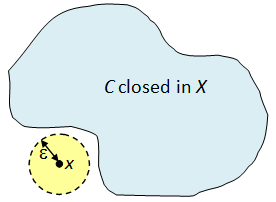
Now we’re ready to prove the theorem.
Proof of Theorem.
For each 


We claim U and V are disjoint. If not, z lies in both 

But by definition d(x, y) ≥ d(x, D) and d(y, x) ≥ d(y, C), which is a contradiction. ♦

Separation Axioms
Let X be any topological space now. The following labels are given to X if it satisfies the corresponding condition:
Definition.
- T1 : for any distinct points
we can find an open subset U of X containing x but not y.
- T2 : for any distinct points
- T3 : T1 and regular (X is regular if, for any point
and closed subset C of X not containing x, we can find open subsets U, V of X, such that
).
- T4 : T1 and normal (X is normal if, for any disjoint closed subsets
we can find open subsets U, V of X such that
).

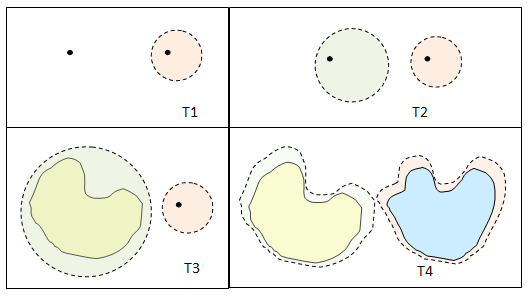
Note that T2 is just the Hausdorff condition. Theorem 1 thus says: a metric space satisfies all the separation axioms.
Let’s examine these axioms one at a time.
Proposition 2 (T1). The space X is T1 if and only if all singleton sets {x} are closed.
Proof.
(→) If X is T1, let C = {x}. For any y outside x, the T1 axiom tells us there’s an open subset V containing y but not x, i.e. 
(←) If x, y are distinct points in X, then X-{y} is open and it contains x but not y. ♦
Note.
This proposition explains why, for T3 and T4, we have to specify the condition of T1 in addition to regularity / normality. This ensures that each {x} is closed and so T4 → T3 → T2 → T1, in increasing order of generality.
Furthermore, none of the implications is reversible. E.g. the topology (X, T) with X = {1, 2} and T = {{}, {1}, {1, 2}} satisfies T1 but not T2. For other examples, the reader may search the “spacebook” which is based on the famous book “Counterexamples in Topology“.
Proposition 3 (T3). A locally compact Hausdorff space is T3.
Proof.
Note that a space X is regular if and only if for any open subset U of X and 

Now suppose X is locally compact and Hausdorff. Let U be an open subset of X containing x. By theorem 1 here, x is contained in an open subset V of X such that cl(V) is compact and contained in U. ♦
The converse is not true: there’re T3 spaces which are not locally compact. Also, there’re locally compact spaces which are not T4.
Proposition 4 (T4). A compact Hausdorff space is T4.
Proof
Suppose X is compact; then it’s locally compact so it’s T3. Let C, D be disjoint closed subsets of X. For each 


Now the collection of {Vy} covers D. Since D is a closed subset of compact X, it’s compact as well, so there’s a finite subcover 

Since Uy and Vy are disjoint for each y, so are U and V. We get: 

Clearly, not every T4 space is compact since there’re metric spaces which are not compact.
 Combined Properties
The separation axioms satisfy the following properties. We skip the case of T2 since it had been done earlier.
Theorem 3. If Y is a subspace of X, and X satisfies T1 (resp. T2, T3), then so does Y.
Proof.
(T1). If 
(T3). Let D be a closed subset of Y and 


we see that C doesn’t contain x. Since X is regular, we can enclose x, C in disjoint open subsets U, V of X. Then 

Exercise.
Prove that if Y is a closed subset of X and X satisfies T4, then so does Y. [ A subspace of a T4 space is not necessarily T4, but counter-examples are hard to find. ]
Theorem 4. If
is a collection of topological spaces which satisfy T1 (resp. T2, T3), then so is their product

Proof.
(T1). Let 


(T3) Let 


where equality holds for 


Now 

Note
Unfortunately, a product of T4 spaces is not necessarily T4.
Urysohn’s Lemma
Urysohn’s Lemma. Suppose X is normal. Then for any disjoint non-empty closed subsets C, D of X, there is a continuous map
such that f(C)={0} and f(D)={1}.
[ In particular, this holds for T4 spaces. ]
Note.
If X is connected, then f must be surjective since f(X) is a connected subset of [0, 1] containing 0 and 1. So we can label points of X continuously from 0 to 1 without gaps!
Proof.
[ All closed/open subsets are assumed with reference to X. ]
Note that normality is equivalent to: for any closed C and open U containing it, there’s an open V and closed D such that

Armed with this, first define 



Now proceed inductively, suppose we have a sequence of sets (each “C” is closed and “V” is open):

For each 0 ≤ r/2k < 1, given the inclusion 



This creates a corresponding chain for r/2k+1. In this way, we create a series of 


Now define the function:
![f:X \to [0,1], \quad f(x) = \inf\{t : x\in V_t \text{ or } t=1\}.](https://s0.wp.com/latex.php?latex=f%3AX+%5Cto+%5B0%2C1%5D%2C+%5Cquad+f%28x%29+%3D+%5Cinf%5C%7Bt+%3A+x%5Cin+V_t+%5Ctext%7B+or+%7D+t%3D1%5C%7D.&bg=ffffff&fg=333333&s=0&c=20201002)
Clearly f(C) = {0} and f(D) = {1}. It remains to show f is continuous.
Let 

Let ![C=f^{-1}([0, b])](https://s0.wp.com/latex.php?latex=C%3Df%5E%7B-1%7D%28%5B0%2C+b%5D%29&bg=ffffff&fg=333333&s=0&c=20201002)




![f^{-1}((b, 1])](https://s0.wp.com/latex.php?latex=f%5E%7B-1%7D%28%28b%2C+1%5D%29&bg=ffffff&fg=333333&s=0&c=20201002)
Since [0, b) and (b, 1] form a subbasis for [0, 1], we’re done. ♦
Urysohn’s Metrisation Theorem
The following result shows a sufficient condition for metrisability.
Definition. A topological space X is second-countable if it has a basis B with countably many elements.
For example, even though set-theoretically R is uncountable, its topology is second-countable since it has a basis comprising of open intervals (a, b) for rational a<b.
Urysohn’s Metrisation Theorem. If X is a T3 space which is second-countable, then it’s metrisable.
The proof follows a couple of steps.
Step 1 : T3 + second-countable implies T4.
Let 



Similarly, we’ll cover D via 



Each 


Step 2: Find countably many continuous fn : X → [0, 1] such that for any x in X and closed subset C not containing x, there’s an fn such that fn(x)=0, fn(C)={1}.
Pick a countable basis. For any U, V in this basis satisfying 
![f: X\to [0, 1]](https://s0.wp.com/latex.php?latex=f%3A+X%5Cto+%5B0%2C+1%5D&bg=ffffff&fg=333333&s=0&c=20201002)
Indeed, for any x in X and closed subset C not containing x, we can pick an open subset V such that 

Step 3: Embed X into countably many copies of R.
Let ![f_1, f_2, \ldots :X\to [0,1]](https://s0.wp.com/latex.php?latex=f_1%2C+f_2%2C+%5Cldots+%3AX%5Cto+%5B0%2C1%5D&bg=ffffff&fg=333333&s=0&c=20201002)
![f:X \to [0,1]^\mathbf{N}](https://s0.wp.com/latex.php?latex=f%3AX+%5Cto+%5B0%2C1%5D%5E%5Cmathbf%7BN%7D&bg=ffffff&fg=333333&s=0&c=20201002)


First if x≠y, then there’s an fn: X → [0, 1] such that fn(x)=0 and fn(y)=1. So f(x)≠f(y) and f is injective.
Next we need to show: if 

![V\subseteq [0,1]^\mathbf{N}.](https://s0.wp.com/latex.php?latex=V%5Csubseteq+%5B0%2C1%5D%5E%5Cmathbf%7BN%7D.&bg=ffffff&fg=333333&s=0&c=20201002)

and the union of all such 
![V\subseteq [0, 1]^\mathbf{N}](https://s0.wp.com/latex.php?latex=V%5Csubseteq+%5B0%2C+1%5D%5E%5Cmathbf%7BN%7D&bg=ffffff&fg=333333&s=0&c=20201002)

Thus X has the subspace topology from [0, 1]N. We already saw that the product of countably many metrisable spaces is metrisable, so we’re done. ♦

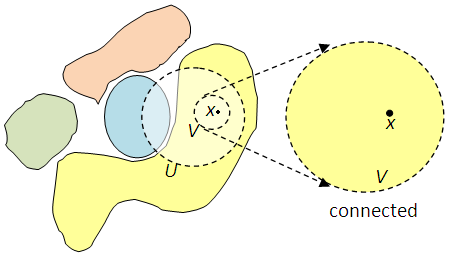
 is open in U if and only if it’s open in X. In such instances, we’ll sometimes abuse our language and say “V is open” without specifying the ambient space.
 Now we can write U as a union of connected open subsets. One of these (say V) must contain x. ♦
 , where Y is a connected component of X. By definition, x is contained in some open connected subset U of X. Since Y is a maximal connected set containing x, we have
  This shows that Y is open in X. ♦
 where:
![Y = \{0\} \times[0,1]](https://s0.wp.com/latex.php?latex=Y+%3D+%5C%7B0%5C%7D+%5Ctimes%5B0%2C1%5D&bg=ffffff&fg=333333&s=0&c=20201002) and
and 
 , the ε-neighbourhood of the origin contains more than one (in fact infinitely many!) connected components:
 is a union of open subsets and each Ui is locally connected, then so is X.
 where U’ is open in U. Then U’ is open in X so there exists a connected open subset V of X such that
  This V is also open in U.
 . Then
  for some i. By local connectedness of Ui, and
  there exists a connected open subset V of Ui ∩ U such that
  Thus,
Thus, 
 Then Y is closed in X, but there’s no connected open subset of 0 in Y.
 is a basis of X × Y comprising of open connected subsets. ♦
 where
where  for some n. Then projecting to the n-th component gives a surjective map
  which violates the theorem that the
  for some ε>0, which is open in X.
 and consider an infinite sequence of wheel spokes:
 ![X_0 = [0, 1] \times \{0\}](https://s0.wp.com/latex.php?latex=X_0+%3D+%5B0%2C+1%5D+%5Ctimes+%5C%7B0%5C%7D&bg=ffffff&fg=333333&s=0&c=20201002) and:
and: for n = 1, 2, … .
 :
:
 On the other hand, X is clearly path-connected.
 is a union of open subsets and each Ui is locally C, then so is X.
![f:[0, 1] \to X.](https://s0.wp.com/latex.php?latex=f%3A%5B0%2C+1%5D+%5Cto+X.&bg=ffffff&fg=333333&s=0&c=20201002) The path is said to connect x and y in X if f(0)=x and f(1)=y. X is said to be path-connected if any two points can be connected by a path.
The path is said to connect x and y in X if f(0)=x and f(1)=y. X is said to be path-connected if any two points can be connected by a path.
 Pick
Pick  such that f(x)=0 and f(y)=1. There’s a path
 ![g:[0, 1] \to X](https://s0.wp.com/latex.php?latex=g%3A%5B0%2C+1%5D+%5Cto+X&bg=ffffff&fg=333333&s=0&c=20201002) such that g(0)=x and g(1)=y. Now the composition
such that g(0)=x and g(1)=y. Now the composition ![f\circ g:[0, 1] \to\{0,1\}](https://s0.wp.com/latex.php?latex=f%5Ccirc+g%3A%5B0%2C+1%5D+%5Cto%5C%7B0%2C1%5C%7D&bg=ffffff&fg=333333&s=0&c=20201002) is continuous and surjective, which contradicts the fact that [0, 1] is connected. ♦
is continuous and surjective, which contradicts the fact that [0, 1] is connected. ♦ where
where ![Y = \{0\}\times [0, 1],](https://s0.wp.com/latex.php?latex=Y+%3D+%5C%7B0%5C%7D%5Ctimes+%5B0%2C+1%5D%2C&bg=ffffff&fg=333333&s=0&c=20201002)

![f:[0, 1] \to X](https://s0.wp.com/latex.php?latex=f%3A%5B0%2C+1%5D+%5Cto+X&bg=ffffff&fg=333333&s=0&c=20201002) is continuous and f(0) = (0, 0), f(1) = (1, sin(1)).
is continuous and f(0) = (0, 0), f(1) = (1, sin(1)).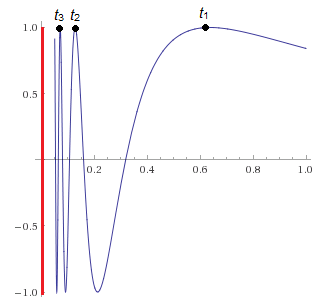
 be projection maps to the x– and y-coordinates respectively. Then
 ![\pi_x \circ f:[0, 1]\to \mathbf{R}](https://s0.wp.com/latex.php?latex=%5Cpi_x+%5Ccirc+f%3A%5B0%2C+1%5D%5Cto+%5Cmathbf%7BR%7D&bg=ffffff&fg=333333&s=0&c=20201002) contains 0 and 1, so its image is the whole [0, 1] by the
contains 0 and 1, so its image is the whole [0, 1] by the  Pick points
 ![t_0, t_1, t_2, \ldots \in [0, 1]](https://s0.wp.com/latex.php?latex=t_0%2C+t_1%2C+t_2%2C+%5Cldots+%5Cin+%5B0%2C+1%5D&bg=ffffff&fg=333333&s=0&c=20201002) such that
such that 
![t, u\in [0, 1]](https://s0.wp.com/latex.php?latex=t%2C+u%5Cin+%5B0%2C+1%5D&bg=ffffff&fg=333333&s=0&c=20201002) satisfy
satisfy  we have
  Since [0, 1] is compact, we’ll pick m<n such that
  By intermediate value theorem, there’s a point u between tm and tn such that
  Then
Then  but
but  which is a contradiction.
 is a continuous map of topological spaces and X is path-connected, then so is f(X).
 we can pick
  such that
  Pick a path
  and
and  Then the composition gives a path
 ![g\circ f:[0, 1] \to Y](https://s0.wp.com/latex.php?latex=g%5Ccirc+f%3A%5B0%2C+1%5D+%5Cto+Y&bg=ffffff&fg=333333&s=0&c=20201002) which connects
which connects  to
to  ♦
♦ is a collection of path-connected subspaces of X and
  then so is
 If
If  then
then  and
and  for some indices i and j. Since Yi and Yj are path-connected and contain x, there’s a path in Yi connecting x to y and a path in Yj connecting x to z. Hence, concatenating gives a path connecting y to z. ♦
 is also path-connected.
 Since each
  is path connected, pick a path
 ![f_i :[0,1]\to X_i](https://s0.wp.com/latex.php?latex=f_i+%3A%5B0%2C1%5D%5Cto+X_i&bg=ffffff&fg=333333&s=0&c=20201002) such that
such that  Now let
 ![f:[0, 1]\to X](https://s0.wp.com/latex.php?latex=f%3A%5B0%2C+1%5D%5Cto+X&bg=ffffff&fg=333333&s=0&c=20201002) be the path
be the path 
![\pi_i \circ f : [0,1]\to X_i](https://s0.wp.com/latex.php?latex=%5Cpi_i+%5Ccirc+f+%3A+%5B0%2C1%5D%5Cto+X_i&bg=ffffff&fg=333333&s=0&c=20201002) is continuous for each i, where
is continuous for each i, where  is the projection map. But
  so we’re done. ♦
 Since the example
  in the
 ![X = [0, 1) \cup (2, 3]](https://s0.wp.com/latex.php?latex=X+%3D+%5B0%2C+1%29+%5Ccup+%282%2C+3%5D&bg=ffffff&fg=333333&s=0&c=20201002) is a disjoint union of
is a disjoint union of  and
and ![(2, 3],](https://s0.wp.com/latex.php?latex=%282%2C+3%5D%2C&bg=ffffff&fg=333333&s=0&c=20201002) each of which is a path-connected component.
each of which is a path-connected component. Otherwise, it’s disconnected.
 where {0, 1} has the discrete topology, is constant.

 and
and  are non-empty disjoint open subsets such that
  Conversely, if
  where U, V are non-empty, disjoint and open in X, then we can set
 ♦
♦ is connected.
 so Y is dense in Z. Suppose
  is continuous. Then
  is constant (say, 0) since Y is connected. Since
  is closed and contains Y, it must be the whole of Z. ♦
 is a surjective continuous map. Then
  is also continuous and surjective, so X is disconnected (contradiction). Hence, g does not exist. ♦
 then
then  is connected.
 . Let
. Let  be a continuous map. Then each
  is constant for each i, and it must be equal to f(x). So f is constant. ♦
![(a, b), (a, b], [a, b), [a, b]](https://s0.wp.com/latex.php?latex=%28a%2C+b%29%2C+%28a%2C+b%5D%2C+%5Ba%2C+b%29%2C+%5Ba%2C+b%5D&bg=ffffff&fg=333333&s=0&c=20201002) ;
;![(-\infty, b), (-\infty, b], (a, \infty), [a, \infty), \mathbf{R}](https://s0.wp.com/latex.php?latex=%28-%5Cinfty%2C+b%29%2C+%28-%5Cinfty%2C+b%5D%2C+%28a%2C+%5Cinfty%29%2C+%5Ba%2C+%5Cinfty%29%2C+%5Cmathbf%7BR%7D&bg=ffffff&fg=333333&s=0&c=20201002) ;
;![(a, b], [a, b), [a, b],](https://s0.wp.com/latex.php?latex=%28a%2C+b%5D%2C+%5Ba%2C+b%29%2C+%5Ba%2C+b%5D%2C&bg=ffffff&fg=333333&s=0&c=20201002) these are all connected by proposition 2. Finally, for the unbounded intervals, apply proposition 4. E.g.
these are all connected by proposition 2. Finally, for the unbounded intervals, apply proposition 4. E.g. 
 is connected and
  with a<b, then
 ![[a,b]\subseteq X.](https://s0.wp.com/latex.php?latex=%5Ba%2Cb%5D%5Csubseteq+X.&bg=ffffff&fg=333333&s=0&c=20201002) [ Indeed, if a < r < b and
[ Indeed, if a < r < b and  then
then  and the two open subsets are non-empty since they contain a and b respectively. ]
![[y,z]\subseteq X](https://s0.wp.com/latex.php?latex=%5By%2Cz%5D%5Csubseteq+X&bg=ffffff&fg=333333&s=0&c=20201002) and
and  Thus,
Thus,  The fact that a isn’t in X shows that equality holds. ] ♦
![f:[a,b]\to \mathbf{R}](https://s0.wp.com/latex.php?latex=f%3A%5Ba%2Cb%5D%5Cto+%5Cmathbf%7BR%7D&bg=ffffff&fg=333333&s=0&c=20201002) is continuous, then the image of f is also a closed interval [c, d]. In particular, if s lies between f(a) and f(b), then there exists an r in [a, b], f(r) = s.
is continuous, then the image of f is also a closed interval [c, d]. In particular, if s lies between f(a) and f(b), then there exists an r in [a, b], f(r) = s. and
and  with a<b, then we can pick an irrational r, a<r<b so that
  is a disjoint union of two non-empty open subsets. So Y is disconnected.
 But Y is a maximal connected subset, so
  ♦
♦ is connected if and only if each
  be surjective and continuous. Let
  Since
Since  where
where  for all but finitely many i‘s :
  Thus:
Thus: (#)
(#) satisfy:
  for all i except i=j, then they belong to the same connected component.
 is homeomorphic to Xj so it is a connected subset containing
 one at a time and see that the whole
  is contained in
  i.e. X is connected. ♦
 the space of all real sequences and U the subset of all sequences converging to 0. Any
  is also contained in
  which is open in the box topology and contained in U. Thus U is open. The same holds for any
  so X–U is also open. [ Note that the sublemma implies altering a single term in a sequence has no effect on whether it converges to 0. ]
![X = [0, 1)\cup (2, 3]](https://s0.wp.com/latex.php?latex=X+%3D+%5B0%2C+1%29%5Ccup+%282%2C+3%5D&bg=ffffff&fg=333333&s=0&c=20201002) is disconnected since
is disconnected since  and
and ![(2, 3] = (2, 4)\cap X](https://s0.wp.com/latex.php?latex=%282%2C+3%5D+%3D+%282%2C+4%29%5Ccap+X&bg=ffffff&fg=333333&s=0&c=20201002) are open subsets of X. These give the connected components of X.
are open subsets of X. These give the connected components of X.
 contains a point of Z. Thus
  Since Z is connected, proposition 2 tells us X is connected too.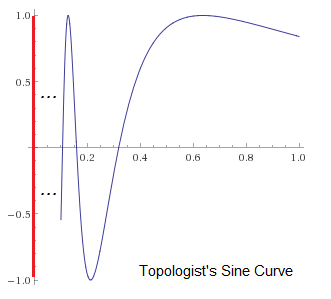
 is a dense subspace of Y.
 This is called a one-point compactification of X.
 in the plane.
 is given by the union of two circles which are tangent to each other.
 in 3-space.
 then V is an open subset of Y contained in X, so V is open in X.
 , then
  is of the second type (it’s compact since ∩Ci is closed is closed in each Ci).
 and C ∩ (X–U) is closed in X and compact since it’s a closed subset of C.
 be an open cover. Then there’s at least one Cj, and
 by
by  and
and  Clearly f is continuous outside ∞. For continuity at ∞, an open subset containing (1, 0) must contain the set V of
 for some ε>0. Then
  is the set
 ![Y - [\epsilon, 1-\epsilon]](https://s0.wp.com/latex.php?latex=Y+-+%5B%5Cepsilon%2C+1-%5Cepsilon%5D&bg=ffffff&fg=333333&s=0&c=20201002) which is open in the Alexandroff extension. Now we’ll finish the proof by a trick.
which is open in the Alexandroff extension. Now we’ll finish the proof by a trick. maps closed subsets to closed subsets. It suffices to show f maps closed subsets to closed subsets. But if C is closed in X, then C is compact and thus f(C) is compact. Since Y is Hausdorff, f(C) is closed in Y. Done. ♦
 . Map the Alexandroff extension
 ![f:Y \to [0,1]](https://s0.wp.com/latex.php?latex=f%3AY+%5Cto+%5B0%2C1%5D&bg=ffffff&fg=333333&s=0&c=20201002) by taking t to itself and ∞ to 1. Once again f is continuous outside ∞. For continuity at ∞, an open subset containing 1 in [0, 1] must also contain V = (1-ε, 1] for some ε>0. But then
by taking t to itself and ∞ to 1. Once again f is continuous outside ∞. For continuity at ∞, an open subset containing 1 in [0, 1] must also contain V = (1-ε, 1] for some ε>0. But then ![f^{-1}(V) = Y - [0, 1-\epsilon]](https://s0.wp.com/latex.php?latex=f%5E%7B-1%7D%28V%29+%3D+Y+-+%5B0%2C+1-%5Cepsilon%5D&bg=ffffff&fg=333333&s=0&c=20201002) which is open in the Alexandroff extension. Hence f is continuous and we invoke the above lemma to show that it is a homeomorphism.
which is open in the Alexandroff extension. Hence f is continuous and we invoke the above lemma to show that it is a homeomorphism. containing 0. For ∞, we have V = Y–C, for a compact subset C of Q containing U. This means
 ![[-\epsilon, +\epsilon] \cap\mathbf{Q}](https://s0.wp.com/latex.php?latex=%5B-%5Cepsilon%2C+%2B%5Cepsilon%5D+%5Ccap%5Cmathbf%7BQ%7D&bg=ffffff&fg=333333&s=0&c=20201002) is closed in C and hence also compact, which is impossible by this lemma.
is closed in C and hence also compact, which is impossible by this lemma.![C:=[a, b] \cap \mathbf{Q}\subset \mathbf{R}](https://s0.wp.com/latex.php?latex=C%3A%3D%5Ba%2C+b%5D+%5Ccap+%5Cmathbf%7BQ%7D%5Csubset+%5Cmathbf%7BR%7D&bg=ffffff&fg=333333&s=0&c=20201002) for a<b is not compact.
for a<b is not compact. is compact.
 Now V = Y–C for some closed compact subset C of X. Then
  Since clX(U) is closed in C, it’s compact.
 can be separated by open subsets. The only problem is
  Pick open subset U of X containing x such that C := clX(U) is compact. Then U and Y–C are open subsets of Y which separate x and y. ♦
 there’s an open subset U containing x such that cl(U) is compact.
 separate x and y by open subsets
  such that

 and C is compact, there’s a finite set of points
  such that
  Let
Let  which gives an open subset containing x which doesn’t intersect W’. Thus, cl(W) also doesn’t intersect W’, and
  :
: , with cl(W) closed in cl(V) and hence compact. ♦
 of Y doesn’t contain an open subset whose closure in Y is compact. This is because any such open subset contains
  and the closure thus contains
 ![[a,b]\cap \mathbf{Q}](https://s0.wp.com/latex.php?latex=%5Ba%2Cb%5D%5Ccap+%5Cmathbf%7BQ%7D&bg=ffffff&fg=333333&s=0&c=20201002) so this
so this  where clX(V) is compact. Since V is an open subset of X contained in U, it’s also open in U; also
 By theorem 1, there exists V (open in Ui and hence in X) containing x such that
  and
and  is compact and hence closed in X. Thus
  and conversely,
  So
So  and clX(V) is compact. ♦
 . By local compactness of X, there’s an open subset U of X containing x such that
  is compact. Thus, (x, y) is contained in U × V, whose closure
  is compact. ♦
 where each
  is open and equality holds for all but finitely many i. The same must hold for any open
  , is in fact compact.
 is a collection of closed subsets of X such that every finite intersection
  then
then 
 so the open cover {X–Ci} has a finite subcover. This gives a finite collection of Ci with empty intersection.
 is an open cover of X, then
  By F.I.P., there’s a finite collection
  so
so  is a finite subcover. ♦
 are non-empty compact Hausdorff spaces and
  is a collection of continuous maps:
 where
where  and
and  for each n≥1.
 and each fn is the inclusion map, then no such sequence exists since the intersection of all X>n is empty.
 which is compact by
 Also
Also  is homeomorphic to
  via the following mutually inverse maps:
 ♦
♦ is a sequence of non-empty finite sets and
  such that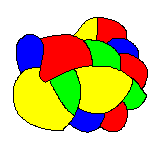

 with
with  such that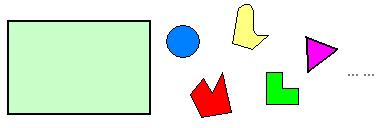

 and a point on the unit circle representing its orientation. Thus Xn can be parametrised by 2n coordinates and n points on the unit circle, which forms a subset of R4n. This subset is clearly bounded; it’s also closed because its complement is open: e. g. if two shapes have overlapping interiors, then by perturbing all shapes a little, those two shapes still overlap. Thus, by the Heine-Borel theorem, Xn is compact. The above proposition tells us there’s a way to fit all shapes in. ♦
 there’s a way to pack every finite set of rectangles in the square, but if we attempt to pack the entire infinite set, some of them must share an edge and thus overlap.
 then we can find a finite set of indices
  such that
  On an intuitive level, one should imagine a compact space as being constrained, and is the topological equivalent of a finite set.
 there exists a finite set of indices
 we have
  and each
  is open in Y. Thus, there’s a finite subcover
  which gives
 be an open cover of Y. Each
  for some open subset Ui of X. Now
  By assumption, there’s a finite set of indices
  such that
  which gives
  ♦
♦ Then
Then 
 .
.
 and Y is compact, we can find a finite subcover:
 which is open in X and contains x. Since
  for each k, we have
  which contradicts the fact that x is a point of accumulation of Y. ♦
 Letting
  we have
 which gives
  By the above lemma, f(X) is compact. ♦
 are compact, then so is
  Thus a finite union of compact subspaces is compact.
 and Y is compact, there’s a finite set of indices
  such that
  Then
Then  so
so  in X must have a subsequence which converges to a in X. Since
  ♦
♦ , continuity at a means there’s a δ>0 such that
  Now the collection of the open balls
  covers X, so it has a finite subcover
 where
where 
 Now whenever
 for some 1 ≤ i ≤ n;
 ;
; and
and  ;
;
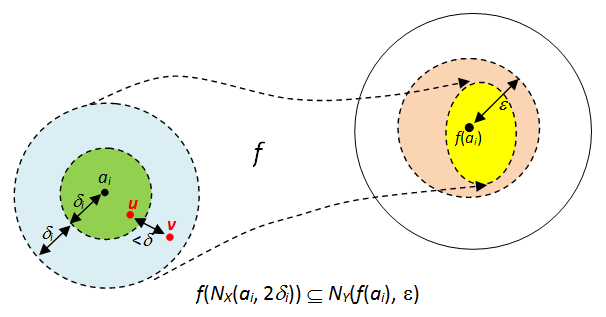
 which covers X, has a finite subcover.
 as a union of basic open sets
  Then
Then  and there must be a finite subcover
 we have
  which covers X, has a finite subcover.
 of basic open sets which covers X but with no finite subcover. We’ll assume Σ is “maximal”, i.e.
 the collection
  has a finite subcover, which must include V. [ Note: we don’t assume there’s a unique maximal Σ. ]
 satisfy
  then we have
  for some i. [ Indeed, if each
  then maximality implies
  has a finite subcover, say
  where each
  Then
Then  is a finite subcover of Σ. Contradiction. ]
 such that
  Since V is a basic open set, write
  for
for  The above condition then implies
  for some i. Since
  we see that
 forms a subbasis for X. Suppose we have an open cover of X of the form {Vi}. Then for some index i, the union of Ui‘s which appear must be the whole of Xi; otherwise, for each i, pick some
  and the tuple
  is not in the union of {Vi}. By compactness of Xi, there’s a finite subcover via the {Ui}, so X has a finite subcover via the {Vi}. ♦
![X\subseteq [0, 1].](https://s0.wp.com/latex.php?latex=X%5Csubseteq+%5B0%2C+1%5D.&bg=ffffff&fg=333333&s=0&c=20201002) By proposition 1, it suffices to prove X = [0, 1] is compact. Since we can pick a subbasis of R comprising of (-∞, b) and (a, ∞), we can
By proposition 1, it suffices to prove X = [0, 1] is compact. Since we can pick a subbasis of R comprising of (-∞, b) and (a, ∞), we can ![\{[0, b_i)\}_i \cup \{(a_j, 1]\}_j.](https://s0.wp.com/latex.php?latex=%5C%7B%5B0%2C+b_i%29%5C%7D_i+%5Ccup+%5C%7B%28a_j%2C+1%5D%5C%7D_j.&bg=ffffff&fg=333333&s=0&c=20201002) Since:
Since: and
and ![\cup_j (a_j, 1] = (\inf a_j, 1]](https://s0.wp.com/latex.php?latex=%5Ccup_j+%28a_j%2C+1%5D+%3D+%28%5Cinf+a_j%2C+1%5D&bg=ffffff&fg=333333&s=0&c=20201002)
 Then there exist i, j such that
  so there’s a finite subcover
 ![\{[0, b_i), (a_j, 1]\}.](https://s0.wp.com/latex.php?latex=%5C%7B%5B0%2C+b_i%29%2C+%28a_j%2C+1%5D%5C%7D.&bg=ffffff&fg=333333&s=0&c=20201002) By Alexander’s Subbase Theorem, X is compact. ♦
By Alexander’s Subbase Theorem, X is compact. ♦ then either α ≤ β or β ≤ α.
 is a totally ordered subset, there’s an upper bound
  of T, i.e. s ≥ t for all

 is a collection of non-empty sets, then the product
  is non-empty. This looks deceptively obvious, so we’ll just take it at face value while sweeping the philosophical ramifications under the rug (or continue the discussion another time). Read the
  is an open cover of X without any finite subcover.
 which is totally ordered and each
  satisfies (*). Totally ordered means for any i, j, either
  or
or 
 We’ll prove Σ satisfies (*) as well.
 Since there’re only finitely many such i‘s and
  the cover
 really ought to converge to 0, but that limit is not found in the space.
 for various m is not bounded, so there exists m>n for which
 But by sequential compactness of Y we must have a subsequence
  which converges to an element of Y. Thus
  indeed. ♦
 Then
Then  is also a convergent subsequence of (yn).
 there’s also a subsequence
  which converges to b in Y. Since
  is a subsequence of
  it also converges to a. Thus
  To prove the converse apply the property above to projection maps X × Y → X and X × Y → Y.
![X\subseteq [0, \frac 2 3]^n](https://s0.wp.com/latex.php?latex=X%5Csubseteq+%5B0%2C+%5Cfrac+2+3%5D%5En&bg=ffffff&fg=333333&s=0&c=20201002) , in which case proposition 2 tells us we only need to show
, in which case proposition 2 tells us we only need to show ![[0, \frac 2 3]^n](https://s0.wp.com/latex.php?latex=%5B0%2C+%5Cfrac+2+3%5D%5En&bg=ffffff&fg=333333&s=0&c=20201002) is sequentially compact and for that, it suffices to show X = [0, 2/3] is sequentially compact. For a sequence (xn) in X, write out the decimal expansion of each xn; if more than one expression exists, pick any one. Each xn may be written in the form (0.abcd…).
is sequentially compact and for that, it suffices to show X = [0, 2/3] is sequentially compact. For a sequence (xn) in X, write out the decimal expansion of each xn; if more than one expression exists, pick any one. Each xn may be written in the form (0.abcd…). This gives
 ![r = (0.d_1 d_2 d_3\ldots) \in [0, \frac 2 3].](https://s0.wp.com/latex.php?latex=r+%3D+%280.d_1+d_2+d_3%5Cldots%29+%5Cin+%5B0%2C+%5Cfrac+2+3%5D.&bg=ffffff&fg=333333&s=0&c=20201002) Clearly, there’s a subsequence of (xn) converging to r. Since xn ≤ 2/3, we also have r ≤ 2/3. ♦
Clearly, there’s a subsequence of (xn) converging to r. Since xn ≤ 2/3, we also have r ≤ 2/3. ♦ and
and  ]
] which contradicts the fact that each
  contains only finitely many terms of the sequence.
 Replacing (xn) with

 is a net indexed by directed set I, then a subnet is given by
  for some subset J of I such that:
 , there exists an index j ≥ i contained in J (note that this condition implies J is a directed set).
 This gives a subnet (xj) which converges to a. Contradiction. ]
 we can find a finite subset {a1, a2, …, an} of X such that
  Also for each k=1, …, n, there’s an index ik such that U(ak) does not contain xj for all j ≥ ik. Since I is a directed set, we’ll pick j ≥ all ik‘s, and so
  does not contain xj which is absurd.
 is an open cover of X indexed by J. We construct a net as follows: the index set is I, the collection of all finite subsets of J, ordered by inclusion. Thus, if
  then
then  For each
  define the open subset
  If {Uj} has no finite subcover, then each US ≠ X so we can pick
  This gives a net (xS).
 If we pick T containing j, then
  so
so  which is a contradiction. ♦
 and
and  are complete metric spaces, then so is
  where d can be any one of the following metrics:
 ;
; ;
; .
. in X × Y is Cauchy, then
  are Cauchy in X and Y respectively. Hence, they’re both convergent, say, to
 is convergent. ♦
 is a countably infinite collection of complete metric spaces. Construct a metric on
  as
as  Now Z is closed in Y so it is complete by proposition 1 above. Furthermore, X is dense in Z by definition. So
  is now a completion. In other words, the third condition enforces a minimality condition on Y. One can visualise Y as filling up the gaps of X.
 to a complete metric space Z, there is a unique continuous
  such that
 is a Cauchy sequence in Y, then it converges to some y, so
  is convergent and must also be Cauchy.
 then since X is dense in Y and Z is Hausdorff, we have g = g’.
 since X is dense in Y, y is a limit of a sequence (xn) in X. Then (xn) is Cauchy and since f is Cauchy-continuous, (f(xn)) is Cauchy in Z. So (f(xn)) converges to some z and we let g(y) = z.
 We need to show
  have the same limit. It suffices to show
  as n → ∞.
 and
and 

 since if
  we can pick the constant sequence (y, y, …) in X.
 then
then  Now since X is dense in Y, we can pick a sequence
  This gives
  also. From our definition of g, we must have
  so we’re done. ♦
 are both completions, then there is a unique homeomorphism f : Y → Y’ which restricts to the identity map on X.
 and
and  be the injections. Since i and j are uniformly continuous, by the universal property (U.P.) on Y, there exists a unique uniformly continuous
  which extends the identity map idX on X. Likewise, by the U.P. on Y’, there is a unique uniformly continuous
  extending idX. Composing gives uniformly continuous maps
  and
and  extending idX. By uniqueness in U.P., both
  and
and  must be identity maps. ♦
 , then the completion of X’ is its closure in Y.
 so X1 × X2 is dense in Y1 × Y2. ♦
 extends to a uniformly continuous
 to obtain a uniformly continuous map
  to a complete space. By universal property of Y2, this extends to a uniformly continuous
  such that
  ♦
♦ which takes t to exp(2πit). We leave it to the reader to prove its uniform continuity. The induced map on the completion is
 ![[0, 1]\to \{z\in\mathbf{C} : |z|=1\}](https://s0.wp.com/latex.php?latex=%5B0%2C+1%5D%5Cto+%5C%7Bz%5Cin%5Cmathbf%7BC%7D+%3A+%7Cz%7C%3D1%5C%7D&bg=ffffff&fg=333333&s=0&c=20201002) which takes t to exp(2πit) as well, and this is not injective.
which takes t to exp(2πit) as well, and this is not injective. write
write  if
if 
 are represented by Cauchy sequences
  we define the distance function to be:
 is Cauchy. To do that, note that for all m, n:
 which gives:
 are Cauchy, for any ε>0, we can find N such that whenever m, n > N, we have
  Thus
Thus  is Cauchy.
 and
and  Arguing as in step 2, we obtain:
 and
and  on the RHS tends to 0. Hence d’ is well-defined.
 Then
Then  , so
, so  Then we have
  for each n. Taking the limit of each term, we get the triangular inequality for d’.
 be represented by
  We claim that (xn), as a sequence in Y, converges to y; i.e.
 Fixing n, and taking the limit as m→∞, we get
  Thus, we’re done.
 We claim that
 Thus, when m, n > N, we have
  and
and 
 Indeed, we have:
 since
since  And we’re done. ♦


 iff
iff  and
and 

 which exists by assumption.
 which converges to both x and y, which is a contradiction. ♦
 which takes x to (x, x) has a closed image
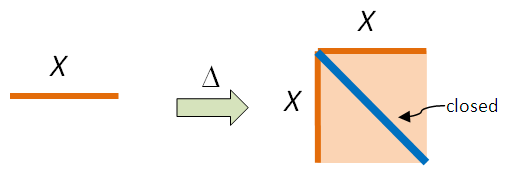
 So (X×X)-Δ(X) is open.
 must be contained in a basic open subset
  for some open
  Then U, V are open subsets of X containing x, y respectively and they’re disjoint since U × V is a subset of W. ♦
 is an injective continuous map and X is Hausdorff, then so is Y. In particular, a subspace of a Hausdorff space is Hausdorff.

 are disjoint, then so are f(a), f(b). Since X is Hausdorff, we can find disjoint open subsets U, V of X containing f(a), f(b) respectively. Then
  are disjoint open subsets of Y containing a, b respectively.
 Then
Then  are the desired open subsets of X. Otherwise,
  belong to the same component; since this is Hausdorff, we can find disjoint open subsets
  containing x, y respectively. But
  is open, hence so are
  are distinct, there’s an index i such that
  Since
Since  containing
  respectively. Then the open slices
  and
and  are disjoint open subsets of X containing
  respectively. ♦
 , is not Hausdorff if |X|>1.
 then saying Y is dense in Z means
  But since
  this is equivalent to saying clX(Y) contains Z. In particular, given any subset Y of X, taking the closure in X gives
  Setting Z = clX(Y), we see that Y is dense in Z.
 which holds if and only if X–Y has no non-empty subset open in X. This is the same as saying any non-empty open subset of X intersects Y. ♦
 are continuous functions to a Hausdorff space Z. If Y is a dense subset of X such that
  then f=g.
 .
. so W is a non-empty open subset of X.
 and
and  Yet U, V are disjoint, which gives us a contradiction. ♦
 is a surjective continuous map and Y is a dense subset of X, then f(Y) is dense in Z.
 is dense, then so is

 be open and non-empty. Then
  for some i. Since U ∩ Xi is a non-empty open subset of Xi, it must intersect Yi, and hence, Y. Thus, U intersects Y.
 Mathematics and Such