Tensor Product over Noncommutative Rings

Following the earlier article on tensor products of vector spaces, we will now look at tensor products of modules over a ring R, not necessarily commutative. It turns out we have to distinguish between left and right modules now. Indeed recall the isomorphism from earlier: \text{Hom}_K(V, W)\cong V^* \otimes_K W for vector spaces. If we replace V and W by left R-modules, then V* becomes a right module, so this hints that we should consider a tensor product between a right module and a left one.

Definition. Let M be a right R-module, N a left R-module and X an abelian group. A bilinear map of modules is a map B:M \times N \to X such that

  • when we fix n∈N, B(-, N): M→X is additive;
  • when we fix m∈M, B(m, -): N→X is additive;
  • B(mr, n) = B(m, rn) for any r∈R, m∈M, n∈N.

The tensor product of M and N, denoted M\otimes_R N is an abelian group together with a bilinear map \psi: M\times N \to M\otimes_R N such that the following universal property holds:

  • for any bilinear map B:M \times N\to X there is a unique additive map f:M\otimes N \to X such that f\circ \psi = B.

As before, the element m\otimes n:= \psi(m,n) for any m\in M, n\in N is called a pure tensor.

The universal property again guarantees that the tensor product is unique if it exists.

Proof of Existence

The proof is identical to earlier. Let T be the free abelian group with basis \{e_{m,n} : m\in M, n\in N\}. Take the subgroup U generated by elements of the form:

e_{m+m', n} - e_{m,n} - e_{m', n}, \quad e_{m,n+n'} - e_{m,n} - e_{m, n'}, \quad e_{mr,n} - e_{m,rn},

for r\in R, m,m'\in M, n,n'\in N. Now our desired group is T/U, and M\times N \to T/U is given by (m,n)\mapsto e_{m,n} \pmod U so mn is the image of e_{m,n} in T/U. ♦

Note

A bilinear map M × N → X corresponds to a homomorphism of right modules M\to \text{Hom}_{\mathbf{Z}}(N, X). [ Recall that since N is a left R-module, Hom(NX) becomes a right R-module. ]  Hence, the above universal property can also be written as:

\text{Hom}_\mathbf{Z}(M\otimes_R N, X) = \text{Hom}_{\text{right}-R}(M, \text{Hom}_{\mathbf{Z}}(N, X)).

Often, we would like the tensor product to be a module instead of merely an abelian group:

Proposition. Let R, S be rings. If M is an (R, S)-bimodule and N is a left S-module, then M\otimes_S N is a left R-module satisfying r(m\otimes n) := (rm)\otimes n.

The bilinear map \psi : M\times N \to M\otimes_S N is also R-linear in M, i.e. r\cdot \psi(m, n) = \psi(rm, n).

Proof

By definition M \otimes_S N is an abelian group. For each rR, consider the map

f_r: M \times N \to M\otimes_S N, \quad (m,n) \mapsto (rm)\otimes n.

The map is R-bilinear (e.g. fr(msn) = (r(ms))⊗= (rm)snrm⊗sn = fr(msn)). So it induces \phi_r : M\otimes_S N \to M\otimes_S N taking m\otimes n \mapsto (rm)\otimes n. One now checks that this turns M\otimes_S N into a left R-module such that M \times N \to M\otimes_S N is R-linear in M. ♦

Properties.

  • For any left R-module M, R\otimes_R M \cong M as left R-modules.
  • For any right R-module M, (R, S)-bimodule N, and left S-module P, we have M\otimes_R (N\otimes_S P)\cong (M \otimes_R N)\otimes_S P.
  • For any right R-module M, and left R-modules \{N_i\}, we have M\otimes_R (\oplus_i N_i) \cong \oplus_i (M\otimes_R N_i).

Sketch of Proof.

We’ll briefly sketch the proof of the second claim. Fixing mM, the map f_r: N\times P \to (M\otimes_R N)\otimes_S P taking (n, p) \mapsto (m\otimes n)\otimes p is bilinear over S, so it induces a group homomorphism \psi_r : N\otimes_S P \to (M\otimes_R N)\otimes_S P which is easily checked to be left R-linear. Check that this is right R-linear in r, so we obtain a group homomorphism M\otimes_R (N\otimes_S P) \to (M\otimes_R N)\otimes_S P taking (mn)⊗p to m⊗(np). ♦

blue-lin

Base Extension

Suppose S is an R-algebra and M a left R-module. Since S is an (SR)-bimodule, the tensor product M_S := S \otimes_R M is now a left S-module. This is called the base extension of M. Since (T\otimes_S S)\otimes_R M \cong T\otimes_R M, we have:

Proposition. Base extension commutes, i.e. if T is an S-algebra, then T\otimes_S (S\otimes_R M) \cong T\otimes_R M as T-modules.

Base extension satisfies the following universal property.

Universal Property of Base Extension. The canonical map \psi: M \to M_S taking m\mapsto 1\otimes m is R-linear.

For any left S-module N and R-module homomorphism \phi: M\to N there is a unique S-module homomorphism f: M_S \to N such that f\circ\psi = \phi.

Thus for any S-module N:

\text{Hom}_R(M, N) = \text{Hom}_S(M_S, N)

Proof

The first statement is obvious. For the second, let us prove existence of f. The map S\times M \to N mapping (s,m)\mapsto s\cdot \phi(m) is R-bilinear so it induces f: M_S = S\otimes_R M\to N satisfying f(s\otimes m) = s\cdot \phi(m). This is S-linear since

f(s'\cdot (s\otimes m)) = f(s's\otimes m) = s's\cdot \phi(m) = s'\cdot f(s\otimes m)

and it satisfies f\circ\psi(m) = f(1\otimes m) = \phi(m). Uniqueness follows from the fact that M generates MS as an S-module.

Example

Suppose RR, the real field and V is the space of polynomials with real coefficients and degree ≤ 2. Then \mathbf{C}\otimes_{\mathbf{R}} V is naturally identified with the space of polynomials with complex coefficients and degree ≤ 2.

For Group Representations

Tensor products are useful in group representations in two different ways. First, suppose V and W are K[G]-modules for a field K and finite group G. Then V\otimes_K W (note: the tensor product over K, not the group ring!) becomes a K[G]-module as well. Indeed, each g induces isomorphisms VV and WW and thus a bilinear map V×WVW taking (vw) to gvgw. This in turn gives us a linear map VW → VW  taking vw to gvgw. [ It is an isomorphism since g-1 induces the inverse. ]

Another use of tensor product is via the induced representation. If H ⊆ G is a subgroup and V is a K[H]-module, then one can define: V^G := K[G] \otimes_{K[H]} V to obtain a representation of G. The universal property of base extension gives us: for any K[G]-module W,

\text{Hom}_{K[H]}(V, W) = \text{Hom}_{K[G]}(V^G, W).

This is the Frobenius reciprocity theorem in representation theory and is often written as:

\left<V, \text{res}^G_H W\right>_H = \left<\text{ind}^G_H V, W\right>_G.

blue-lin

Tensor Product is Right Exact

We have the following

Theorem. If N' \to N\to N'' \to 0 is an exact sequence of left R-modules, then for any right R-module M, we get an exact sequence of abelian groups:

M\otimes_R N' \to M\otimes_R N\to M\otimes_R N'' \to 0.

Proof

We use the property from above:

\text{Hom}_\mathbf{Z}(M\otimes_R N, X) = \text{Hom}_{\text{right}-R}(M, \text{Hom}_{\mathbf{Z}}(N, X)).

Now, for any abelian group X, since N' \to N \to N'' \to 0 is exact by condition, the following is exact since Hom is left-exact:

0\to \text{Hom}_{\mathbf{Z}}(N'', X)\to\text{Hom}_{\mathbf{Z}}(N, X) \to\text{Hom}_{\mathbf{Z}}(N', X).

Again since Hom is left-exact, we have:

0\to \text{Hom}_R(M, \text{Hom}_{\mathbf{Z}}(N'',X)) \to \text{Hom}_R(M, \text{Hom}_{\mathbf{Z}}(N, X)) \to \text{Hom}_R(M, \text{Hom}_{\mathbf{Z}}(N', X))

which is precisely the same as saying:

0\to \text{Hom}_\mathbf{Z}(M\otimes_R N'', X) \to\text{Hom}_\mathbf{Z}(M\otimes_R N, X)\to \text{Hom}_\mathbf{Z}(M \otimes_R N', X)

is exact for all X. Thus, M\otimes_R N' \to M\otimes_R N \to M\otimes_R N''\to 0 is exact. ♦

Example

Let I be a two-sided ideal of R, so R/I becomes an R-algebra via the canonical map RR/I. We claim that for any left R-module M, base extension gives

R/I \otimes_R M \cong M/IM.

Indeed, consider the map R/I\times M\to M/IM taking (r+Im) to rm+IM. This map is well-defined on R/I and R-bilinear so it induces a map R/I \otimes_R M \to M/IM. Conversely, take the map M\to R/I \otimes_R M where m\mapsto (1+I)\otimes m. Everything in IM maps to 0, so this factors through M/IM \to R/I\otimes_R M. It’s easy to check that both maps are mutually inverse.

Note

From our example above, it is easy to find examples where the tensor product is not left-exact. For example, consider 0 → 2Z → Z. Tensoring with Z/2 is the same as taking M to M/2M; so we obtain 0 → 2Z/4Z → Z/2Z which is not exact since the second map takes everything to 0.

Posted in Notes | Tagged , , , , , | Leave a comment

Tensor Product and Linear Algebra

Tensor products can be rather intimidating for first-timers, so we’ll start with the simplest case: that of vector spaces over a field K. Suppose V and W are finite-dimensional vector spaces over K, with bases \{v_1, \ldots, v_n\} and \{w_1, \ldots, w_m\} respectively. Then the tensor product V\otimes_K W is the vector space with abstract basis \{ v_i w_j\}_{1\le i \le n, 1\le j\le m}. In particular, it is of dimension mn over K. Now we can “multiply” elements of V and W to obtain an element of this new space, e.g.

(2v_1 + 3v_2)(w_1 - 2w_3) = 2v_1 w_1 + 3 v_2 w_1 - 4 v_1 w_3 - 6v_2 w_3.

For example, if V is the space of polynomials in x of degree ≤ 2 and W is the space of polynomials in y of degree ≤ 3, then V\otimes_K W is the space of polynomials spanned by x^i y^j where 0≤i≤2, 0≤j≤3. However, defining the tensor product with respect to a chosen basis is rather unwieldy: we’d like a definition which only depends on V and W, and not the bases we picked.

Definition. A bilinear map of vector spaces is a map B:V \times W \to X, where V, W, X are vector spaces, such that

  • when we fix w, B(-, w): V→X is linear;
  • when we fix v, B(v, -): W→X is linear.

The tensor product of V and W, denoted V\otimes_K W, is defined to be a vector space together with a bilinear map \psi : V\times W \to V\otimes_K W such that the following universal property holds:

  • for any bilinear map B: V\times W \to X, there is a unique linear map f:V\otimes_K W \to X such that f\circ \psi = B.

For v∈V and w∈W, the element v\otimes w := \psi(v,w) is called a pure tensor element.

The universal property guarantees that if the tensor product exists, then it is unique up to isomorphism. What remains is the

Proof of Existence.

Recall that if S is a basis of vector space V, then any linear function VW uniquely corresponds to a function SW. Thus if we let T be the (infinite-dimensional) vector space with basis:

\{e_{v, w} : v \in V, w\in W\}

then linear maps gTX correspond uniquely to functions BV×W → X. Saying that B is bilinear is precisely the same as g factoring through the subspace U to obtain \overline g : T/U \to X, where U is the subspace generated by elements of the form:

\begin{aligned} e_{v+v', w} - e_{v,w} - e_{v', w}, \qquad & e_{cv, w} - c\cdot e_{v,w}\\ e_{v, w+w'} - e_{v,w} - e_{v, w'},\qquad & e_{v,cw} - c\cdot e_{v,w}\end{aligned}

for all vv’ ∈ Vww’ ∈ W and constant c ∈ K. Hence T/U is precisely our desired vector space, with \psi : V\times W \to T/U given by (v, w) \mapsto e_{v,w} \pmod U. And vw is the image of e_{v,w} in T/U. ♦

Note

From the proof, it is clear that V ⊗ W is spanned by the pure tensors; in general though, not every element of V ⊗ W is a pure tensor. E.g. vw + v’w’ is generally not a pure tensor. However, vw + vw’ + v’w + v’w’ = (v+v’)⊗(w+w’) is a pure tensor since ψ is bilinear.

blue-lin

Properties of Tensor Product

We have:

Proposition. The following hold for K-vector spaces:

  • K \otimes_K V \cong V, where c\otimes v\mapsto cv;
  • V \otimes_K W \cong W \otimes_K V, where v\otimes w\mapsto w\otimes v;
  • V \otimes_K (W \otimes_K W') \cong (V\otimes_K W)\otimes_K W', where v\otimes (w\otimes w') \mapsto (v\otimes w)\otimes w';
  • V \otimes_K (\oplus_i W_i) \cong \oplus_i (V\otimes W_i), where v\otimes (w_i)_i \mapsto (v\otimes w_i)_i.

Proof

For the first property, the map K × V → V taking (cv) to cv is bilinear over K, so by the universal property of tensor products, this induces fK ⊗ V → V taking cv to cv. On the other hand, let’s take the linear map gV → K ⊗ V mapping v to 1⊗v. It remains to prove gf and fg are identity maps. Indeed: fg takes v → 1⊗v → v and gf takes cv → cv → 1⊗cvcv where the equality follows from bilinearity of ⊗.

For the third property, fix vV. The map W×W’ → (VW)⊗W’ taking (ww’) to (vw)⊗w‘ is bilinear in W and W’ so it induces f_v : W\otimes W' \to (V\otimes W)\otimes W' taking w\otimes w' \mapsto (v\otimes w)\otimes w'. Next we check that the map

V\times (W\otimes W') \to (V\otimes W)\otimes W', \qquad (v, x) \mapsto f_v(x)

is bilinear so it induces a linear map f : V\otimes (W\otimes W') \mapsto (V\otimes W)\otimes W' taking v\otimes (w\otimes w') \mapsto (v\otimes w)\otimes w'. Similarly one defines a reverse map g: (V\otimes W)\otimes W' \to V\otimes (W\otimes W') taking (v\otimes w)\otimes w' \mapsto v\otimes (w\otimes w'). Since the pure tensors generate the whole space, it follows that f and g are mutually inverse.

The second and fourth properties are left to the reader. ♦

As a result of the second and fourth properties, we also have:

Corollary. For any collection \{V_i\} and \{W_j\} of vector spaces, we have:

\oplus_{i, j} (V_i \otimes_K W_j) \cong (\oplus_i V_i)\otimes_K (\otimes_j W_j),

where the LHS element (v_i) \otimes (w_j) maps to (v_i \otimes w_j)_{i,j} on the RHS.

In particular, if \{v_i\} and \{w_j\} are bases of V and W respectively, then

V = \oplus_i Kv_i, \ W = \oplus_j Kw_j \implies V\otimes W = \oplus_{i, j} K(v_i \otimes w_j)

so \{v_i \otimes w_j\} forms a basis of VW. This recovers our original intuitive definition of the tensor product!

blue-lin

Tensor Product and Duals

Recall that the dual of a vector space V is the space V* of all linear maps VK. It is easy to see that V* ⊕ W* is naturally isomorphic to (V ⊕ W)* and when V is finite-dimensional, V** is naturally isomorphic to V.

[ One way to visualize V** ≅ V is to imagine the bilinear map V* × V → K taking (fv) to f(v). Fixing f we obtain a linear map VK as expected while fixing v we obtain a linear map V*→K and this corresponds to an element of V**. ]

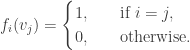
If V is finite-dimensional, then a basis \{v_1, \ldots, v_n\} of V gives rise to a dual basis \{f_1, \ldots, f_n\} of V* where

f_i(v_j) = \begin{cases} 1, \quad &\text{if } i = j,\\ 0,\quad &\text{otherwise.}\end{cases}

or simply f_i(v_j) = \delta_{ij} with the Kronecker delta symbol. The next result we would like to show is:

Proposition. Let V and W be finite-dimensional over K.

  • We have V^*\otimes W^* \cong (V\otimes W)^* taking (f, g) to the map V\otimes W\to K, (v\otimes w) \mapsto f(v)g(w).
  • Also V^* \otimes W \cong \text{Hom}_K(V, W) taking (f, w) to the map V\to W, v\mapsto f(v)w.

Proof

For the first case, fix fV*, gW*. The map V\times W \to K taking (v,w)\mapsto f(v)g(w) is bilinear so it induces a map h:V\otimes W\to K taking (v\otimes w)\mapsto f(v)g(w). But the assignment (fg) → h gives rise to a map V^* \times W^* \to (V\otimes W)^* which is bilinear so it induces \varphi:V^* \otimes W^* \to (V\otimes W)^*. Note that f\otimes g corresponds to the map h:V\otimes W\to K taking v\otimes w \mapsto f(v)g(w).

To show that this is an isomorphism, let \{v_i\} and \{w_j\} be bases of V and W respectively, with dual bases \{f_i\} and \{g_j\} of V* and W*. The map then takes f_i \otimes g_j to the linear map V\otimes W\to K which takes v_k \otimes w_l to f_i(v_k) g_j(w_l) = \delta_{ik}\delta_{jl}. But this corresponds to the dual basis of \{v_i \otimes w_j\}, so we see that the above map φ takes a basis \{f_i \otimes g_j\} to a basis: dual of \{v_i\otimes w_j\}.

The second case is left as an exercise. ♦

Note

Here’s one convenient way to visualize the above. Suppose elements of V comprise of column vectors. Then V* is the space of row vectors, and evaluating V* × → K corresponds to multiplying a row vector by column vector, thus giving a scalar. So V*W* ≅ (VW)* follows quite easily: indeed, the LHS concatenates two spaces of row vectors, while the RHS concatenates two spaces of column vectors then turns it into a space of row vectors.

The tensor product is a little trickier: for V and W we take column vectors with entries \alpha_1, \ldots, \alpha_n and \beta_1, \ldots, \beta_m respectively. Then we form the column vector with mn entries \alpha_i \beta_j. This lets us see why V*⊗W* ≅ (VW)*: in both cases we get a row vector with mn entries. Finally, to obtain V* ⊗W we take row vectors \alpha_1, \ldots, \alpha_n for elements of V* and column vectors \beta_1, \ldots, \beta_m for those of W, and the these multiply to give us an m × n matrix, which represents linear maps VW:

row_col_matrix

Question

Consider the map V* × V → K which takes (f, v) to f(v). This is bilinear so it induces a linear map fV*⊗V → K. On the other hand, V*⊗V is naturally isomorphic to End(V), the space of K-linear maps VV. If we represent elements of End(V) as square matrices, what does f correspond to?

[ Answer: the trace of the matrix. ]

Tensor Algebra

Given a vector space V, let us consider n consecutive tensors:

V^{\otimes n} := \overbrace{V\otimes V\otimes \ldots \otimes V}^{n \text{ copies}}.

and let T(V) be the direct sum \oplus_{n=0}^\infty V^{\otimes n} = K \oplus V \oplus (V\otimes V) \oplus (V\otimes V\otimes V)\ldots. This gives an associative algebra over K by extending the bilinear map

V^{\otimes m} \times V^{\otimes n} \to V^{\otimes (m+n)}, \quad (v_1, v_2) \mapsto v_1 \otimes v_2.

to the entire space T(V) × T(V) → T(V). Note that it is not commutative in general. For example, suppose V has a basis {xyz}. Then

  • V^{(2)} has basis \{x^2, xy, xz, yx, y^2, yz, zx, zy, z^2\}, where we have shortened the notation x^2 := x\otimes x, xy := x\otimes y, etc.
  • V^{(3)} has basis \{x^3, x^2 y, \ldots\}, with 27 elements.
  • Multiplying V\times V^{(2)} \to V^{(3)} gives (x+z)(xy + zx) = x^2 y + xzx + zxy + z^2 x.

The algebra T(V), called the tensor algebra of V, satisfies the following universal property.

Theorem. The natural map ψ : V → T(V) is a linear map such that:

  • for any associative K-algebra A, and K-linear map φ: V → A, there is a unique K-algebra homomorphism f: T(V) → A such that φ = fψ.

Thus, \text{Hom}_{K-\text{lin}}(V, A) \cong \text{Hom}_{K-\text{alg}}(T(V), A).

However, often we would like multiplication to be commutative (e.g. when dealing with polynomials) and we’ll use the symmetric tensor algebra instead. Or we would like multiplication to be anti-commutative, i.e. xy = –yx (e.g. when dealing with differential forms) and we’ll use the exterior tensor algebra instead. We will say more about these when the need arises.


Posted in Notes | Tagged , , , , , | Leave a comment

Hom Functor

Fret not if you’re unfamiliar with the term functor; it’s a concept in category theory we will use implicitly without delving into the specific definition. This topic is, unfortunately, a little on the dry side but it’s a necessary evil to get through.

Let R be a ring, and MN be left R-modules. The set of R-module homomorphisms MN is denoted by HomR(MN) or just Hom(MN) when the base ring is clear. This forms an abelian group under addition, where adding fgM → N just gives:

f+g : M \to N, \quad (x\in M) \mapsto (f(x) + g(x) \in N).

When R is commutative, in fact Hom(MN) is an R-module since given rRfM → N, we can define (r·f) : M → N to be the map x \mapsto r\cdot f(x). This fails when the base ring is non-commutative because (r\cdot f)(r'x) = r\cdot f(r'x) = rr'\cdot f(x) \ne r'\cdot (r\cdot f)(x).

Functoriality

By functoriality, we mean the following:

Lemma. If g : N → N’ is a homomorphism of R-modules, then composing gives us group homomorphisms:

\begin{aligned} g_* :\text{Hom}_R(M, N) \to \text{Hom}_R(M,N'), \qquad &(f : M\to N) \mapsto (g\circ f : M\to N')\\ g^*:\text{Hom}_R(N', M) \to \text{Hom}_R(N, M), \qquad &(f : N'\to M) \mapsto (f\circ g :N\to M).\end{aligned}

Furthermore, if h : N’ → N” is another R-module homomorphism, then composing gives:

\begin{aligned} h_* \circ g_* &= (h\circ g)_* : \text{Hom}_R(M, N) \to \text{Hom}_R(M, N''), \\ g^* \circ h^* &= (h\circ g)^* : \text{Hom}_R(N'', M) \to \text{Hom}_R(N, M). \end{aligned}

Finally, given any module N, the identity map 1N : N → N gives the identity maps for the following:

\begin{aligned} (1_N)_* : &\text{Hom}(M, N) \to \text{Hom}(M, N), \\ (1_N)^* : &\text{Hom}(N, M) \to \text{Hom}(N, M).\end{aligned}

The proofs for the above are quite easy and thus omitted. Hence, we need to bear in mind that the Hom functor is direction-reversing in the first term and direction-preserving in the second. [ At worst, just memorise it; that certainly beats getting confused by the direction all the time. ]

Note

Under category theory, direction-reversing (resp. -preserving) is given the term contravariant (resp. covariant). It is standard notation in literature to denote a contravariant functor by g^* and covariant one by g_*. Breaking this convention will result in unnecessary confusion!

Example

To motivate the above definition, let us look not at modules but at rings instead. Consider the following ring R:

R = \mathbf{Z}[a,b,c,d]/\left< ad-bc-1\right>.

Any ring homomorphism fRS then corresponds to picking elements wxyz ∈ S such that wz – xy = 1, i.e. a 2 × 2 matrix of determinant 1. Indeed, for such an f, we just take the images f(a), f(b), f(c), f(d) ∈ S. Furthermore, if gST is a ring homomorphism, then the map:

g_* : \text{Hom}_{\text{ring}}(R, S) \longrightarrow \text{Hom}_{\text{ring}}(R, T), \quad f \mapsto g\circ f

corresponds to mapping elements wxyz ∈ S such that wz – xy = 1 to g(w), g(x), g(y), g(z) ∈ T, which also satisfy the same equation.

blue-lin

Bimodules

When M or N is endowed with additional structure, it is possible to form a module out of Hom(MN):

Definition. Let R, S be rings. An (R, S)-bimodule is an abelian group M equipped with a left R-module and right S-module structure such that both commute, i.e. for all r∈R, s∈S, m∈M, we have (rm)s = r(ms).

One way of visualizing this is via an expression:

\overbrace{r_1 r_2 \ldots r_k}^{\in R}\overbrace{\ m\ }^{\in M} \overbrace{s_1 s_2 \ldots s_l}^{\in S}

which is associative, i.e. independent of our choice of bracketing.

Examples

  1. If R is commutative, any R-module is automatically an (RR)-bimodule.
  2. Any ring R is an (RR)-bimodule.
  3. More generally, if RS is a ring homomorphism, then S is an R-algebra and S is an (RS)-, (SR)- and (RR)-bimodule.
  4. If M is a left R-module, we can turn it into a right Rop module by defining mr’ (r’ ∈ Rop) to be rm where rR is the element corresponding to r’Rop. Does this turn M into an (R, Rop)-bimodule? [ Answer: no because the left and right actions don’t commute. ]

When either M or N is a bimodule, the resulting Hom(MN) gets a module structure.

Proposition. Let M, N be R-modules.

  • If M is an (R, S)-bimodule, then HomR(M, N) is a left S-module, via s\cdot f : M\to N, m \mapsto f(ms).
  • If N is an (R, S)-bimodule, then HomR(M, N) is a right S-module, via f\cdot s:M \to N, m\mapsto f(m)s.

Proof

We will only check the commutativity of the action of S. For the first case,

s'(s\cdot f): m \mapsto (s\cdot f)(ms') = f(ms's),\qquad (s's)\cdot f : m\mapsto f(ms's).

For the second case,

(f\cdot s)\cdot s' : m\mapsto (f\cdot s)(m)s' = f(m)ss', \qquad f\cdot (ss') : m\mapsto f(m)ss'. ♦

Here’s one way to remember this: as we mentioned earlier, Hom reverses direction in the first component by turning the right S-action into a left one, and preserves direction in the second.

Quick exercise

We know that HomR(R, M) is uniquely determined by the image of 1∈R. Thus we get a bijection M ↔ HomR(R, M). This is clearly an isomorphism of abelian groups. On the other hand, R is an (RR)-bimodule so HomR(R, M) also becomes a left R-module. Check that the bijection is an isomorphism of left R-modules.

Definition. Let M be a left R-module. From the (R, R)-bimodule structure of R, we get a right-module structure onHomR(M, R). This is called the dual of M and denoted by M*.

Note

Linear algebra over division rings is mostly identical to that over fields, but the dual of a left vector space becomes a right vector space.

blue-lin

Hom Functor is Left Exact

The main result we’d like to show is:

Theorem. Suppose 0\to M' \stackrel{f}\to M \stackrel{g}\to M'' is an exact sequence of modules. Then for any module N, the following sequence is exact as well:

0 \to \text{Hom}_R(N, M') \stackrel{f_*}\to \text{Hom}_R(N, M) \stackrel{g_*}\to \text{Hom}_R(N, M'').

Proof

There are several parts to this result:

  • f_* is injective: if hN → M’ is such that fhN → M is zero, then since f is injective, h = 0.
  • Since gf = 0, we also have g_* f_* = (gf)_* = 0_* = 0. Thus \text{im}(f_*) \subseteq \text{ker}(g_*).
  • Conversely, suppose h\in \text{ker}(g_*) so hN → M is a map such that ghN → M” is the zero map. Then im(h) ⊆ ker(g) = im(f). Since fM’ → M is injective, this gives h' := f^{-1} h: N\to M' and f_*(h') = fh' = h. ♦

The following result is sometimes useful too:

Proposition. If 0\to M' \stackrel{f}\to M \stackrel{g}\to M'' is a sequence of modules such that

0 \to \text{Hom}_R(N, M') \stackrel{f_*}\to \text{Hom}_R(N, M) \stackrel{g_*}\to \text{Hom}_R(N, M'').

is exact for all N, then the sequence is exact.

Sketch of Proof

Let NR, the base ring. Then we recover the exact desired sequence. ♦

Motivation

Let us briefly explain why the above results are of interest. Ideally, we would like to have a functor F such that whenever M’ → M → M” is exact, the resulting F(M’) → F(M) → F(M”) is exact too. This is tremendously convenient, since F then commutes with kernel, image, cokernel etc. However, the above result says Hom(N, -) is only “left-exact”. For example, consider the surjective map of Z-modules, Z → Z/2 → 0. Taking NZ/2 gives us Hom(Z/2, Z) → Hom(Z/2, Z/2) → 0 which is not exact since the first term is 0.

Suppose we would like to prove that some functor F is left-exact. Here’s one way:

  • Represent F using the Hom-functor, i.e. find an N such that F(M) = Hom(NM).
  • From the above result, we immediately see that F is left-exact.

Exercise

Prove the above for Hom(-, N) as well: i.e. suppose M' \stackrel{f}\to M \stackrel{g}\to M'' \to 0 is an exact sequence. Then for any module N, we get an exact sequence:

0 \to \text{Hom}_R(M'', N) \stackrel{g^*}\to \text{Hom}_R(M, N) \stackrel{f^*}\to \text{Hom}_R(M', N).

Conversely, if the above sequence is exact for all N, then M' \stackrel{f}\to M \stackrel{g}\to M'' \to 0 is exact.

Thus, Hom(N, -) takes left-exact sequences to left-exact sequences and Hom(-, N) takes right-exact to left-exact sequences too. In both cases, the final outcome is left-exact and one often says in short, the Hom functor is left-exact.

Posted in Notes | Tagged , , , , , | Leave a comment

Exact Sequences and the Grothendieck Group

As before, all rings are not commutative in general.

Definition. An exact sequence of R-modules is a collection of R-modules M_i and a sequence of R-module homomorphisms:

\ldots \stackrel{f_{i+2}}{\longrightarrow} M_{i+1} \stackrel{f_{i+1}}{\longrightarrow} M_i \stackrel{f_i}{\longrightarrow} M_{i-1} \stackrel{f_{i-1}}{\longrightarrow}\ldots

such that \text{ker}(f_i) = \text{im}(f_{i+1}) for all i.

Examples

1. The sequence 0\longrightarrow N \stackrel f\longrightarrow M is exact if and only if f is injective.

2. The sequence M \stackrel g\longrightarrow P\longrightarrow 0 is exact if and only if g is surjective.

3. The sequence 0 \longrightarrow N \stackrel{f}{\longrightarrow} M \stackrel{g}{\longrightarrow} P\longrightarrow 0 is exact if and only if f is injective, g is surjective, and im(f) = ker(g). This is called a short exact sequence.

Short Exact Sequences

Note that the short exact sequence is equivalent to the following assertions:

  • N is isomorphic to a submodule N’ of M;
  • P is isomorphic to the quotient M/N’.

Hence, given a short exact sequence we may assume it is of the form 0 \to N \to M \to M/N \to 0 for a submodule N of M. Short exact sequences are important because knowledge of N and M/N often tell us something about M itself. Here are some examples.

1. M is of finite order if and only if N and M/N are, in which case we have |M| = |M/N| × |N|.

2. Suppose RZ. Then M is finitely generated if and only if N and M/N are, in which case rk(M) = rk(M/N) + rk(N).

3. Suppose R is a division ring. Then M is finite-dimensional if and only if N and M/N are, in which case dim(M) = dim(M/N) + dim(N).

4. Over any ring, M is of finite length if and only if N and M/N are, in which case we have l(M) = l(M/N) + l(N). More generally, if we let CF(M) denote the formal sum of its composition factors, then CF(M) = CF(M/N) + CF(N).

In general, it is hard to recover M from M/N and N; this is called the extension problem and is classified by something called the “Ext functor”, which is another story for another day.

Breaking Up Long Exact Sequences

Suppose we have the following long exact sequence:

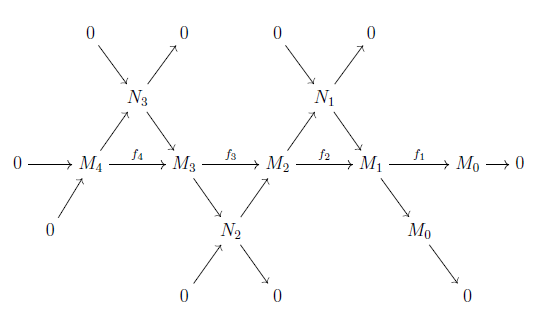
0 \longrightarrow M_4 \stackrel{f_4}{\longrightarrow} M_3\stackrel{f_3}{\longrightarrow} M_2 \stackrel{f_2}{\longrightarrow} M_1 \stackrel{f_1}{\longrightarrow}M_0 \longrightarrow 0.

Since N_i := \text{ker}(f_i) = \text{im}(f_{i+1}), this allows us to break it into a collection of short exact sequences.

long_exact_seq_sep

For example, if all the terms are finite, we obtain:

|M_4| = |N_3|,\ |M_3| = |N_3| + |N_2|, \ |M_2| = |N_2| + |N_1|, \ |M_1| = |N_1| + |M_0|,\ |M_0| = |M_0|

which gives the alternating sum |M_4| - |M_3| + |M_2| - |M_1| + |M_0| = 0. We could repeat the same argument for the ranks of the terms, etc, but instead let’s have a common framework.

Grothendieck Group

Let ∑ be any set of R-modules, including the zero module. Take the set of all formal sums

\sum_{i=1}^k a_i [M_i],\quad a_i \in \mathbf{Z}, M_i \in \Sigma

which forms an abelian group freely generated by \{[M_i] : M_i \in \Sigma\}. Note that we specifically said ∑ is a set to avoid running into set-theoretic paradoxes. Take the quotient of this group by the subgroup generated by relations:

[M] - [N] - [P] if there is an exact sequence 0\to N\to M \to P \to 0.

The resulting quotient is called the Grothendieck group G(∑). Letting NMP = 0,  we have [0] = [0] + [0] in G(∑), so [0] = 0 as it should be. Next if MM’ ∈ ∑ are two isomorphic modules, the short exact sequence 0 → M → M’ → 0 → 0 then gives us [M] = [M’] in the Grothendieck group, as we would expect.

Suppose ∑ is closed under submodules and quotients. From the above observation, a long exact sequence of the form:

0 \longrightarrow M_n \stackrel{f_n}{\longrightarrow} M_{n-1}\stackrel{f_{n-1}}{\longrightarrow} \ldots \stackrel{f_2}{\longrightarrow} M_1 \stackrel{f_1}{\longrightarrow}M_0 \longrightarrow 0

then gives the following relation in the Grothendieck group:

[M_0] - [M_1] + \ldots + (-1)^{n-1}[M_{n-1}] + (-1)^n [M_n] = 0.

Now we have a convenient language to describe the above.

Examples

1. Let ∑ be the collection of isomorphism classes of R-modules of finite cardinality. Taking the order then gives a group homomorphism G(∑) → Q*, where each [M] → |M|. [ We need to take the isomorphism classes so that ∑ forms a set instead of a proper class. This will be implicit from now onwards. ]

2. Let ∑ be the collection of finitely generated Z-modules. Taking the rank then gives a group homomorphism G(∑) → Z, where each [M] → rk(M).

3. When R is a division ring, taking the dimension for finite-dimensional vector spaces also gives a group homomorphism G(∑) → Z.

4. Let R be any ring and ∑ be the collection of R-modules of finite length. Let Φ be the set of isomorphism classes of simple modules, and ZΦ be the abelian group freely generated by elements of Φ. We define a group homomorphism ω : G(∑) → ZΦ as follows:

[M], M\in \Sigma\ \mapsto\ [N_0] + [N_1]+ \ldots + [N_k] \in \mathbf{Z}\Phi

where N_0, N_1, \ldots, N_k are the composition factors of M. Recall that the composition factors of M are independent of the choice of composition series, up to isomorphism and permutation. Hence ω is a well-defined map. It is a group homomorphism since we can concatenate composition series of N and M/N to obtain one for M. It is clearly surjective since ω[M] = [M] for any simple module M.

On the other hand, consider the map ν : ZΦ → G(∑) via extending [M] → [M] for any simple M. Clearly νω is the identity on G(∑) since [M] gets mapped to the sum of its composition factors in G(∑), which is equal to [M] in G(∑). Thus, ω is injective. In conclusion:

Theorem. Let ∑ be the collection of all modules of finite length. The Grothendieck group G(∑) is an abelian group freely generated by [M], for all simple modules M.

If R is artinian, there are only finitely many such M so G(∑) is finitely generated.

Posted in Notes | Tagged , , , , | 2 Comments

Krull-Schmidt Theorem

Here, we will prove that the process of decomposing M = M_1 \oplus \ldots \oplus M_k is unique, given that M is noetherian and artinian.

Again, R is a ring, possibly non-commutative.

Definition. A decomposition of an R-module M is an expression M = M_1 \oplus \ldots \oplus M_k for non-zero modules M_1, \ldots, M_k.

An R-module M is said to be indecomposable if no such expression exists for k≥2 (or equivalently, for k=2).

A simple module is clearly indecomposable, but the converse is not true.

For example, let R = \begin{pmatrix} * & * \\ 0 & *\end{pmatrix} be the ring of upper-triangular 2 × 2 real matrices. Consider the module M of column vectors R2, where R acts by matrix multiplication. Then M is not simple since it has a submodule spanned by (1, 0). But M is indecomposable since any submodule N ⊂ M which contains an (xy) for y≠0 must be the whole M.

We have a criterion for a module to be indecomposable:

Proposition. Let M be an artinian and noetherian R-module. Then M is indecomposable if and only if \text{End}_R(M) is a local ring.

Proof

⇐ : if MM1 ⊕ M2 is a decomposition of M, let π1, π2  : M → M be the projection onto M1M2 respectively. Then π1, π2 are not units but π12 is.

⇒ : recall that for an artinian and noetherian M, a module map fM → M is bijective iff it is surjective or injective. Now suppose fg : M → M are module maps such that f+g is a unit and g is not. We need to show that f is a unit.

Write (f+g)h = 1 for some h : M → M, so fh = 1-gh. Now k := gh is not an isomorphism since g is not surjective. Since M is artinian and noetherian, eventually

\text{ker} (k^n)= \text{ker}(k^{n+1}) = \ldots, \qquad \text{im}(k^n)= \text{im}(k^{n+1}) \ldots

for some large n. We claim that M = \text{ker}(k^n)\oplus \text{im}(k^n).

  • To show M = \text{ker}(k^n)+ \text{im}(k^n): for any xM, we have k^n(x) \in \text{im}(k^n) = \text{im}(k^{2n}) so we can write k^n(x) = k^{2n}(y). But then x = (x - k^n(y)) + k^n(y); clearly the second term lies in \text{im}(k^n) and the first term gives k^n(x - k^n(y)) = k^n(x) - k^{2n}(y) = 0 so it lies in \text{ker}(k^n).
  • To show \text{ker}(k^n) \cap \text{im}(k^n) = 0: if y = k^n(x) lies in \text{ker}(k^n) then we have k^n(y) = k^{2n}(x) = 0 which gives x \in \text{ker}(k^{2n}) = \text{ker}(k^n) and so y =k^n(x) = 0.

Since M is indecomposable either \text{ker}(k^n) = 0 or \text{im}(k^n) = 0. The former case says k is injective and hence an isomorphism, so we have the latter case kn=0. Thus fh = 1-k is invertible (since 1 + nilpotent = unit), so f is right-invertible. By symmetry, it is also left-invertible. ♦

blue-lin

The Krull-Schmidt Theorem

Before stating and proving our main theorem, here is a useful criterion for splitting a module as a direct sum:

Splitting Lemma. If f: M \to N, g:N\to M satisfy gf = 1_M then N splits as \text{im}(f)\oplus \text{ker}(g). Furthermore f is injective, thus M is a direct summand of N.

Note

To remember this, imagine NMP with fM → MP and gMP → M given by the inclusion and projection maps.

Proof

f is injective since gf is. For the first statement:

  • M = im(f) + ker(g) : any xM can be written as x = fg(x) + (xfg(x)); the first term lies in im(f); the second term gives g(x – fg(x)) = g(x) – gfg(x) = 0.
  • im(f) ∩ ker(g) = 0: if f(y) lies in ker(g), then gf(y) = 0 so y = 0. ♦

Finally the main theorem we would like to prove:

Krull-Schmidt Theorem. Let M be an artinian and noetherian module. If we decompose:

M \cong U_1 \oplus U_2 \oplus \ldots \oplus U_k, \qquad M\cong V_1 \oplus V_2 \oplus \ldots \oplus V_l

then k=l and there is a permutation σ of {1, 2, …, k} such that U_i \cong V_{\sigma(i)} for all i=1,…,k.

Proof

We shall prove that U1 ≅ Vj for some j, such that M \cong V_j \oplus U_2 \oplus \ldots \oplus U_k, after which we can apply induction on k.

Let p: M\to M be the projection onto U1 and q_i : M\to M be the projection onto Vi.  This gives \sum_i q_i = 1_M and thus p = p\sum_i q_i = \sum_i (pq_i). Since im(p) ⊆ U1 this restricts to a map

\alpha_i = p(q_i|_{U_1}) : U_1 \to U_1.

Since U1 is indecomposable, End(U1) is local; and since \sum_j \alpha_j = 1_{U_1}, one of the αj is invertible, say α1. Let r:U_1 \to U_1 be the inverse of \alpha_1 : U_1 \to U_1, so

r(p|_{V_1})(q_1|_{U_1}) = 1_{U_1}, where q_1|_{U_1} : U_1 \to V_1, p|_{V_1} : V_1 \to U_1, r: U_1 \to U_1. (*)

From the splitting lemma, Uis a direct summand of V1; since V1 is indecomposable we must have U1V1. To prove that M \cong V_1 \oplus (U_2 \oplus \ldots \oplus U_k) we write (*) as

rp (q_1|_{U_1}) = 1_{U_1} where q_1|_{U_1} : U_1 \to M, p : M\to U_1, r : U_1\to U_1.

Again, splitting lemma tells us M \cong \text{ker}(rp) \oplus \text{im}(q_1|_{U_1}). The second term is isomorphic to V1 and the first is just ker(p), which is U_2 \oplus \ldots \oplus U_k as desired. ♦

Note

Because M is artinian and noetherian it is always possible to decompose M as a direct sum of finitely many indecomposable modules. Simply keep decomposing the terms until we’re left with indecomposable modules: since M is of finite length, the process must terminate. Krull-Schmidt theorem says that the resulting terms are unique to isomorphism and permutation.

Example

Let R be the ring of upper-triangular 2 × 2 matrices with real entries. Here are two different ways of decomposing R as a direct sum of indecomposable left ideals:

R = \left\{\begin{pmatrix} * & * \\ 0 & * \end{pmatrix}\right\} = \left\{ \begin{pmatrix} * & 0 \\ 0 & 0 \end{pmatrix}\right\} \oplus \left\{ \begin{pmatrix} 0 & * \\ 0 & *\end{pmatrix}\right\} = \left\{ \begin{pmatrix} a & a \\ 0 & 0\end{pmatrix}\right\} \oplus \left\{ \begin{pmatrix} 0 & * \\ 0 & * \end{pmatrix} \right\}.

Regardless of the decomposition we pick, the second term must be there (prove this!).

Posted in Notes | Tagged , , , , , | Leave a comment

Local Rings

Mathematicians are generally more familiar with the case of local commutative rings, so we’ll begin from there.

Definition. A commutative ring R is said to be local if it has a unique maximal ideal.

Note that every non-zero commutative ring has at least one maximal ideal; indeed, we can take the collection ∑ of all ideals of R not containing 1; Zorn’s lemma provides a maximal element in ∑, which does not contain 1 and is maximal.

Lemma. If R is a commutative local ring with maximal ideal M, then its complement R-M is the set of units of R.

Proof

If xR is a unit, it cannot be contained in the proper ideal M, so it must lie in RM. Conversely, if xR is not a unit, the ideal Rx is properly contained in R so it is contained in a maximal ideal. But since there’s only one maximal ideal we have Rx ⊆ M, so xM, and we have xRM. ♦

Proposition. A commutative ring R is local if and only if whenever x and y are non-units, so is x+y. [ Equivalently, if x+y is a unit, then either x or y is a unit. ]

Proof

Suppose R is local with maximal ideal M. The above lemma says M is precisely the set of non-units of R. Thus this set is closed under addition.

Conversely, let M be the set of non-units of R and assume (xy ∈ M ⇒ x+y ∈ M). We claim that M is an ideal. First it is closed under addition by condition. Next if xMyR, we claim xyM; indeed if not, xy is a unit so both x and y are units (contradiction!). So the set of non-units of R is an ideal. On the other hand, every xRM is a unit so cannot be contained in a maximal ideal. This shows that M is the unique maximal ideal of R. ♦

Examples

1. Let R be the set of rational numbers of the form a/b, where b is not divisible by 7. Then R is local; indeed, xR is a unit if and only if x=a/b, where ab are not divisible by 7. So if x,yR are non-units, then x=a/by=c/d, where a, b are divisible by 7 and cd are not. Hence, so is x+y = (ad+bc)/(bd). Thus, the unique maximal ideal M of R is given by a/b, where a is divisible by 7 and b is not.

2. Let R be the set of rational functions in x of the form f(x)/g(x) where f(x), g(x) are polynomials and g has non-zero constant term. An element of R is non-unit iff it is of the form f(x)/g(x) where f has zero constant term and g does not. By the same reasoning as in example 1, this forms the unique maximal ideal of R.

3. More generally let S be an integral domain and P be any prime ideal of S. Take K, the field of fractions of S. Now define:

R = \{\frac x y \in K : x \in S, y \in S-P\}.

The set of non-units of R is thus M := \{\frac x y\in K : x\in P, y\in S-P\}. One sees that this is closed under addition (we need P to be prime so that the product of elements of SP remains in SP). So R is local with maximal ideal M.

Example 3 can even be generalized to a commutative ring with zero-divisors. This is the essence of localization, which is another story for another day.

blue-lin

Non-commutative Local Rings

We repeat the above definition for non-commutative R.

Definition. Let R be a ring, not necessarily commutative. We say that R is local if, whenever x, y ∈ R are non-unit, so is x+y.

In other words, R is local if whenever x+y is a unit, either x or y is a unit. Since x is a non-unit iff –x is, we see that the definition is unchanged when we replace x+y with xy. Hence, we have the following:

  • (non-unit) ± (non-unit) = (non-unit);
  • (unit) ± (non-unit) = (unit). [ For if it were a non-unit, bringing the LHS non-unit term to the RHS contradicts the first property. ]

Lemma. Let R be a local ring. If x, y are non-units, so is xy.

[ Note: this is not as trivial as it seems! Indeed, without the local property, we can only conclude that x has a right inverse. ]

Proof

Assuming xy is a unit, we get:

  • y non-unit, 1 unit ⇒ 1+y unit;
  • xy unit, x non-unit ⇒ xy+x unit;
  • xy+xx(y+1) unit, y+1 unit ⇒ x unit (contradiction). ♦

Thus, in a local ring we have:

  • (unit) × (unit) = (unit). [ Obvious. ]
  • (non-unit) × (unit) = (non-unit). [ If this were a unit, divide by the inverse of the unit on the LHS to get a contradiction. ]
  • (unit) × (non-unit) = (non-unit). [ Same as above. ]
  • (non-unit) × (non-unit) = (non-unit). [ Above lemma. ]

Next we have:

Proposition. If R is a non-zero local ring, the set of non-units is precisely the Jacobian radical J(R), the set of “bad elements”.

Proof

Let N be the set of non-units of R. By definition, N is closed under addition/subtraction. By the above observation, we see that if x or y is a non-unit, so is xy. Thus N is a two-sided ideal of R.

Obviously no element of J(R) is a unit (for R must have a maximal left ideal). Thus J(R)⊆N. Conversely, if x lies in N, and not in some maximal left ideal M, we get RxMR. So yxz = 1 for some y in Rz in M. But yx and z are both non-units which sum up to a unit, contradicting what we know about local rings. ♦

Corollary. In an artinian local ring R, every element is either unit or nilpotent. The radical is precisely the set of nilpotent elements.

Proof

In an artinian ring, the Jacobian J is nilpotent. In particular, every element of J is nilpotent. But the above proposition says J is precisely the set of non-units! ♦

Finally, we have:

Lemma. Let R be a local ring, and I ⊂ R be a proper two-sided ideal. Then R/I is also local.

Proof

Suppose (x+I), (y+I) ∈ R/I are such that (x+y)+I is a unit, so there is zR such that z(x+y) – 1 and (x+y)z – 1 are elements of I. An element of I is not a unit. Since R is local, z(x+y) and (x+y)z are units (e.g. if z(x+y) and z(x+y)-1 are both non-units, then so is 1, which is absurd). Hence, x+y is a unit, since in general if ab and ba are both units, then a and b are both left- and right-invertible and units as well. Again since R is local, we know that x or y is a unit, and so x+I or y+I is a unit. ♦

Posted in Notes | Tagged , , , , | Leave a comment

Jacabson Radical

Recall that the radical of the base ring R is called its Jacobson radical and denoted by J(R); this is a two-sided ideal of R. Earlier, we had proven that a ring R is semisimple if and only if it is artinian and J(R) = 0. Here we will demonstrate more properties of J(R).

For convenience, we will assume throughout this article that our base ring R is always artinian. Thus, we can take its quotient by the Jacobson radical to obtain S := R/J(R) in an attempt to make it semisimple by eliminating the radical.

Lemma. The collection of simple R-modules is precisely the collection of simple S-modules.

Proof

⇐ : in general, if I ⊂ R is any two-sided ideal, then a simple (R/I)-module is also a simple R-module.

⇒ : if M is a simple R-module, we saw earlier that J(R)M = 0, so M is in fact an R/J(R)-module. ♦

Proposition. S is semisimple, and is called the largest semisimple quotient of R because of the following universal property:

  • R → S is a surjective ring homomorphism to a semisimple ring;
  • if f : R → T is a surjective ring homomorphism to a semisimple ring T, then f factors through R → S (i.e. ker(f) ⊇ J(R)).

Proof

S is an artinian ring since any left S-module is also an R-module. Now it remains to show J(S) = 0. But J(S) is the intersection of all maximal left ideals of S, which corresponds to the intersection of all maximal left ideals of R containing J(R), which is precisely J(R). Thus J(S) = 0 and the first property holds.

For the second, T is semisimple as a T-module so it is a direct sum of simple left ideals of T. Since RT is surjective, they are also simple left modules over R. On the other hand, every x in J(R) satisfies xM = 0 for any simple R-module M. Thus J(R)T = 0, and J(R) ⊆ ker(f). ♦

There is an analogous result for modules.

Proposition. Let M be an R-module; now N := M/(J(R)M) is the largest semisimple quotient of M due to the following universal property:

  • M → N is a module homomorphism to a semisimple module;
  • if f : M → P is a module homomorphism to a semisimple module, then f factors through N (i.e. ker(f) ⊇ J(R)M).

Proof

N is also a module over S := R/J(R), which we already know is a semisimple ring, so it is a sum of simple S-modules. Every simple S-module is a simple R-module, so N is a semisimple R-module. This proves the first statement.

For the second, since P is semisimple we have J(R)P = 0. So f(J(R)M) = J(R)f(M) ⊆ J(R)P = 0, and so J(R)M ⊆ ker f. ♦

But what about the radical of M? It turns out to be the same as J(R)M:

Lemma. If M is an R-module, J(R)M = rad(M).

Proof.

For any ring R, we always have J(R)M ⊆ rad(M). Indeed, the natural map

M/\text{rad}(M) \longrightarrow \prod_{N\subset M \text{max}} (M/N)

is injective and the image lies in a product of simple modules M/N. Since J(R)·(M/N) = 0 for each simple M/N, we also have J(R)M ⊆ rad(M) at the domain module.

Conversely, when R is artinian, the previous proposition says M/(J(R)M) is semisimple so it has zero radical, i.e. the intersection of all maximal submodules of M containing J(R)M is precisely J(R)M. So the intersection of all maximal submodules of M is contained in J(R)M and we get rad(M) ⊆ J(R)M. ♦

Before we proceed, let’s consider a concrete case.

Example

Let R be the set of 3 × 3 upper-triangular matrices with real entries \begin{pmatrix} * & * & * \\ 0 & * & * \\ 0 & 0 & * \end{pmatrix}. We saw in the previous article that R has exactly 3 simple modules up to isomorphism. Explicitly:

\begin{pmatrix} a & b & c \\ 0 & d & e \\ 0 & 0 & f\end{pmatrix} : \overbrace{\begin{pmatrix} u\\ 0 \\ 0 \end{pmatrix} \mapsto \begin{pmatrix} au\\ 0 \\ 0 \end{pmatrix}}^A, \overbrace{\begin{pmatrix} 0 \\ v \\ 0 \end{pmatrix} \mapsto \begin{pmatrix} 0 \\ dv \\ 0 \end{pmatrix}}^B, \overbrace{\begin{pmatrix} 0 \\ 0 \\ w \end{pmatrix} \mapsto \begin{pmatrix} 0 \\ 0 \\ fw\end{pmatrix}}^C.

We repeat that B and C are not submodules of the base ring. From the description of the simple modules, we get:

J(R) = \left\{\begin{pmatrix} 0 & * & * \\ 0 & 0 & * \\ 0 & 0 & 0 \end{pmatrix}\right \}.

So the largest semisimple quotient R/J(R) is just R × R × R. If M denotes the space R3 of column vectors, with R acting by left-multiplication, then rad(M) = J(R)M is just the space of (xyz) with z=0.

blue-lin

Further Properties

Finally, we wish to prove some rather important properties for artinian rings.

Theorem. J(R) is a nilpotent ideal of R.

Proof

Let IJ(R). Since R is artinian, the decreasing sequence (I^n)_{n\ge 1} of two-sided ideals must terminate so eventually I^{n+1} = I^n. Let J be this ideal; we get J^2 = J. We need to show that J=0.

If not, let ∑ be the set of all left submodules K ⊆ J such that JK≠0. This is non-empty since it contains J, so pick a minimal element K. Choose xK such that Jx≠0, which gives J(Jx) = J2xJx ≠0. Thus Jx is in ∑ and since Jx ⊆ K, we have JxK by minimality of K. In particular, yxx for some y in J; this gives (1-y)x = 0. Now apply the following lemma and we’re done. ♦

Lemma. For any y in J(R), 1+y is invertible.

Proof of Lemma.

Take the left ideal I := R(1+y) of R; we claim IR. Indeed, if not, it must be contained in a maximal left ideal M. [ Proof: consider the collection of all left ideals containing I but not 1; Zorn’s lemma says there is a maximal left ideal here; since it doesn’t contain 1, it is proper and maximal. ] But this gives J(R) ⊆ M and since 1+y and y are both in M, we get 1∈M which is absurd.

Hence, R(1+y) = R so we have z(1+y) = 1 for some z in R. But now z = 1-zy is in 1+J(R) also, so there is a w such that wz = 1. This gives 1+ywz(1+y) = w and so z is a two-sided inverse for 1+y. ♦

The next theorem is rather fascinating.

Hopkins-Levitzki Theorem. A left artinian ring is left noetherian.

Note

For commutative rings, we can say more: a ring is artinian ⇔ it is noetherian and all prime ideals are maximal.

Proof.

Let JJ(R) and consider the sequence of ideals

R \supseteq J \supseteq J^2 \supseteq \ldots

We just proved that J is nilpotent, so J^n = 0 for some n. Now each J^{i-1}/J^i is a left-module annihilated by J so it is an (R/J)-module, i.e. J^{i-1}/J^i is semisimple! Since R is artinian, so is each J^{i-1}/J^i. A semisimple module is a direct sum of simple modules; if it is artinian, there are only finitely many terms in this direct sum, so it is noetherian too. Hence each J^{i-1}/J^i is a noetherian R-module, and so is R. ♦

Next, we wish to strengthen the above theorem.

Theorem. The Jacobson radical J(R) is the unique maximal nilpotent ideal of R.

Proof

First we show that any nilpotent ideal I must be contained in J(R). Let xI. Since x is nilpotent, 1-x is a unit, for if xn = 0 we can write:

(1-x)(1+x+x^2 + \ldots+x^{n-1}) = \overbrace{1-x^n}^{=1} = (1+x+x^2+\ldots+x^{n-1})(1-x).

If I is not contained in J(R), then it is not contained in some maximal left ideal M of R. This gives IMR, so we have 1 = x+y for some xI and yM. But we just saw that y=1-x is a unit, which contradicts the fact that M is proper!

Now we complete the proof.

Consider the collection ∑ of all nilpotent ideals of R; we know J(R)∈∑. Now if A and B are both in ∑, so is A+B. Indeed, AB lies in both A and B, so:

A^m = B^n = 0 \implies (A+B)^{m+n} \subseteq A^m + B^n = 0

since in each expansion of AABA…, either A occurs at least m times or B occurs at least n times. Since R is left artinian, it is also left noetherian, and ∑ has a maximal element. From the above, this maximal element must be J(R) and every nilpotent ideal is contained in it. ♦

Posted in Notes | Tagged , , , , , , | Leave a comment

Composition Series

Positive integers can be uniquely factored as a product of primes. Here, we would like to prove a counterpart for modules. Now there are two ways to “factor” a module M; a more liberal way takes a submodule N which gives us composition factors (NM/N). A stricter way is to insist upon a direct sum MN ⊕ N’. There are uniqueness theorems in both cases, but we’ll focus on the former here.

Here, all modules are over a fixed ring R, possibly non-commutative.

Definition. A composition series of M is a sequence of submodules

0 = M_0 \subset M_1 \subset M_2 \subset \ldots \subset M_n = M

such that M_{i+1}/M_i is simple for each i=0,…,n-1. The length of the composition series is then n. The modules (M_{i+1}/M_i)_{i=0}^{n-1} are called the composition factors of the series.

Example

Let R be the ring of upper triangular matrices \begin{pmatrix} * & * & * \\ 0 & * & * \\ 0 & 0 & * \end{pmatrix} with real entries. Let R act on MR3 by left multiplication, so we get an R-module. We get a sequence of submodules:

e_1 = \begin{pmatrix} 1 \\ 0 \\ 0 \end{pmatrix}, e_2 = \begin{pmatrix} 0 \\ 1 \\ 0 \end{pmatrix}, e_3 = \begin{pmatrix} 0 \\ 0 \\ 1 \end{pmatrix} \implies 0 \subset \mathbf{R} e_1 \subset \mathbf{R} e_1 \oplus \mathbf{R} e_2 \subset M

which is a composition series since the consecutive factors are of dimension 1 over R so they must be simple.

Theorem. M has a composition series if and only if it is noetherian and artinian.

Proof

⇒ : a simple module is both noetherian and artinian, so M1 is noetherian and artinian. Since the same holds for M2/M1 we see that so is M2. Iterating, we see that Mn = M is artinian and noetherian.

⇐ : suppose M is noetherian and artinian. Assume M≠0. Taking the collection of non-zero submodules of M, this collection has a minimal element M1, which is necessarily simple. If M = M1 we’re done. Otherwise M/M1 is also noetherian, artinian and non-zero so it has a simple submodule, which must be of the form M2/M1 for some M1 ⊂ M2 ⊆ M. Keep repeating this procedure and we get an increasing sequence of M_0 \subset M_1 \subset \ldots of submodules of M. Since M is noetherian this must terminate after finitely many terms. ♦

 Corollary. If M has a composition series, so do any submodule N and its quotient M/N.

Furthermore, we can concatenate the composition series of N and M/N together, since a composition series for M/N corresponds to an increasing sequence N = M_0 \subset M_1 \subset \ldots \subset M_k = M such that the consecutive quotients are simple.

Now the main theorem we would like to prove is:

Theorem. If

\begin{aligned} 0 &=M_0 \subset M_1 \subset \ldots \subset M_m = M\\ 0 &=N_0 \subset N_1 \subset \ldots \subset N_n = M\end{aligned}

are two composition series for M, then the composition factors are identical up to isomorphism and permutation. In particular, they are of the same length.

Proof

For notation convenience, we shall denote the composition factors of (Mi) by CF(Mi).

The proof is by contradiction: suppose not. We let ∑ be the set of all submodules N of M such that there exist two composition series for N with distinct composition factors. Since M is artinian, ∑ has a minimal element. Replacing M with this, we may assume:

  • 0 = M_0 \subset M_1 \subset \ldots \subset M_m = M and 0 =N_0 \subset N_1 \subset \ldots \subset N_n = M are composition series of M with distinct composition factors;
  • for any proper submodule N of M, any two composition series have the same composition factors.

Now suppose M_{m-1} = N_{n-1} are the same submodule of M, then M_0 \subset M_1 \subset \ldots \subset M_{m-1} and N_0 \subset N_1 \subset \ldots \subset N_{n-1} are composition series for this submodule with distinct composition factors, which contradicts the minimality of M.

Otherwise M_{m-1} + N_{n-1} = M so we have

M_m/M_{m-1} = (M_{m-1} + N_{n-1})/M_{m-1} \cong N_{n-1}/(M_{m-1} \cap N_{n-1}) (#)

as well as N_n/N_{n-1} \cong M_{m-1}/(N_{n-1} \cap M_{m-1}). Now pick a composition series (Pi) for N_{n-1} \cap M_{m-1}. We have:

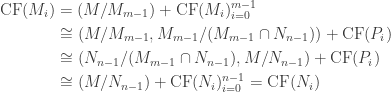
\begin{aligned}\text{CF}(M_i) &= (M/M_{m-1}) + \text{CF}(M_i)_{i=0}^{m-1}\\ &\cong (M/M_{m-1}, M_{m-1}/(M_{m-1} \cap N_{n-1})) + \text{CF}(P_i) \\ &\cong (N_{n-1}/(M_{m-1} \cap N_{n-1}), M/N_{n-1}) + \text{CF}(P_i)\\ &\cong (M/N_{n-1}) + \text{CF}(N_i)_{i=0}^{n-1} = \text{CF}(N_i)\end{aligned}

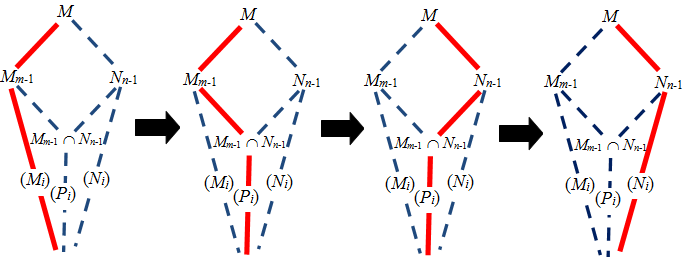
where the second and third equivalences follow from that M_{m-1}, N_{n-1} \subset M are proper submodules, so any two composition series must have identical factors. Pictorially, we have:

composition_uniq

where the first and third arrows follow from minimality of M and the second follows from the isomorphism (#). ♦

Hence, we define the length and composition factors of M to be those of any composition series of M. If l(M) denotes its length, we have l(M) = l(N) + l(M/N) for any submodule N of M.

If R is an artinian and noetherian ring, every simple module must occur among the composition factors of R, since a simple module must be a quotient of R. Let us consider the above example of R = set of 3 × 3 upper triangular real matrices. Then

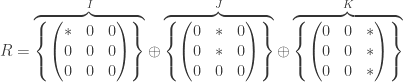
R = \overbrace{\left \{ \begin{pmatrix} * & 0 & 0 \\ 0 & 0 & 0 \\ 0 & 0 & 0\end{pmatrix}\right \}}^I \oplus \overbrace{\left \{ \begin{pmatrix} 0 & * & 0 \\ 0 & * & 0 \\ 0 & 0 & 0 \end{pmatrix} \right\}}^J \oplus \overbrace{ \left\{ \begin{pmatrix} 0 & 0 & * \\ 0& 0 & * \\ 0 & 0 & *\end{pmatrix} \right\}}^K

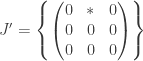
is a direct sum of three left ideals. I is clearly simple, while J has a submodule J' =\left\{ \begin{pmatrix} 0 & * & 0 \\ 0 & 0 & 0 \\ 0 & 0 & 0 \end{pmatrix}\right\} which is isomorphic to I. Similarly, K has a submodule which is isomorphic to J. Hence, as composition factors, we can write:

IA,   JA+B,   KA+B+C

so the composition series for R has 3 copies of A, 2 copies of B and 1 copy of C; thus R has exactly 3 simple modules up to isomorphism. Note that the composition series for J and K do not decompose them into direct sums.

Exercise

Prove that there is no submodule of M which is isomorphic to B or C. [ Hint: an element of B can be represented by (0, *, 0). Explicitly write down its R-module structure. Suppose fB → R takes (0, 1, 0) to the matrix T; write down equations for the 6 entries of T.  ]

Prove that AB and C are pairwise non-isomorphic.

Posted in Notes | Tagged , , , , , , , | Leave a comment

Radical of Module

As mentioned in the previous article, we will now describe the “bad elements” in a ring R which stops it from being semisimple. Consider the following ring:

R = \left \{ \begin{pmatrix} a & b \\ 0 & d\end{pmatrix} : a,b,d\in \mathbf{R}\right\}

Since R is finite-dimensional over the reals, it is both artinian and noetherian. However, R is not semisimple since the module MR2 (whose elements are column vectors) with R acting by left-multiplication is not semisimple. Indeed, the R-space spanned by (1, 0) is a submodule which is not a direct summand.

Definition. A maximal submodule of M is an N\subsetneq M such that if N’ satisfies N ⊆ N’ ⊆ M, then N’=N or N’=M.

For example, the zero module has no maximal submodules. For any prime p, the Z-submodule pZ ⊂ Z is maximal. Also, if M = \{\frac a {2^m} : a, m\in \mathbf{Z}\}, then the Z-module M/Z has no maximal submodule.

Exercise: prove the last sentence in the previous paragraph.

Now we shall define what we mean by “bad elements”.

Definition. The radical of M, written as rad(M), is the intersection of all maximal submodules of M. When M=R, this is also called the Jacobson radical and denoted J(R).

radical_module

Let us consider the case of modules first. We have the following basic result.

Lemma. Let M, N be modules over a fixed ring R.

  • If M ⊆ N, then rad(M) ⊆ rad(N).
  • If p : M → N is surjective, then p(rad(M)) ⊆ rad(N).
  • We have rad(M ⊕ N) = rad(M) ⊕ rad(N).

Proof

  • If x∈rad(M) and P is a maximal submodule of N, then M ∩ P ⊆ M is either maximal or equal to M (since we get an injection M/(M ∩ P) → N/P into a simple module). In either case, x lies in M ∩ P ⊆ P. Hence x∈rad(N).
  • Let x∈rad(M) and P be a maximal submodule of N. Then p-1(P) ⊂ M is maximal too since M/p-1(P) is isomorphic to N/P. Thus xp-1(P) and p(x)∈P.
  • ⊇ follows from the first part and M⊕0, 0⊕N ⊆ MN. And ⊆ follows from the second part, applied to projections MN → M and MN → N. ♦

The next result relates the radical to semisimplicity.

Proposition. If M is non-zero and semisimple, then rad(M) = 0. In particular, the Jacobson radical of a semisimple ring is 0.

Proof

If M is semisimple, write M as a direct sum \oplus_i M_i of simple submodules M_i \subseteq M. For each index i, let N_i be the submodule of M obtained by summing all \{M_j\}_{j\ne i}. Then each N_i is a maximal submodule of M and clearly \cap_i N_i =0. ♦

Corollary. Since we know that a semisimple ring is artinian and noetherian, we conclude that a semisimple ring R is artinian and its Jacobson radical is zero.

Now, we will prove the converse.

blue-lin

Jacobson Radical J(R)

Here is an alternative way of describing the Jacobson radical of R.

Lemma. J(R) is the set of all x∈R for which xM = 0 for any simple left module M.

Proof

Suppose xM = 0 for any simple M. If I ⊂ R is a maximal left ideal, then R/I is simple, so x(R/I) = 0 and taking the image of 1 in R/I, we get xI. So x is contained in every maximal left ideal of R.

Conversely, suppose x is in J(R). Any simple left module M is a quotient R/I, where I is a maximal left ideal. [ Warning: it is tempting to conclude xI, and so x(R/I) = 0, but the 2nd conclusion is not obvious due to the left/right subtlety! ]

Pick any yR. Since R/I is simple, the image of y in R/I is 0 or generates the whole module. In the former case, yI so xyI. Otherwise the map fR → R/I mapping 1 to y+I is surjective, so it induces an isomorphism gR/J → R/I. Then J is maximal in R, so xJ, and we get 0 = g(x+J) = g(x(1+J)) = xy+I, and so xyI. ♦

Note

Since every semisimple module is a sum of simple submodules, the lemma also shows that xR iff xM = 0 for any semisimple left module M.

Corollary. J(R) is a two-sided ideal of R.

Proof

We already know J(R) is a left module, being an intersection of left modules. Let xJ(R), yR; we need to show xyJ(R). But for any simple module M, we have yM ⊆ M so xyM ⊆ xM = 0 since xJ(R). Hence we also have xyJ(R). ♦

Exercise.

In the above proof to the corollary, is it correct to say: yM ⊆ M must be 0 or whole of M since M is a simple module? [ Answer: no, because yM may not be a left submodule of M. ]

Example

Consider the ring

R = \left\{ \begin{pmatrix}a & b\\ 0 & d\end{pmatrix} : a, b, d\in\mathbf{R}\right\} = \overbrace{\left\{ \begin{pmatrix} a & 0\\ 0 & 0\end{pmatrix} : a\in\mathbf{R}\right\}}^{I} \oplus \overbrace{\left\{ \begin{pmatrix} 0 & b\\ 0 & d\end{pmatrix} : b,d\in\mathbf{R} \right\}}^{J}

written as a direct sum of two left ideals. Clearly I is simple since it has dimension 1 over R. On the other hand, J has a simple submodule J' = \left\{ \begin{pmatrix} 0 & b\\ 0 & 0\end{pmatrix} \right\} which is isomorphic to I, and the quotient J/J’ is another simple module. Hence any simple module of R is isomorphic to I or J/J’.

[ To see why the last statement holds, every simple S is a quotient of R. Then one invokes the fact that if S is a quotient of M, then for any submodule N ⊆ M, S is a quotient of M or M/N. ]

Now the set of all rR for which rI = 0 and r(J/J’) = 0 is clearly \left\{\begin{pmatrix} 0 & b \\ 0 & 0\end{pmatrix}\right\}. So this is J(R).

Exercise

Prove that the modules I and J/J’ are not isomorphic as R-modules. Thus R has exactly two simple modules up to isomorphism.

Finally, we prove the main

Theorem. If R is an artinian ring and J(R) = 0, then R is semisimple.

Proof

Let ∑ be the collection of maximal left ideals M ⊂ R. By definition of radical, \cap_{M\in\Sigma} M = \text{rad}(R) = 0. We claim that there is a finite subset \Phi \subseteq \Sigma such that \cap_{M\in \Phi} M = 0.

Indeed, for all finite \Phi \subseteq \Sigma, consider the left ideal

I_\Phi := \cap_{M\in \Phi} M.

The collection of all such I_\Phi has a minimal element, also written as I_\Phi. If it is not zero, pick x \in I_\Phi - \{0\} and since rad(R) = 0 there is an M∈∑ not containing x. But now I_\Phi \cap M is properly contained in I_\Phi, contradicting its minimality. This proves our claim.

Thus, the map R\to \oplus_{M\in\Phi} R/M is injective. Since R/M is simple, the RHS is semisimple (as R-modules) and hence R is also semisimple. ♦

In conclusion:

Theorem. A ring R is semisimple if and only if it is artinian and J(R) = 0.

Exercise

Modify the above results to prove that the following are equivalent for an R-module M:

  • M is semisimple and finitely generated.
  • M is an artinian module and rad(M) = 0.
Posted in Notes | Tagged , , , , , , | Leave a comment

Noetherian and Artinian Rings and Modules

We saw the case of the semisimple ring R, which is a (direct) sum of its simple left ideals. Such a ring turned out to be nothing more than a finite product of matrix algebras. One asks if there is a more intrinsic property of R which makes it semisimple. Heuristically, it turns out that the ring must be “suitably small” and must not have any “obstructing elements”. We will consider the first property in this article, i.e. what does it mean for a ring to be “small”? [ The other property will be discussed in the next article. ]

Again, R denotes a ring, possibly non-commutative. All modules are left modules. We begin with a:

Theorem. For an R-module M, the following are equivalent:

  • any non-empty collection Σ of submodules of M has a maximal element N (i.e. N ∈ Σ, and whenever M’ ∈ Σ we have M’ ⊆ N);
  • for any increasing sequence M_0 \subseteq M_1 \subseteq M_2 \subseteq \ldots of submodules of M, there is an n such that M_n = M_{n+1} = M_{n+2} = \ldots. We say that the sequence is eventually constant.

Proof

⇒: assume the first property; given M_0 \subseteq M_1\subseteq \ldots, let Σ be the collection of all Mn. This has a maximal element, say Mn∈Σ. Being maximal, all subsequent terms M_{n+1}, M_{n+2}, \ldots must be equal to Mn.

⇐ : suppose Σ is non-empty and has no maximal element; pick M0∈Σ; this is not maximal, so we can pick M1∈Σ which properly contains M0; again this is not maximal, so pick M2∈Σ properly containing M1; repeat. ♦

Definition. A module M which satisfies the two properties in the above theorem is said to be (left) noetherian. A ring is (left) noetherian if it is noetherian as a module over itself.

The following result is a basic property of noetherian modules.

Theorem.

  • If M is noetherian, so is any submodule and quotient module of M.
  • Conversely, if N ⊆ M is such that N and M/N are noetherian, then so is M.

Proof

First statement: let NM. Any increasing sequence of submodules of N is also an increasing sequence of submodules of M, so it must terminate. Similarly, any increasing sequence of submodules of M/N corresponds to a sequence of submodules of M containing N, so it must terminate.

Second statement: let (Mn) be an increasing sequence of submodules of M. Then (N ∩ Mn) is an increasing sequence of submodules of N so it is eventually constant. Also, ((N+Mn)/N) is an increasing sequence of submodules of M/N so it is eventually constant. So for large n, we have:

M_n \subseteq M_{n+1},\quad N\cap M_n = N\cap M_{n+1}, \quad N + M_n = N + M_{n+1}.

This implies Mn = Mn+1. [ Proof : if xMn+1, then by third equality xy+z for yN and zMn. So yxz is in N ∩ Mn+1 = N ∩ Mn, and xz ∈ Mn means xMn. ] So (Mn) is eventually constant. ♦

Corollary.

  • If M, N are noetherian, so is their direct sum M ⊕ N.
  • If M, N are noetherian submodules of P, so is M+N.
  • If M is a finitely generated module over a noetherian ring, then M is noetherian.

Proof

Indeed, M ⊆ MN is a submodule whose quotient is isomorphic to N. Since M and N are noetherian, so is MN. The second statement follows from that M+N is a quotient of MN.

For the third statement, let M be generated by x_1, \ldots, x_n. Then M is a sum of Rxi, as submodules of M. Each Rxi is a quotient of the form R/I for some left ideal I ⊂ R; since R is noetherian, so is R/I, and M. ♦

Examples

1. A simple module is noetherian since it has only two submodules. Thus a finitely generated semisimple module is noetherian. [#] In particular, a semisimple ring is noetherian.

[#] Subtle point: show that a finitely generated semisimple module M must be a direct sum of finitely many simple submodules. Warning: even if M is generated by k elements, it is not true that M is a direct sum of k or less simple submodules. E.g. as Z-module, Z/6 is generated by 1 element but Z/6 = Z/2 ⊕ Z/3.

2. The Z-module Z is noetherian, i.e. Z is a noetherian ring. Thus, a finitely generated abelian group is a noetherian Z-module.

3. The Z-module Q is not noetherian, for we have an infinite increasing sequence Z ⊂ (1/2)Z ⊂ (1/4)Z ⊂ … . This example also shows that M := \{\frac a {2^m} : a, m \in\mathbf{Z}\} is not noetherian. Since Z is noetherian, it implies M/Z is non-noetherian.

4. The Q-module Q is obviously noetherian though. More generally, all division rings are noetherian.

5. Z[√2] is a finitely generated Z-module, so it is noetherian as a Z-module. This implies it is a noetherian ring, since every (left) ideal of Z[√2] is also a Z-module.

6. The infinite polynomial ring \mathbf{R}[x_1, x_2, \ldots] := \cup_{n\ge 1} \mathbf{R}[x_1, \ldots, x_n] is a non-noetherian ring since the sequence of ideals (x_1) \subset (x_1, x_2) \subseteq \ldots never terminates.

blue-lin

Artinian Modules and Rings

Reversing the direction of inclusion in the definition of noetherian rings, we get a similar concept. We will merely state the results since the proofs are identical to the above.

Theorem. For an R-module M, the following are equivalent:

  • any non-empty collection Σ of submodules of M has a minimal element N (i.e. N ∈ Σ, and whenever M’ ∈ Σ we have M’ ⊇ N);
  • for any decreasing sequence M_0 \supseteq M_1 \supseteq M_2 \supseteq \ldots of submodules of M, there is an n such that M_n = M_{n+1} = M_{n+2} = \ldots.

Definition. A module which satisfies the above two properties is said to be (left) artinian. A ring is (left) artinian if it is artinian as a module over itself.

Again we have the following basic property.

Theorem.

  • If M is artinian, so is any submodule and quotient module of M.
  • Conversely, if N ⊆ M is such that N and M/N are artinian, then so is M.

Corollary.

  • If M, N are artinian, so is their direct sum M ⊕ N.
  • If M, N are artinian submodules of P, so is M+N.
  • A finitely generated module over an artinian ring is also artinian.

Examples

1. A simple module is artinian since it has only two submodules. Thus, a finitely generated semisimple module is artinian. In particular a semisimple ring is noetherian and artinian!

2. The Z-module Z is not artinian since it contains an infinite decreasing sequence of left ideals Z ⊃ 2Z ⊃ 4Z ⊃ … .

3. The module M := \{\frac a {2^m} : a, m \in\mathbf{Z}\} is not artinian since it contains Z; however, M/Z is artinian! The proof is left as an exercise.

Easy Exercises

Prove that if R is a noetherian (resp. artinian) ring, then for any two-sided ideal IR/I is also noetherian (resp. artinian).

Prove that if R and S are noetherian (resp. artinian) rings, so is R × S.

Summary. Noetherian and artinian modules are both concepts of “finite” modules. Finite sums, submodules and quotients of noetherian modules are noetherian. A finitely generated module over a noetherian ring is noetherian. All the above holds when we replace “noetherian” with “artinian”.

In case you missed the above examples, let us reiterate that semisimple rings are noetherian and artinian.

Finally, to further emphasize the fact that noetherian / artinian modules are the correct analogy for “finite”, we have the following important lemma. Recall that for a finite set X, a function fX → X is bijective ⇔ f is injective ⇔ f is surjective. Likewise:

Lemma. Let M be a noetherian and artinian module. The following are equivalent for a module map f : M → M.

  • f is bijective;
  • f is injective;
  • f is surjective.

Proof

Suppose f is injective. We get

\text{im} f\supseteq \text{im} f^2 \supseteq \text{im} f^3 \supseteq \ldots.

Since M is artinian, eventually \text{im} f^k = \text{im} f^{k+1}. To prove that f is surjective, let xM. Then f^k(x) \in \text{im} f^k = \text{im} f^{k+1} so f^k(x) = f^{k+1}(y) for some yM. Now f^k(x - f(y)) = 0 and since f is injective we have xf(y) ∈ im f.

The case where f is surjective ⇒f is injective, is left as an exercise for the reader. Hint: replace im with ker and you get an increasing sequence. ♦

blue-lin

Subtleties on Noetherian and Artinian

In the above examples, we saw that a noetherian module may not be artinian, and vice versa. But when it comes to rings, an artinian ring must be noetherian! [ Hopefully we will eventually get around to proving this. ] The apparent asymmetry is rather surprising at first glance, but it may be partially explained by the following heuristics.

Suppose R is a commutative ring which is artinian (thus, all left ideals are two-sided). If we let ∑ be any collection of ideals of R, then the collection of products I_1 I_2 \ldots I_n of ideals from ∑ has a lower bound, so eventually I_1 I_2 \ldots I_n = I_1 I_2\ldots I_{n+1} = I_1 I_2 \ldots I_{n+2} = \ldots. This suggests that R has only finitely many ideals, so the artinian condition is a rather strong one.

Let us mention a result for noetherian modules which has no parallel for artinian ones.

Theorem. An R-module M is noetherian ⇔ all its submodules are finitely generated.

Proof

⇒: since a submodule of M is noetherian, it suffices to show a noetherian module is finitely generated. Now, if M is noetherian, let ∑ be the collection of all finitely generated submodules of M. This has a maximal N∈∑, which is finitely generated. If N≠M, pick x in M outside N; then N + Rx is a finitely generated submodule of M which is strictly bigger than N, contradicting its maximality. Hence N=M, so M is finitely generated.

⇐: take any increase sequence M_0 \subseteq M_1 \subseteq \ldots of submodules of M. Let N := \cup_{n\ge 0} M_n, which is a submodule of M, so it is finitely generated by, say, x_1, \ldots, x_k. Since there are only finitely many xi, some Mn must contain all of them, but this means MnN so M_n = M_{n+1} = \ldots. ♦

Left and Right Modules

Finally, note that we’ve been talking about left modules throughout, but we can also define the concept of noetherian and artinian for right modules. [ Or just note that a right R-module is the same as a left Rop-module. ] You may be surprised to learn that a left noetherian ring is not necessarily right noetherian. In fact, here we have a ring which is left noetherian and left artinian, but neither right noetherian nor right artinian!

R = \begin{pmatrix} \mathbf{Q} &0 \\ \mathbf{R} &\mathbf{R}\end{pmatrix} = \left\{\begin{pmatrix} a & 0 \\ c & d\end{pmatrix} : a\in\mathbf{Q}, c,d\in\mathbf{R}\right\}.

Proof

It’s not right artinian or right noetherian because it has right ideals of the form \begin{pmatrix} 0 & 0 \\ A & 0\end{pmatrix} where A is a subspace of R as a Q-vector space. It is easy to see that the collection of such subspaces has no maximal or minimal element.

On the other hand, R is a direct sum of left ideals

R = \overbrace{\begin{pmatrix} \mathbf{Q} & 0 \\ \mathbf{R} & 0\end{pmatrix} }^I \oplus \overbrace{\begin{pmatrix} 0 & 0 \\ 0 & \mathbf{R}\end{pmatrix}}^J.

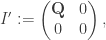
Clearly J is simple. And I has a simple submodule I' := \begin{pmatrix} \mathbf{Q} & 0\\ 0 & 0\end{pmatrix}, and the resulting quotient is I/I’ is isomorphic to J. Since I’I/I’ and J are simple, they’re noetherian and artinian. Thus R is left noetherian and left artinian. ♦
Posted in Notes | Tagged , , , , | 1 Comment