Minkowski Theory: Introduction
Suppose  is a finite extension and
  is the integral closure of
  in K.
in K.
In algebraic number theory, there is a classical method by Minkowski to compute the Picard group of (note: in texts on algebraic number theory, this is often called the divisor class group; there is a slight difference between the two but for Dedekind domains they are identical).
We will only consider the simplest cases here to give readers a sample of the theory.
Minkowski’s Lemma.
If a measurable region  has area > 1, then there exist distinct
  such that
  .
.
Proof
Use the following picture:
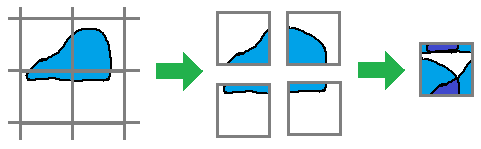
Since the area > 1, there exist two points which overlap in the unit square on the right. The corresponding  then give . ♦
Minkowski’s Theorem.
Let be a measurable region which is convex, symmetric about the origin and has area > 4. Then X has a lattice point other than the origin.
Proof
Take  , which has area > 1. By Minkowski’s lemma, there exist distinct such that
  . Since X is symmetric about the origin replace y by –y (so
  ) to give
  . And since X is convex,
  . Finally since
  ,
,  is not the origin. ♦
By applying a linear transform to  we obtain the more useful version of Minkowski’s theorem.
Minkowski’s Theorem B.
Take a full lattice  (i.e. discrete subgroup which spans ). Taking a basis
  of L, we obtain a fundamental domain

of area D. If is convex, symmetric about the origin, and has area > 4D, then X has a non-zero point of L.

Picard Group of Number Rings
Now we use this to compute  for
for ![A =\mathcal O_{\mathbb Q(\sqrt{-5})} = \mathbb Z[\sqrt{-5}]](https://s0.wp.com/latex.php?latex=A+%3D%5Cmathcal+O_%7B%5Cmathbb+Q%28%5Csqrt%7B-5%7D%29%7D+%3D+%5Cmathbb+Z%5B%5Csqrt%7B-5%7D%5D&bg=ffffff&fg=333333&s=0&c=20201002) .
.
First note that any non-zero ideal  has finite index since if
  , then
  is a non-zero integer in
  so
so  , where N is the norm function. We let
![N(\mathfrak a) := [A : \mathfrak a]](https://s0.wp.com/latex.php?latex=N%28%5Cmathfrak+a%29+%3A%3D+%5BA+%3A+%5Cmathfrak+a%5D&bg=ffffff&fg=333333&s=0&c=20201002) .
.
Recall that if  , by proposition 4 here, the composition factors of
  comprise of exactly
  copies of
  for each i, so

In particular,  for any non-zero ideals
  , and we can extend the norm function to the set of all fractional ideals of A.
Exercise
Prove that if  then
then

so we can consider  as an extension of the norm function to the set of ideals.
To apply Minkowski’s theorem B, we identify  with
with  . Let
. Let  be any non-zero ideal with norm N, considered as a full lattice in . We take

where t will be decided later. Note that S is convex, symmetric about the origin and has area  . If
. If  where
where  then Minkowski’s theorem B assures us there exists
  with
with  . Since this holds for all we have:

Now  has norm
  , i.e.
  . Hence every element of Pic A can be represented by an ideal of norm 1 or 2. Since A has norm 1 and
  has norm 2, we have proven:
![\mathrm{Pic} (\mathbb Z[\sqrt{-5}]) = \mathbb Z / 2\mathbb Z](https://s0.wp.com/latex.php?latex=%5Cmathrm%7BPic%7D+%28%5Cmathbb+Z%5B%5Csqrt%7B-5%7D%5D%29+%3D+%5Cmathbb+Z+%2F+2%5Cmathbb+Z&bg=ffffff&fg=333333&s=0&c=20201002) .
.
More generally, one can show the following.
Theorem.
Let be a finite extension. Then the Picard group of is finite; its cardinality is called the class number of K.
Exercise
Prove that  has class number 3. Note that
 ![\mathcal O_K = \mathbb Z[ \frac{1 + \sqrt{-23}}2]](https://s0.wp.com/latex.php?latex=%5Cmathcal+O_K+%3D+%5Cmathbb+Z%5B+%5Cfrac%7B1+%2B+%5Csqrt%7B-23%7D%7D2%5D&bg=ffffff&fg=333333&s=0&c=20201002) .
.
Prove that  has class number 1.
Prove that  has class number 2.
[ Hint: identify ![a + b\sqrt{10} \in \mathbb Z[\sqrt{10}]](https://s0.wp.com/latex.php?latex=a+%2B+b%5Csqrt%7B10%7D+%5Cin+%5Cmathbb+Z%5B%5Csqrt%7B10%7D%5D&bg=ffffff&fg=333333&s=0&c=20201002) with
with  . Pick the square
  for a suitable t. You could also pick
  but it is not as efficient. ]
Geometric Example: Elliptic Curve Group
Take the elliptic curve E over  given by
  and let
 ![A = \mathbb C[E]](https://s0.wp.com/latex.php?latex=A+%3D+%5Cmathbb+C%5BE%5D&bg=ffffff&fg=333333&s=0&c=20201002) be its coordinate ring. In Exercise B.1 here, we showed A is a normal domain. Clearly it is noetherian. By Noether normalization theorem,
be its coordinate ring. In Exercise B.1 here, we showed A is a normal domain. Clearly it is noetherian. By Noether normalization theorem,  . Hence, A is a Dedekind domain.
We will show how computation of Pic A leads to point addition on the elliptic curve. For each maximal ideal  , write
 ![[\mathfrak m]](https://s0.wp.com/latex.php?latex=%5B%5Cmathfrak+m%5D&bg=ffffff&fg=333333&s=0&c=20201002) for its image in Pic A. Recall that points
for its image in Pic A. Recall that points  correspond bijectively to maximal ideals
  .
.
Lemma 1.
Suppose  is not a unit. Then taking
  as a complex vector space,
  if and only if
  can be represented by a linear function in X, in which case
![A/(f) \cong \mathbb C[Y]/(Y^2 - \beta)](https://s0.wp.com/latex.php?latex=A%2F%28f%29+%5Ccong+%5Cmathbb+C%5BY%5D%2F%28Y%5E2+-+%5Cbeta%29&bg=ffffff&fg=333333&s=0&c=20201002)
for some  .
.
Note
The intuition is that the curve  and the elliptic curve cannot have less than 3 intersection points (with multiplicity) unless we take a vertical line.
Proof
Since  in the ring A, without loss of generality we can write

for ![g(X), h(X) \in \mathbb C[X]](https://s0.wp.com/latex.php?latex=g%28X%29%2C+h%28X%29+%5Cin+%5Cmathbb+C%5BX%5D&bg=ffffff&fg=333333&s=0&c=20201002) . The condition implies
. The condition implies  and
and  have at most two intersection points. Solving gives us
 .
.
If  , the LHS has odd degree while the RHS has even degree; hence the equation has at least 3 roots and each corresponds to at least one point on the elliptic curve. If
  and
and  , then
  so
so  is linear in X, and we are done. ♦
Exercise
If we replace by a general algebraically closed field k, would the proof still work? What additional conditions (if any) need to be imposed?
Corollary 1.
No maximal ideal of A is principal.
Proof
If is generated by f then  , which is impossible by lemma 1. ♦
Corollary 2.
For any points  and
and  on E,
on E,  is principal if and only if

When that happens, we write  .
.
Proof
(⇐) If  then setting
  gives
gives
![A/(f) \cong \mathbb C[X, Y]/(Y^2 - X^3 + X, X - \alpha_1) \cong \mathbb C[Y]/(Y^2 - (\overbrace{\alpha_1^3 - \alpha_1}^{\beta_1^2})).](https://s0.wp.com/latex.php?latex=A%2F%28f%29+%5Ccong+%5Cmathbb+C%5BX%2C+Y%5D%2F%28Y%5E2+-+X%5E3+%2B+X%2C+X+-+%5Calpha_1%29+%5Ccong+%5Cmathbb+C%5BY%5D%2F%28Y%5E2+-+%28%5Coverbrace%7B%5Calpha_1%5E3+-+%5Calpha_1%7D%5E%7B%5Cbeta_1%5E2%7D%29%29.&bg=ffffff&fg=333333&s=0&c=20201002)
If  , this ring has exactly two maximal ideals, corresponding to maximal ideals
  and
and  of A. If
  , it has exactly one maximal ideal so we still have
  .
.
(⇒) If  is principal, then
  so by lemma 1, f can be represented by a linear function in X so we must have P and Q as described. ♦
Corollary 3.
If  satisfy
 ![[\mathfrak m_P] = [\mathfrak m_Q]](https://s0.wp.com/latex.php?latex=%5B%5Cmathfrak+m_P%5D+%3D+%5B%5Cmathfrak+m_Q%5D&bg=ffffff&fg=333333&s=0&c=20201002) , then
, then  .
.
Proof
Let  as in corollary 2. Then
 ![[\mathfrak m_P][\mathfrak m_{R}] = 1](https://s0.wp.com/latex.php?latex=%5B%5Cmathfrak+m_P%5D%5B%5Cmathfrak+m_%7BR%7D%5D+%3D+1&bg=ffffff&fg=333333&s=0&c=20201002) . By the given condition
. By the given condition ![[\mathfrak m_Q][\mathfrak m_R] = 1](https://s0.wp.com/latex.php?latex=%5B%5Cmathfrak+m_Q%5D%5B%5Cmathfrak+m_R%5D+%3D+1&bg=ffffff&fg=333333&s=0&c=20201002) so by corollary 2 again we have
so by corollary 2 again we have  and hence
  . ♦
. ♦
Lemma 2.
For any  with
with  , there is a unique
  such that
![[\mathfrak m_P]\cdot [\mathfrak m_Q]\cdot [\mathfrak m_R] = 1.](https://s0.wp.com/latex.php?latex=%5B%5Cmathfrak+m_P%5D%5Ccdot+%5B%5Cmathfrak+m_Q%5D%5Ccdot+%5B%5Cmathfrak+m_R%5D+%3D+1.&bg=ffffff&fg=333333&s=0&c=20201002)
Proof
First suppose  so P and Q have different x-coordinates. Let
  be the equation of PQ. We get:
![A/(f) \cong \mathbb C[X,Y]/(Y^2 - X^3 + X, Y - cX - d) \cong \mathbb C[X]/((cX+d)^2 - X^3 + X),](https://s0.wp.com/latex.php?latex=A%2F%28f%29+%5Ccong+%5Cmathbb+C%5BX%2CY%5D%2F%28Y%5E2+-+X%5E3+%2B+X%2C+Y+-+cX+-+d%29+%5Ccong+%5Cmathbb+C%5BX%5D%2F%28%28cX%2Bd%29%5E2+-+X%5E3+%2B+X%29%2C&bg=ffffff&fg=333333&s=0&c=20201002)
which has complex dimension 3. Since  is divisible by we have
  for some . Geometrically R is the third point of intersection of PQ with E, which can be equal to P or Q.
If  with
with  , we can similarly pick a line through P of gradient
  . Then as above
 ![A/(f) \cong \mathbb C[X]/((cX+d)^2 - X^3 + X)](https://s0.wp.com/latex.php?latex=A%2F%28f%29+%5Ccong+%5Cmathbb+C%5BX%5D%2F%28%28cX%2Bd%29%5E2+-+X%5E3+%2B+X%29&bg=ffffff&fg=333333&s=0&c=20201002) where
where  has a double root for
  (this requires some algebraic computation). Hence
  for some . ♦
Summary.
The Picard group of A is given by
![\{ [\mathfrak m] : \mathfrak m \subset A \text{ maximal} \} \cup \{1\}](https://s0.wp.com/latex.php?latex=%5C%7B+%5B%5Cmathfrak+m%5D+%3A+%5Cmathfrak+m+%5Csubset+A+%5Ctext%7B+maximal%7D+%5C%7D+%5Ccup+%5C%7B1%5C%7D&bg=ffffff&fg=333333&s=0&c=20201002) .
.
In particular it is infinite.


 is a maximal ideal. The expression is unique up to permutation of terms.
 we are done. Otherwise it is contained in some maximal ideal
  , necessarily invertible. Now
  , because if equality holds multiplying both sides by
  gives
gives  , so
, so  . We replace
  and repeat the process; this cannot continue indefinitely or we would have
 for a non-zero ideal
  . Write both
  as a product of maximal ideals and we are done.
 , where
  (some possibly zero). If
  , after cancelling terms and reordering, we obtain a relation of the form:
 but the RHS is not. ♦

 is maximal and
  . Then
![k[X]](https://s0.wp.com/latex.php?latex=k%5BX%5D&bg=ffffff&fg=333333&s=0&c=20201002) (for any field k), but these are not too interesting.
(for any field k), but these are not too interesting.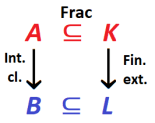
 , when we topologize
  . Hence
  . The integral closure of
 ![L = k(X)[Y]/(Y^2 - X^3 + X)](https://s0.wp.com/latex.php?latex=L+%3D+k%28X%29%5BY%5D%2F%28Y%5E2+-+X%5E3+%2B+X%29&bg=ffffff&fg=333333&s=0&c=20201002) is
is ![A = k[X, Y]/(Y^2 - X^3 +X)](https://s0.wp.com/latex.php?latex=A+%3D+k%5BX%2C+Y%5D%2F%28Y%5E2+-+X%5E3+%2BX%29&bg=ffffff&fg=333333&s=0&c=20201002) . [ Proof: exercise. ] Since A is clearly noetherian, it is a Dedekind domain.
. [ Proof: exercise. ] Since A is clearly noetherian, it is a Dedekind domain. be a square-free integer and
  , which is quadratic over
  . Prove that
![\mathcal O_K = \begin{cases} \mathbb Z[\frac{1 + \sqrt{m}}2], \quad &\text{if } m\equiv 1 \pmod 4, \\ \mathbb Z[\sqrt{m}], \quad &\text{if } m\equiv 2,3 \pmod 4.\end{cases}](https://s0.wp.com/latex.php?latex=%5Cmathcal+O_K+%3D+%5Cbegin%7Bcases%7D+%5Cmathbb+Z%5B%5Cfrac%7B1+%2B+%5Csqrt%7Bm%7D%7D2%5D%2C+%5Cquad+%26%5Ctext%7Bif+%7D+m%5Cequiv+1+%5Cpmod+4%2C+%5C%5C+%5Cmathbb+Z%5B%5Csqrt%7Bm%7D%5D%2C+%5Cquad+%26%5Ctext%7Bif+%7D+m%5Cequiv+2%2C3+%5Cpmod+4.%5Cend%7Bcases%7D&bg=ffffff&fg=333333&s=0&c=20201002)
 . Each maximal
  ,
, to the exponent of
  : for any
  we have:
 .
. these properties hold for all
  .
. . Prove that (K, d) is a metric space, where the metric satisfies the strong triangular inequality.
![A = \mathbb C[X, Y]/(Y^2 - X^3 + X)](https://s0.wp.com/latex.php?latex=A+%3D+%5Cmathbb+C%5BX%2C+Y%5D%2F%28Y%5E2+-+X%5E3+%2B+X%29&bg=ffffff&fg=333333&s=0&c=20201002) , a Dedekind domain. Recall that points P on the curve
, a Dedekind domain. Recall that points P on the curve  is just the order of vanishing of f at P.
 where
where  ; for convenience write
  . Let us compute
  for
for  :
:
 since f does not vanish on P. From an
  so
so  and
and  .
. .
. of any ring A and
  we have a ring isomorphism
 we can pick
  . From the isomorphism
 ,
, such that
 . Thus
  . ♦
. ♦
 . In particular
 .
. . We obtain a series of submodules of

 . It suffices to show each of these is of dimension 1 over
  . To prove that, we recall that
  is a
is a  is a principal ideal. Since
  is already a module over
![A = k[V]](https://s0.wp.com/latex.php?latex=A+%3D+k%5BV%5D&bg=ffffff&fg=333333&s=0&c=20201002) is the coordinate ring of a variety V over an algebraically closed field k. If A is a Dedekind domain, then since
is the coordinate ring of a variety V over an algebraically closed field k. If A is a Dedekind domain, then since  for each maximal ideal
  .
. is an invertible fractional ideal of
  . By definition
  . Let
. Let ![A_{\mathfrak m} = (A_{\mathfrak m} : M_{\mathfrak m})M_{\mathfrak m} = (A:M)_{\mathfrak m} M_{\mathfrak m} = [(A:M)M]_{\mathfrak m}.](https://s0.wp.com/latex.php?latex=A_%7B%5Cmathfrak+m%7D+%3D+%28A_%7B%5Cmathfrak+m%7D+%3A+M_%7B%5Cmathfrak+m%7D%29M_%7B%5Cmathfrak+m%7D+%3D+%28A%3AM%29_%7B%5Cmathfrak+m%7D+M_%7B%5Cmathfrak+m%7D+%3D+%5B%28A%3AM%29M%5D_%7B%5Cmathfrak+m%7D.&bg=ffffff&fg=333333&s=0&c=20201002)
 is contained in any maximal
 ![[(A:M)M]_{\mathfrak m} \subseteq \mathfrak m A_{\mathfrak m}](https://s0.wp.com/latex.php?latex=%5B%28A%3AM%29M%5D_%7B%5Cmathfrak+m%7D+%5Csubseteq+%5Cmathfrak+m+A_%7B%5Cmathfrak+m%7D&bg=ffffff&fg=333333&s=0&c=20201002) , a contradiction. Hence
, a contradiction. Hence  . ♦
. ♦ be a local domain. A fractional ideal M of A is invertible if and only if it is principal and non-zero. Thus
  .
. for
for  and
and  . Since all
  and sum to 1, not all
  lie in
  by a unit we may assume
  .
. . Clearly since
  . Conversely if
  then
then  since
since  . ♦
. ♦![A = \mathbb Z[2\sqrt 2] = \{a + 2b\sqrt 2 : a,b \in \mathbb Z\}](https://s0.wp.com/latex.php?latex=A+%3D+%5Cmathbb+Z%5B2%5Csqrt+2%5D+%3D+%5C%7Ba+%2B+2b%5Csqrt+2+%3A+a%2Cb+%5Cin+%5Cmathbb+Z%5C%7D&bg=ffffff&fg=333333&s=0&c=20201002) with maximal ideal
with maximal ideal  . We claim that
  is not a principal ideal of
 . Let
. Let  ; we can check that
  so
so  since
since  . Since
  has 4 elements, we see that
  . Hence
 ![A = \mathbb C[X, Y]/(Y^2 - X^3)](https://s0.wp.com/latex.php?latex=A+%3D+%5Cmathbb+C%5BX%2C+Y%5D%2F%28Y%5E2+-+X%5E3%29&bg=ffffff&fg=333333&s=0&c=20201002) with
with  . Is
. Is  if
if  ; this follows from
  for some ideal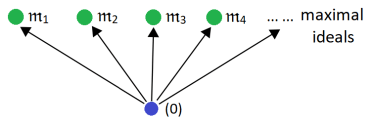
 has height 1. Since
  is principal by proposition 2. By
  . ♦
. ♦ is local. And since
  is principal. If
  , we call
  a uniformizer of the dvr.
 has height 1, so the spectrum of A is easy to describe:
 . If
. If  , then
  is a dvr.
 is a dvr. Common examples include:
![\mathbb Z_{(2)} = \{\frac a b \in \mathbb Q : b \text{ odd}\},\quad k[X]_{(X)} = \{ \frac {f(X)}{g(X)} : g(0) \ne 0\},](https://s0.wp.com/latex.php?latex=%5Cmathbb+Z_%7B%282%29%7D+%3D+%5C%7B%5Cfrac+a+b+%5Cin+%5Cmathbb+Q+%3A+b+%5Ctext%7B+odd%7D%5C%7D%2C%5Cquad+k%5BX%5D_%7B%28X%29%7D+%3D+%5C%7B+%5Cfrac+%7Bf%28X%29%7D%7Bg%28X%29%7D+%3A+g%280%29+%5Cne+0%5C%7D%2C&bg=ffffff&fg=333333&s=0&c=20201002)
 for some
  .
. .
. . Indeed if
  then we can write
  for
for  . Then
  for each n so
  which is impossible since A is noetherian.
 , where
  .
. where
where  .
. for some k. ♦
 so that
  is a noetherian ring with exactly one prime, i.e. it is a local artinian ring, so
  is nilpotent. Thus
  for some n > 0. We may assume
  .
. , an ideal of A. Fix an
  and set
  . Then
  is an ideal of A. If
  , then
  is principal.
 . We claim that
  is integral over A. To prove this, pick a finite generating set
  for the ideal
  can be written as an A-linear combination of
 matrix with entries in A. Hence
  where equality holds in
  . Multiplying by the adjugate matrix, we get
 .
. ; expanding gives a monic polynomial relation in
  is integral over A; since A is normal,
  . Thus
  for all
  . Since
  we have
  . But this means
  , a contradiction. ♦
 is principal for each maximal ideal
  is not smooth at the origin.
 such that there is an
  such that
  .
. ensures that the elements of M do not have “too many denominators” occurring in them. Thus
  .
. such that
  .
. , which are A-submodules of K. We also define the following.
 is the set of finite sums
  , where
  .
. is the set of all
  such that
  .
. represents the “lcm” of M and N,
  represents their “gcd”, while
  ,
,  is a fractional ideal if
  .
. such that
  . Then
 ; then
  because
 ♦
♦
 ; we say it is invertible if MN = A for some fractional ideal N, in which case we write
  .
.![A = \mathbb Z[\sqrt{-5}]](https://s0.wp.com/latex.php?latex=A+%3D+%5Cmathbb+Z%5B%5Csqrt%7B-5%7D%5D&bg=ffffff&fg=333333&s=0&c=20201002) , a
, a  is not principal but it is invertible because
 is invertible because
 ; write
  generate M as an A-module. Indeed let
 . ♦
. ♦ .
. and thus
  by definition. Conversely
  and multiplying both sides by
  gives
gives  . ♦
. ♦ .
.![k[X, Y]/(Y^2 - X^3 + X)](https://s0.wp.com/latex.php?latex=k%5BX%2C+Y%5D%2F%28Y%5E2+-+X%5E3+%2B+X%29&bg=ffffff&fg=333333&s=0&c=20201002) , where k is a field, the maximal ideal
, where k is a field, the maximal ideal  is invertible if
  .
. generates
  for each i we have
  and thus
  .
. so
so  . For each i,
  and thus
  . So
. So  . Thus
  and so
  . ♦
. ♦ is a multiplicative subset not including 0.
 is an
is an  -submodule satisfying
  . Clearly if M is invertible (resp. principal), so is
  .
. ;
; ;
; ;
; .
.
 for
for  . Write
  ; then
  for each i. Write
  for
for  and
and  ; we see that
  for each i where
  . [ Recall that A is an integral domain. ] Hence
 . ♦
. ♦![\mathrm{Pic} A \longrightarrow \mathrm{Pic} S^{-1}A,\quad [M] \mapsto [S^{-1}M].](https://s0.wp.com/latex.php?latex=%5Cmathrm%7BPic%7D+A+%5Clongrightarrow+%5Cmathrm%7BPic%7D+S%5E%7B-1%7DA%2C%5Cquad+%5BM%5D+%5Cmapsto+%5BS%5E%7B-1%7DM%5D.&bg=ffffff&fg=333333&s=0&c=20201002)
 , a non-principal invertible ideal. If
  then
then  takes
takes  since
since  is generated by
  .
. be a chain of prime ideals of a ring A. We say the chain is
 of A,
of A, ;
; is a minimal prime and
  is a maximal ideal.
 , all saturated prime chains with fixed ends
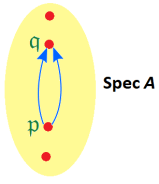
 However, even in a catenary ring A, not all maximal prime chains may be of the same length. The reason is rather simple: A can have multiple minimal prime ideals and multiple maximal ideals. The catenary condition does not specify that every saturated prime chain from every minimal prime to every maximal prime must be of the same length.
 , the set of prime chains of B is the union of that of
  and of
  . So if we pick
  of different dimensions like
 ![B = \mathbb C \times \mathbb C[X]](https://s0.wp.com/latex.php?latex=B+%3D+%5Cmathbb+C+%5Ctimes+%5Cmathbb+C%5BX%5D&bg=ffffff&fg=333333&s=0&c=20201002) we get maximal prime chains of different lengths:
we get maximal prime chains of different lengths:![0 \times \mathbb C[X], \qquad \mathbb C \times 0 \subset \mathbb C \times \mathbb (X)](https://s0.wp.com/latex.php?latex=0+%5Ctimes+%5Cmathbb+C%5BX%5D%2C+%5Cqquad+%5Cmathbb+C+%5Ctimes+0+%5Csubset+%5Cmathbb+C+%5Ctimes+%5Cmathbb+%28X%29&bg=ffffff&fg=333333&s=0&c=20201002) .
.![A = \mathbb Z_{\mathfrak p}[X]](https://s0.wp.com/latex.php?latex=A+%3D+%5Cmathbb+Z_%7B%5Cmathfrak+p%7D%5BX%5D&bg=ffffff&fg=333333&s=0&c=20201002) where
where  . This has maximal prime chains
 must be finite, for A may have maximal prime chains of arbitrary length. For example, Nagata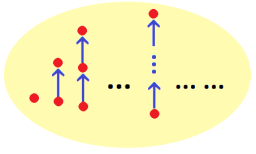
 .
. of A is principal, then it is a minimal non-zero prime.
![\mathbb Z[X]](https://s0.wp.com/latex.php?latex=%5Cmathbb+Z%5BX%5D&bg=ffffff&fg=333333&s=0&c=20201002) has length 2. In particular,
has length 2. In particular, ![A = k[X_1, \ldots, X_n]](https://s0.wp.com/latex.php?latex=A+%3D+k%5BX_1%2C+%5Cldots%2C+X_n%5D&bg=ffffff&fg=333333&s=0&c=20201002) . All maximal prime chains of A have the same length n.
. All maximal prime chains of A have the same length n. .
. be a minimal non-zero prime and
  . By exercise A.2 above
  since
since  .
.![A\cong k[X_1, \ldots, X_m]/\mathfrak p](https://s0.wp.com/latex.php?latex=A%5Ccong+k%5BX_1%2C+%5Cldots%2C+X_m%5D%2F%5Cmathfrak+p&bg=ffffff&fg=333333&s=0&c=20201002) for a prime ideal
for a prime ideal ![\mathfrak p \subset k[X_1, \ldots, X_m]](https://s0.wp.com/latex.php?latex=%5Cmathfrak+p+%5Csubset+k%5BX_1%2C+%5Cldots%2C+X_m%5D&bg=ffffff&fg=333333&s=0&c=20201002) . Fix a saturated prime chain of
. Fix a saturated prime chain of ![k[X_1, \ldots, X_m]](https://s0.wp.com/latex.php?latex=k%5BX_1%2C+%5Cldots%2C+X_m%5D&bg=ffffff&fg=333333&s=0&c=20201002) which starts at 0 and ends at
which starts at 0 and ends at  so
so  is independent of the maximal prime chain of A we chose. ♦
 be a prime ideal. The height of
  , is the supremum of the lengths of prime chains ending at
  . Since
  is the supremum of the lengths of prime chains starting from
 , is the infimum of
  .
. is the supremum of
  take the infimum of
  over all
  .
. we have
 are algebraically independent over k if they are so as elements of
  be a finitely generated k-algebra. There exist
 ![k[\alpha_1, \ldots, \alpha_n]](https://s0.wp.com/latex.php?latex=k%5B%5Calpha_1%2C+%5Cldots%2C+%5Calpha_n%5D&bg=ffffff&fg=333333&s=0&c=20201002) .
. so
so  .
.![A = k[x_1, \ldots, x_m]](https://s0.wp.com/latex.php?latex=A+%3D+k%5Bx_1%2C+%5Cldots%2C+x_m%5D&bg=ffffff&fg=333333&s=0&c=20201002) for some
for some  . We will prove the result by induction on m; when m = 0 there is nothing to show so suppose m ≥ 1.
![B:=k[x_1, \ldots, x_{m-1}]](https://s0.wp.com/latex.php?latex=B%3A%3Dk%5Bx_1%2C+%5Cldots%2C+x_%7Bm-1%7D%5D&bg=ffffff&fg=333333&s=0&c=20201002) so that
so that  . By induction hypothesis we can find
  which are algebraically independent over k and B is finite over
  is algebraic or transcendental over Frac(B).
 is transcendental over Frac(B).
 are algebraically independent over k. Also
![k[\alpha_1, \ldots, \alpha_n, x_m] \subseteq B[x_m] = A](https://s0.wp.com/latex.php?latex=k%5B%5Calpha_1%2C+%5Cldots%2C+%5Calpha_n%2C+x_m%5D+%5Csubseteq+B%5Bx_m%5D+%3D+A&bg=ffffff&fg=333333&s=0&c=20201002)
 for some
  .
.
![p_i \in k[X_1, \ldots, X_n]](https://s0.wp.com/latex.php?latex=p_i+%5Cin+k%5BX_1%2C+%5Cldots%2C+X_n%5D&bg=ffffff&fg=333333&s=0&c=20201002) , not all zero. We reparametrize
, not all zero. We reparametrize  for
for  , where the
  will be determined later. Substituting then gives us
 such that expanding the above gives
 where
where ![q_j \in k[X_1, \ldots, X_n]](https://s0.wp.com/latex.php?latex=q_j+%5Cin+k%5BX_1%2C+%5Cldots%2C+X_n%5D&bg=ffffff&fg=333333&s=0&c=20201002) and
and  .
. and let
  . Expanding
  , we obtain a sum of terms of the form
 . Since
  , we see that these values are distinct across all the terms. Thus there is a unique term of
  where D is the maximum over these
  .
.![k[\beta_1, \ldots, \beta_n]](https://s0.wp.com/latex.php?latex=k%5B%5Cbeta_1%2C+%5Cldots%2C+%5Cbeta_n%5D&bg=ffffff&fg=333333&s=0&c=20201002) , so we have finite extensions
, so we have finite extensions![k[\beta_1, \ldots, \beta_n] \subseteq k[\beta_1, \ldots, \beta_n, x_m] = k[\alpha_1, \ldots, \alpha_n, x_m] \subseteq B[x_m] = A](https://s0.wp.com/latex.php?latex=k%5B%5Cbeta_1%2C+%5Cldots%2C+%5Cbeta_n%5D+%5Csubseteq+k%5B%5Cbeta_1%2C+%5Cldots%2C+%5Cbeta_n%2C+x_m%5D+%3D+k%5B%5Calpha_1%2C+%5Cldots%2C+%5Calpha_n%2C+x_m%5D+%5Csubseteq+B%5Bx_m%5D+%3D+A&bg=ffffff&fg=333333&s=0&c=20201002)
 . For each of the following A, find an algebraically independent sequence
 ![\mathbb C[\alpha_1, \ldots, \alpha_n] \subseteq A](https://s0.wp.com/latex.php?latex=%5Cmathbb+C%5B%5Calpha_1%2C+%5Cldots%2C+%5Calpha_n%5D+%5Csubseteq+A&bg=ffffff&fg=333333&s=0&c=20201002) is finite.
is finite.![\mathbb C[X, Y]/(XY - 1), \quad \mathbb C[X, Y, Z]/(XY + YZ + ZX - 1).](https://s0.wp.com/latex.php?latex=%5Cmathbb+C%5BX%2C+Y%5D%2F%28XY+-+1%29%2C+%5Cquad+%5Cmathbb+C%5BX%2C+Y%2C+Z%5D%2F%28XY+%2B+YZ+%2B+ZX+-+1%29.&bg=ffffff&fg=333333&s=0&c=20201002)
![k[\alpha_1, \ldots, \alpha_n] \subseteq A](https://s0.wp.com/latex.php?latex=k%5B%5Calpha_1%2C+%5Cldots%2C+%5Calpha_n%5D+%5Csubseteq+A&bg=ffffff&fg=333333&s=0&c=20201002) is finite. If
is finite. If  is integral over
 ![A := k[X_1, \ldots, X_n]](https://s0.wp.com/latex.php?latex=A+%3A%3D+k%5BX_1%2C+%5Cldots%2C+X_n%5D&bg=ffffff&fg=333333&s=0&c=20201002) and closed subsets
and closed subsets  .
. is a proper ideal then
  .
. . Then
  . Hence
  . ♦
. ♦ .
. . Since A is noetherian
  . Consider the ideal
  of
of ![B = k[X_1, \ldots, X_n, Y]](https://s0.wp.com/latex.php?latex=B+%3D+k%5BX_1%2C+%5Cldots%2C+X_n%2C+Y%5D&bg=ffffff&fg=333333&s=0&c=20201002) . Note that
. Note that  . We claim that
  .
. such that
  for
for  and
and  . Then
  , contradicting
  so
so  for some m > 0. Since
  . ♦
. ♦![\dim k[X_1, \ldots, X_n] = n](https://s0.wp.com/latex.php?latex=%5Cdim+k%5BX_1%2C+%5Cldots%2C+X_n%5D+%3D+n&bg=ffffff&fg=333333&s=0&c=20201002) .
. .
.![\mathfrak p \subset k[X_1, \ldots, X_n]](https://s0.wp.com/latex.php?latex=%5Cmathfrak+p+%5Csubset+k%5BX_1%2C+%5Cldots%2C+X_n%5D&bg=ffffff&fg=333333&s=0&c=20201002) is any non-zero prime ideal. Now
is any non-zero prime ideal. Now ![A = k[X_1, \ldots, X_n]/\mathfrak p](https://s0.wp.com/latex.php?latex=A+%3D+k%5BX_1%2C+%5Cldots%2C+X_n%5D%2F%5Cmathfrak+p&bg=ffffff&fg=333333&s=0&c=20201002) , by
, by 
 which are algebraically independent such that A is finite over
 ![k[\alpha_1, \ldots, \alpha_m]](https://s0.wp.com/latex.php?latex=k%5B%5Calpha_1%2C+%5Cldots%2C+%5Calpha_m%5D&bg=ffffff&fg=333333&s=0&c=20201002) where
where  . By induction hypothesis,
![\dim k[\alpha_1, \ldots, \alpha_m] = m](https://s0.wp.com/latex.php?latex=%5Cdim+k%5B%5Calpha_1%2C+%5Cldots%2C+%5Calpha_m%5D+%3D+m&bg=ffffff&fg=333333&s=0&c=20201002)
 too. Since
  for all non-zero prime
  . ♦
. ♦ .
.![\dim A = \dim k[\alpha_1, \ldots, \alpha_n] = n.](https://s0.wp.com/latex.php?latex=%5Cdim+A+%3D+%5Cdim+k%5B%5Calpha_1%2C+%5Cldots%2C+%5Calpha_n%5D+%3D+n.&bg=ffffff&fg=333333&s=0&c=20201002) ♦
♦
![A\cong k[V]](https://s0.wp.com/latex.php?latex=A%5Ccong+k%5BV%5D&bg=ffffff&fg=333333&s=0&c=20201002) and
and ![B \cong k[W]](https://s0.wp.com/latex.php?latex=B+%5Ccong+k%5BW%5D&bg=ffffff&fg=333333&s=0&c=20201002) for irreducible affine varieties, then
for irreducible affine varieties, then ![A\otimes_k B \cong k[V\times W]](https://s0.wp.com/latex.php?latex=A%5Cotimes_k+B+%5Ccong+k%5BV%5Ctimes+W%5D&bg=ffffff&fg=333333&s=0&c=20201002) is an integral domain since
is an integral domain since  is also irreducible.
 ) which are algebraically independent over k such that
![k[\alpha_1, \ldots, \alpha_n] \subseteq A, \quad k[\beta_1, \ldots, \beta_m] \subseteq B](https://s0.wp.com/latex.php?latex=k%5B%5Calpha_1%2C+%5Cldots%2C+%5Calpha_n%5D+%5Csubseteq+A%2C+%5Cquad+k%5B%5Cbeta_1%2C+%5Cldots%2C+%5Cbeta_m%5D+%5Csubseteq+B&bg=ffffff&fg=333333&s=0&c=20201002)
![k[X_1, \ldots, X_n, Y_1, \ldots, Y_m] \cong k[\alpha_1, \ldots, \alpha_n] \otimes_k k[\beta_1, \ldots, \beta_m] \hookrightarrow A\otimes_k B](https://s0.wp.com/latex.php?latex=k%5BX_1%2C+%5Cldots%2C+X_n%2C+Y_1%2C+%5Cldots%2C+Y_m%5D+%5Ccong+k%5B%5Calpha_1%2C+%5Cldots%2C+%5Calpha_n%5D+%5Cotimes_k+k%5B%5Cbeta_1%2C+%5Cldots%2C+%5Cbeta_m%5D+%5Chookrightarrow+A%5Cotimes_k+B&bg=ffffff&fg=333333&s=0&c=20201002)
 . ♦
. ♦ here.
here. are said to be algebraically dependent over K if
![\exists p \in K[X_1, \ldots, X_n] - \{0\}, \ p(\alpha_1, \ldots, \alpha_n) = 0.](https://s0.wp.com/latex.php?latex=%5Cexists+p+%5Cin+K%5BX_1%2C+%5Cldots%2C+X_n%5D+-+%5C%7B0%5C%7D%2C+%5C+p%28%5Calpha_1%2C+%5Cldots%2C+%5Calpha_n%29+%3D+0.&bg=ffffff&fg=333333&s=0&c=20201002)
 are algebraically independent over K.
 forms a transcendence basis of L over K if it is algebraically independent over K and L is algebraic over
  .
. ,
,![L := \mathrm{Frac} A \cong \mathbb C(X)[Y]/(Y^2 - X^3 + X)](https://s0.wp.com/latex.php?latex=L+%3A%3D+%5Cmathrm%7BFrac%7D+A+%5Ccong+%5Cmathbb+C%28X%29%5BY%5D%2F%28Y%5E2+-+X%5E3+%2B+X%29&bg=ffffff&fg=333333&s=0&c=20201002) so
so  forms a transcendentce basis of L over
  for the field extension of K generated by
  as
as  . Thus we have an isomorphism:
 .
.![K[X_1, \ldots, X_n] \to L](https://s0.wp.com/latex.php?latex=K%5BX_1%2C+%5Cldots%2C+X_n%5D+%5Cto+L&bg=ffffff&fg=333333&s=0&c=20201002) which takes
which takes  for each
  . By definition of algebraic independence this map is injective so we get an embedding
![K(X_1, \ldots, X_n) = \mathrm{Frac}(K[X_1, \ldots, X_n]) \longrightarrow L](https://s0.wp.com/latex.php?latex=K%28X_1%2C+%5Cldots%2C%C2%A0+X_n%29+%3D+%5Cmathrm%7BFrac%7D%28K%5BX_1%2C+%5Cldots%2C+X_n%5D%29+%5Clongrightarrow+L&bg=ffffff&fg=333333&s=0&c=20201002)
 be algebraically independent over K. Let
  .
. are algebraically dependent over K if and only if
  is algebraic over
  are linearly independent, then for
  ,
,  are linearly dependent if and only if w is a linear combination of
  .
.![p \in K[X_1, \ldots, X_n, Y]](https://s0.wp.com/latex.php?latex=p+%5Cin+K%5BX_1%2C+%5Cldots%2C+X_n%2C+Y%5D&bg=ffffff&fg=333333&s=0&c=20201002) such that
such that  . This polynomial must involve Y or we would obtain a polynomial relation in
 ![q(Y) := p(\alpha_1, \ldots, \alpha_n, Y) \in K(\alpha_1, \ldots, \alpha_n)[Y] \cong K(X_1, \ldots, X_n)[Y]](https://s0.wp.com/latex.php?latex=q%28Y%29+%3A%3D+p%28%5Calpha_1%2C+%5Cldots%2C+%5Calpha_n%2C+Y%29+%5Cin+K%28%5Calpha_1%2C+%5Cldots%2C+%5Calpha_n%29%5BY%5D+%5Ccong+K%28X_1%2C+%5Cldots%2C+X_n%29%5BY%5D&bg=ffffff&fg=333333&s=0&c=20201002) ,
, and
and  . ♦
. ♦ pick
pick  , not all zero, such that
![c_i \in K[\alpha_1, \ldots, \alpha_n]](https://s0.wp.com/latex.php?latex=c_i+%5Cin+K%5B%5Calpha_1%2C+%5Cldots%2C+%5Calpha_n%5D&bg=ffffff&fg=333333&s=0&c=20201002) so
so  with coefficients in K. ♦
 such that
 are algebraically independent over K, then we can pick
  .
.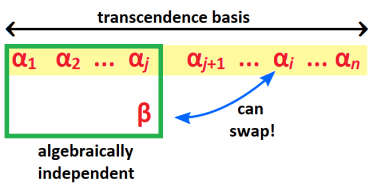
 are algebraically dependent.
 with
with  . By the key observation,
  and hence over K’. So we have algebraic extensions
  .
. are algebraically independent. If not, by the key observation
  and we have algebraic extensions
  , so
, so  , a contradiction. ♦
 and
and  are algebraically independent over K, then
 and
and to obtain another transcendence basis for L over K.
 to obtain another transcendence basis.
 together with n–j elements of
  and
and  .
. are algebraically independent, swapping lemma asserts we can swap out another
  so we get a transcendence basis
  together with n–j-1 elements of
  with n – m elements of
  is well-defined.
 . ♦
. ♦ such that L is algebraic over
  .
. contains a transcendence basis of L over K.
 is algebraic over
  . Hence we get algebraic extensions
 be field extensions. Then M has finite transcendence degree over K if and only if M has finite transcendence degree over L and L has finite transcendence degree over K, in which case
 so by lemma 2, there exists a subset of
  .
. form a transcendence basis of M over K, which would complete the proof.
 for a non-zero
 ![p\in K[X_1, \ldots, X_n, Y_1, \ldots, Y_m]](https://s0.wp.com/latex.php?latex=p%5Cin+K%5BX_1%2C+%5Cldots%2C+X_n%2C+Y_1%2C+%5Cldots%2C+Y_m%5D&bg=ffffff&fg=333333&s=0&c=20201002) . Then
. Then ![q(\alpha_1, \ldots, \alpha_n, Y_1, \ldots, Y_m) \in L[Y_1, \ldots, Y_m]](https://s0.wp.com/latex.php?latex=q%28%5Calpha_1%2C+%5Cldots%2C+%5Calpha_n%2C+Y_1%2C+%5Cldots%2C+Y_m%29+%5Cin+L%5BY_1%2C+%5Cldots%2C+Y_m%5D&bg=ffffff&fg=333333&s=0&c=20201002) is a polynomial relation for
is a polynomial relation for  ; since these are algebraically independent we have
  . But the coefficients of q are polynomials in
  ; since
  .
. is algebraic, so is
 is algebraic by assumption. Thus
![A = K[X_1, \ldots, X_n]/(f)](https://s0.wp.com/latex.php?latex=A+%3D+K%5BX_1%2C+%5Cldots%2C+X_n%5D%2F%28f%29&bg=ffffff&fg=333333&s=0&c=20201002) where
where ![f\in K[X_1, \ldots, X_n]](https://s0.wp.com/latex.php?latex=f%5Cin+K%5BX_1%2C+%5Cldots%2C+X_n%5D&bg=ffffff&fg=333333&s=0&c=20201002) is irreducible. Prove that
is irreducible. Prove that  be an integral extension. If
  is an ideal and
  , the resulting injection
  is an integral extension.
 can be written as
  ,
,  . Then x satisfies a monic polynomial relation:
 .
. gives a monic polynomial relation for
  is a multiplicative subset, then
  is the integral closure of
  .
. where
where  and
and  . Since x is integral over A we have
  for some
  . Then in
 is integral over
  is integral over
  is also integral over
  for some
 , there exist
  and
and  such that
 , we see that
  is integral over A so
  and
and  .
. . ♦
. ♦ induces
  . It turns out geometrically, such a map is like a finite-to-one map.
![A = \mathbb C[X]](https://s0.wp.com/latex.php?latex=A+%3D+%5Cmathbb+C%5BX%5D&bg=ffffff&fg=333333&s=0&c=20201002) and
and ![B = \mathbb C[X, Y]/(Y^2 - X^3 + X)](https://s0.wp.com/latex.php?latex=B+%3D+%5Cmathbb+C%5BX%2C+Y%5D%2F%28Y%5E2+-+X%5E3+%2B+X%29&bg=ffffff&fg=333333&s=0&c=20201002) . The inclusion
. The inclusion  corresponds to projection of the curve
  .
.
 . We can find
  such that
  . If we assume n is minimal, then
  since B is a domain which gives
 . Then
  exists in B. This is integral over A so we have
  gives us
 and
and  . Then
  . By lemma 3,
  is a field if and only if
  is a field. ♦
 be a homomorphism of any rings, which inducees
 .
. is surjective.
 ; we get the following diagram
 , which pulls back to a prime ideal
  . By corollary 2,
  ; this pulls back to
  is a closed map, i.e. it takes closed subsets to closed subsets.
 be a closed subset, for an ideal
  . Let
. Let 
 maps surjectively onto the closed subset
  . ♦
. ♦ is a ring homomorphism such that
  is integral, then
  is a closed map, since
  .
. are prime ideals of A and
  is a prime ideal of B which pulls back to
 of B containing
  .
. .
. we have an integral extension of domains
  . By surjectivity of
  , there is a prime ideal
  of
of  which pulls back to
  , where
  pulls back to
  . ♦
. ♦ of A, and a prime ideal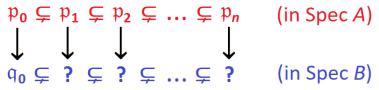
 of B such that each
  lies over
  .
. for
for  , then
  .
. ; let
; let 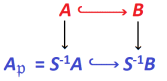
 ,
,  give us prime ideals
  of
of  and hence to
  , the unique maximal ideal. By corollary 2, this means
  and
and  are both maximal, hence equal. So
  . ♦
. ♦ .
. (proposition 1), any prime chain in A lifts to a prime chain in B. Conversely, any prime chain in B maps to a prime chain in A of the same length by proposition 4. ♦
![\mathbb C[X] \subset \mathbb C[X, Y]/(Y^2 - X^3 + X)](https://s0.wp.com/latex.php?latex=%5Cmathbb+C%5BX%5D+%5Csubset+%5Cmathbb+C%5BX%2C+Y%5D%2F%28Y%5E2+-+X%5E3+%2B+X%29&bg=ffffff&fg=333333&s=0&c=20201002) is a finite extension we have
is a finite extension we have![\dim \mathbb C[X, Y]/(Y^2 - X^3 + X) = \dim \mathbb C[X] = 1](https://s0.wp.com/latex.php?latex=%5Cdim+%5Cmathbb+C%5BX%2C+Y%5D%2F%28Y%5E2+-+X%5E3+%2B+X%29+%3D+%5Cdim+%5Cmathbb+C%5BX%5D+%3D+1&bg=ffffff&fg=333333&s=0&c=20201002) ,
,![\mathbb C[X]](https://s0.wp.com/latex.php?latex=%5Cmathbb+C%5BX%5D&bg=ffffff&fg=333333&s=0&c=20201002) is a PID.
is a PID.![A = \mathbb Z[X]](https://s0.wp.com/latex.php?latex=A+%3D+%5Cmathbb+Z%5BX%5D&bg=ffffff&fg=333333&s=0&c=20201002) and
and ![B = \mathbb Z[2i][X, Y]/(Y^2 - X^3 - 1)](https://s0.wp.com/latex.php?latex=B+%3D+%5Cmathbb+Z%5B2i%5D%5BX%2C+Y%5D%2F%28Y%5E2+-+X%5E3+-+1%29&bg=ffffff&fg=333333&s=0&c=20201002) . Lift the following prime chains of A to prime chains of B
. Lift the following prime chains of A to prime chains of B
 , for any
  ,
,  is a finite subset of Spec B. We say that
  has finite fibres.
 is said to be integral over A if we can find
  (where
  ) such that
 in B.
in B. is integral over
  . One intuitively guesses that
  is not integral over
  is integral over
 ![A[b]](https://s0.wp.com/latex.php?latex=A%5Bb%5D&bg=ffffff&fg=333333&s=0&c=20201002) , the A-subalgebra of B generated by b, is
, the A-subalgebra of B generated by b, is  and C is finite over A.
 as an A-linear combination of
  . By induction, this holds for all
  . Hence
  as an A-module.
![C = A[b]](https://s0.wp.com/latex.php?latex=C+%3D+A%5Bb%5D&bg=ffffff&fg=333333&s=0&c=20201002) .
. generate C as an A-module; we can write each
  as an A-linear combination of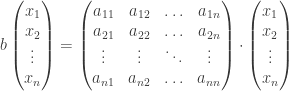
 . Write M for the RHS matrix; denoting
  for the
  identity matrix, we get
  where
where  is the column vector
  . Note that this relation holds in the ring C.
 . All entries of N can be obtained by polynomials in the entries of M with integer coefficients so this holds in any ring.
 , we obtain
  . In particular
  . Expanding this determinant gives us a monic polynomial relation in b with coefficients in A. ♦
 are ring extensions such that B is finite over A, C is finite over B, then C is finite over A.
 are integral over A, so are
  .
.![A \subseteq A[b_1] \subseteq A[b_1, b_2].](https://s0.wp.com/latex.php?latex=A+%5Csubseteq+A%5Bb_1%5D+%5Csubseteq+A%5Bb_1%2C+b_2%5D.&bg=ffffff&fg=333333&s=0&c=20201002)
 is integral over A, it is also integral over
 ![A[b_1]](https://s0.wp.com/latex.php?latex=A%5Bb_1%5D&bg=ffffff&fg=333333&s=0&c=20201002) , so both extensions are finite by the main proposition. Thus by the above exercise
, so both extensions are finite by the main proposition. Thus by the above exercise ![A[b_1, b_2]](https://s0.wp.com/latex.php?latex=A%5Bb_1%2C+b_2%5D&bg=ffffff&fg=333333&s=0&c=20201002) is also a finite extension of A.
is also a finite extension of A.![b_1 + b_2, b_1 b_2 \in A[b_1, b_2]](https://s0.wp.com/latex.php?latex=b_1+%2B+b_2%2C+b_1+b_2+%5Cin+A%5Bb_1%2C+b_2%5D&bg=ffffff&fg=333333&s=0&c=20201002) , by the main proposition they are integral over A. ♦
, by the main proposition they are integral over A. ♦![\sqrt 2 + \sqrt[3] 3](https://s0.wp.com/latex.php?latex=%5Csqrt+2+%2B+%5Csqrt%5B3%5D+3&bg=ffffff&fg=333333&s=0&c=20201002) and
and ![\sqrt 2 + \sqrt[3] 3 + \sqrt[5] 5](https://s0.wp.com/latex.php?latex=%5Csqrt+2+%2B+%5Csqrt%5B3%5D+3+%2B+%5Csqrt%5B5%5D+5&bg=ffffff&fg=333333&s=0&c=20201002) are integral over
are integral over  .
. .
. .
. be ring extensions, where
  is integral over B, then it is integral over A.
 such that
![A \subseteq A[b_0] \subseteq A[b_0, b_1] \subseteq \ldots \subseteq A[b_0, \ldots, b_{n-1}] \subseteq A[b_0, \ldots, b_{n-1}, c]](https://s0.wp.com/latex.php?latex=A+%5Csubseteq+A%5Bb_0%5D+%5Csubseteq+A%5Bb_0%2C+b_1%5D+%5Csubseteq+%5Cldots+%5Csubseteq+A%5Bb_0%2C+%5Cldots%2C+b_%7Bn-1%7D%5D+%5Csubseteq+A%5Bb_0%2C+%5Cldots%2C+b_%7Bn-1%7D%2C+c%5D&bg=ffffff&fg=333333&s=0&c=20201002)
![A[b_0, \ldots, b_{n-1}, c]](https://s0.wp.com/latex.php?latex=A%5Bb_0%2C+%5Cldots%2C+b_%7Bn-1%7D%2C+c%5D&bg=ffffff&fg=333333&s=0&c=20201002) is finite over A; again by the main proposition, c is integral over A. ♦
is finite over A; again by the main proposition, c is integral over A. ♦ , a finite extension is algebraic but the converse may not be true; heuristically, this is because we can attach infinitely many algebraic elements to k. This inspires the following.
![B = A[b_0, \ldots, b_{n-1}]](https://s0.wp.com/latex.php?latex=B+%3D+A%5Bb_0%2C+%5Cldots%2C+b_%7Bn-1%7D%5D&bg=ffffff&fg=333333&s=0&c=20201002) . In the extensions
. In the extensions ![A \subseteq A[b_0] \subseteq \ldots \subseteq A[b_0, \ldots, b_{n-1}] = B](https://s0.wp.com/latex.php?latex=A+%5Csubseteq+A%5Bb_0%5D+%5Csubseteq+%5Cldots+%5Csubseteq+A%5Bb_0%2C+%5Cldots%2C+b_%7Bn-1%7D%5D+%3D+B&bg=ffffff&fg=333333&s=0&c=20201002) , each ring is finite over the previous. Hence B is finite over A. ♦
, each ring is finite over the previous. Hence B is finite over A. ♦ denotes its
 ![A = \mathbb Z[2i] = \{a + 2b\cdot i : a, b\in \mathbb Z\}](https://s0.wp.com/latex.php?latex=A+%3D+%5Cmathbb+Z%5B2i%5D+%3D+%5C%7Ba+%2B+2b%5Ccdot+i+%3A+a%2C+b%5Cin+%5Cmathbb+Z%5C%7D&bg=ffffff&fg=333333&s=0&c=20201002) where
where  . Then
 ![K = \mathbb Q[i]](https://s0.wp.com/latex.php?latex=K+%3D+%5Cmathbb+Q%5Bi%5D&bg=ffffff&fg=333333&s=0&c=20201002) . Now A is not a normal domain because
. Now A is not a normal domain because  is integral over A but does not lie in A.
 and take its minimal polynomial
![q(X) = X^n + c_{n-1} X^{n-1} + \ldots + c_0 \in K[X]](https://s0.wp.com/latex.php?latex=q%28X%29+%3D+X%5En+%2B+c_%7Bn-1%7D+X%5E%7Bn-1%7D+%2B+%5Cldots+%2B+c_0+%5Cin+K%5BX%5D&bg=ffffff&fg=333333&s=0&c=20201002) .
.![q(X) \in A[X]](https://s0.wp.com/latex.php?latex=q%28X%29+%5Cin+A%5BX%5D&bg=ffffff&fg=333333&s=0&c=20201002) .
.![p(X) \in A[X]](https://s0.wp.com/latex.php?latex=p%28X%29+%5Cin+A%5BX%5D&bg=ffffff&fg=333333&s=0&c=20201002) such that
such that  . Note that
  divides
  in
in ![K[X]](https://s0.wp.com/latex.php?latex=K%5BX%5D&bg=ffffff&fg=333333&s=0&c=20201002) . Now pick a field extension
. Now pick a field extension  in which
  .
. each
each  . ♦
. ♦ is integral over A where a and b have no common prime factor. Pick
 . Since a and b have no common prime factor, b is a unit so
  . ♦
. ♦ , which has minimal polynomial
  over
over ![A = \mathbb Z[2i]](https://s0.wp.com/latex.php?latex=A+%3D+%5Cmathbb+Z%5B2i%5D&bg=ffffff&fg=333333&s=0&c=20201002) and
and  . The minimal polynomial of
  , which does not lie in
 ![A[X]](https://s0.wp.com/latex.php?latex=A%5BX%5D&bg=ffffff&fg=333333&s=0&c=20201002) . On the other hand
. On the other hand  . This happens because A is not a normal domain.
![\begin{aligned}\mathbb Z[X], \quad \mathbb Z[\sqrt 2],\quad, \mathbb Z[\sqrt 5], \quad \mathbb C[X, Y, Z],\quad \mathbb C[X, Y]/(Y^2 - X^3 + X),\\ \mathbb C[X, Y, Z]/(Y^2 - X^3 + X),\quad \mathbb C[X, Y]/(Y^2 - X^3),\quad \mathbb C[X, Y, Z]/(X^2 + Y^2 + Z^2).\end{aligned}](https://s0.wp.com/latex.php?latex=%5Cbegin%7Baligned%7D%5Cmathbb+Z%5BX%5D%2C+%5Cquad+%5Cmathbb+Z%5B%5Csqrt+2%5D%2C%5Cquad%2C+%5Cmathbb+Z%5B%5Csqrt+5%5D%2C+%5Cquad+%5Cmathbb+C%5BX%2C+Y%2C+Z%5D%2C%5Cquad+%5Cmathbb+C%5BX%2C+Y%5D%2F%28Y%5E2+-+X%5E3+%2B+X%29%2C%5C%5C+%5Cmathbb+C%5BX%2C+Y%2C+Z%5D%2F%28Y%5E2+-+X%5E3+%2B+X%29%2C%5Cquad+%5Cmathbb+C%5BX%2C+Y%5D%2F%28Y%5E2+-+X%5E3%29%2C%5Cquad+%5Cmathbb+C%5BX%2C+Y%2C+Z%5D%2F%28X%5E2+%2B+Y%5E2+%2B+Z%5E2%29.%5Cend%7Baligned%7D&bg=ffffff&fg=333333&s=0&c=20201002)
![A[X]/(X^2 - f)](https://s0.wp.com/latex.php?latex=A%5BX%5D%2F%28X%5E2+-+f%29&bg=ffffff&fg=333333&s=0&c=20201002) , where
, where ![A = \mathbb Z[2i][X]](https://s0.wp.com/latex.php?latex=A+%3D+%5Cmathbb+Z%5B2i%5D%5BX%5D&bg=ffffff&fg=333333&s=0&c=20201002) and
and ![B = \mathbb Z[2i][X, Y]/(3Y^2 - 2X^3 - 1)](https://s0.wp.com/latex.php?latex=B+%3D+%5Cmathbb+Z%5B2i%5D%5BX%2C+Y%5D%2F%283Y%5E2+-+2X%5E3+-+1%29&bg=ffffff&fg=333333&s=0&c=20201002) . Is this an integral extension?
. Is this an integral extension?![f\in \mathbb Z[X, Y]](https://s0.wp.com/latex.php?latex=f%5Cin+%5Cmathbb+Z%5BX%2C+Y%5D&bg=ffffff&fg=333333&s=0&c=20201002) . Prove that there is a
. Prove that there is a ![g \in \mathbb Z[X, Y] - \{0\}](https://s0.wp.com/latex.php?latex=g+%5Cin+%5Cmathbb+Z%5BX%2C+Y%5D+-+%5C%7B0%5C%7D&bg=ffffff&fg=333333&s=0&c=20201002) such that
such that ![fg \in \mathbb Z[X^{123}, Y^{789}]](https://s0.wp.com/latex.php?latex=fg+%5Cin+%5Cmathbb+Z%5BX%5E%7B123%7D%2C+Y%5E%7B789%7D%5D&bg=ffffff&fg=333333&s=0&c=20201002) .
. , where
  denotes the
  . From the sequence
  we have
  for some n > 0. Thus
  for some
  . Since A is a domain and
  we have
  so x is a unit.
 be the collection of ideals of A of the form
  where
where  . By minimality for any maximal ideal
  and so
  . We claim that
  for some
  which would complete our claim.
 for some i. Indeed if not we can pick
  for
for  . Then
 , where each
  is a local artinian ring with a unique prime ideal.
 for some N > 0. Note that this is not a trivial result: since
  we can find N such that
  but we have to find an N which works for all x.
 . Since A is artinian
  for some N>0. Write
  . It remains to show
  .
. , pick a minimal
  such that
  . Since
  minimality of
  . Also
 for some
  . Since y is nilpotent we have
  for some N; hence
  , a contradiction.
 is an artinian A-module. Furthermore
  is a vector space over
  , where each
  for each i. It follows that
  . [ Indeed this ideal is generated by all
  over all
  ,
,  . Since
  for some i, we have
  . ]
. ]
 as a vector space. Then A is noetherian,
 is the number of prime ideals of A;
 so
so  .
. .
. Mathematics and Such